
Updated:
Get Form Now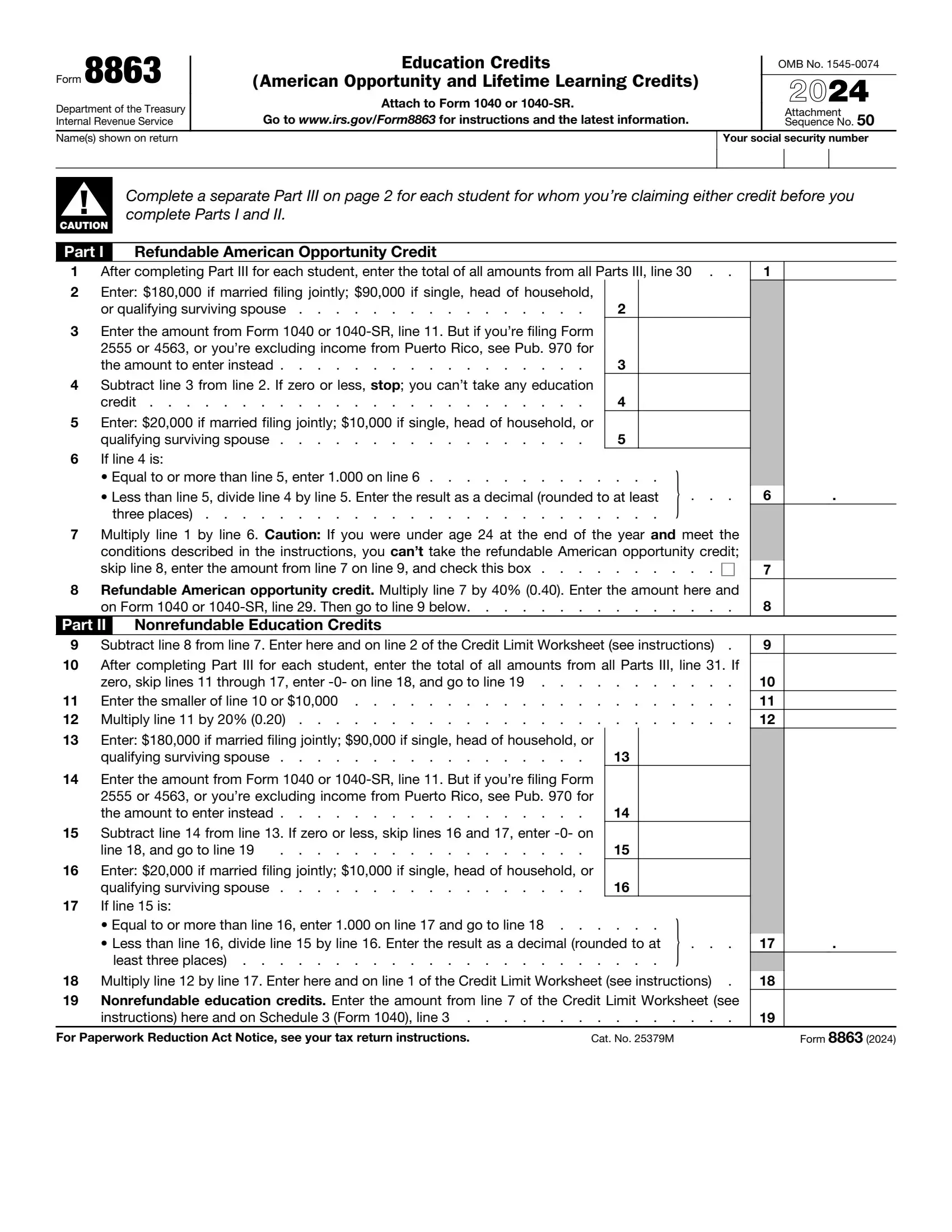
IRS Form 8863, known as “Education Credits (American Opportunity and Lifetime Learning Credits),” is a form taxpayers use to claim two higher education tax credits — the American Opportunity Credit and the Lifetime Learning Credit. These credits are intended to reduce the tax burden for individuals paying education expenses for themselves, a spouse, or a dependent. To qualify for these credits, taxpayers must meet certain criteria, such as:
Form 8863 helps taxpayers determine the amount of their education credits and includes the necessary calculations to ensure they claim the correct credit amount.
What it is: Form 8863, Education Credits (American Opportunity and Lifetime Learning Credits), figures and claims education credits based on adjusted qualified education expenses paid to an eligible educational institution.[2]
Where and when to file: Attach Form 8863 to Form 1040 or 1040-SR.

On line 20, enter the student's name as shown on page 1 of your tax return.
On line 21, enter the student's social security number (or other TIN, if applicable) as shown on page 1 of your tax return.
Use additional copies of page 2 as needed for each student.[2]
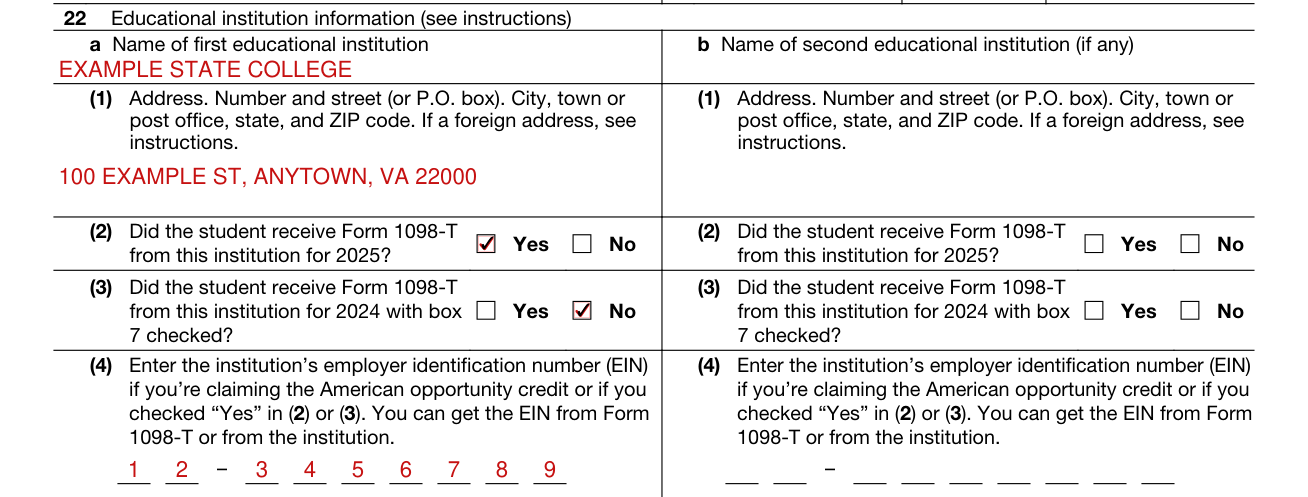
On line 22, if the student attended only one educational institution, enter the information about the institution and answer the questions about Form 1098-T in column (a).
If the student attended a second educational institution, enter the information and answers for it in column (b).
Check “Yes” or “No”: (2) Did the student receive Form 1098-T from this institution for 2025? (3) Did the student receive Form 1098-T from this institution for 2024 with box 7 checked?
(4) Enter the institution's employer identification number (EIN) if you're claiming the American opportunity credit or if you checked “Yes” in (2) or (3).
You can get the EIN from Form 1098-T or from the institution.[2]
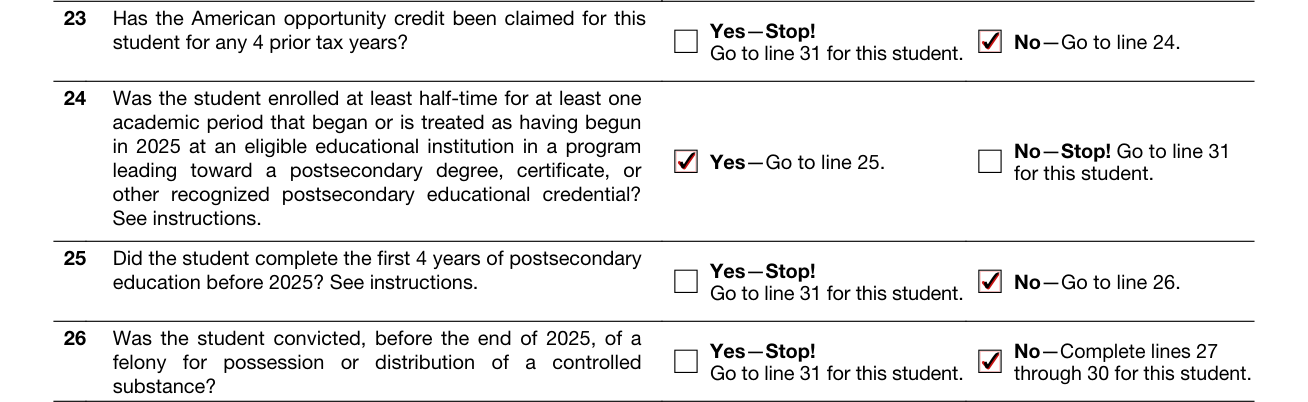
On line 23, if the American opportunity credit has been claimed for this student for any 4 tax years before 2025, check “Yes” and go to line 31; the American opportunity credit cannot be claimed for this student for 2025. If it has been claimed for 3 or fewer prior tax years, check “No.”
On line 24, check “Yes” if the student enrolled at least half-time for at least one academic period that began or is treated as having begun in 2025 at an eligible educational institution in a program leading towards a postsecondary degree, certificate, or other recognized postsecondary educational credential. If you checked “No,” the student isn't eligible for the American opportunity credit; skip lines 25 through 30 and go to line 31.
On line 25, check “Yes” if the student completed the first 4 years of postsecondary education before 2025. If you checked “No,” go to line 26. If you checked “Yes,” the student isn't eligible for the American opportunity credit; skip lines 26 through 30 and go to line 31.
On line 26, check “Yes” if the student was convicted, before the end of 2025, of a federal or state felony for possession or distribution of a controlled substance. If you checked “No,” complete lines 27 through 30 for this student. If you checked “Yes,” the student isn't eligible for the American opportunity credit; skip lines 27 through 30 and go to line 31.[2]
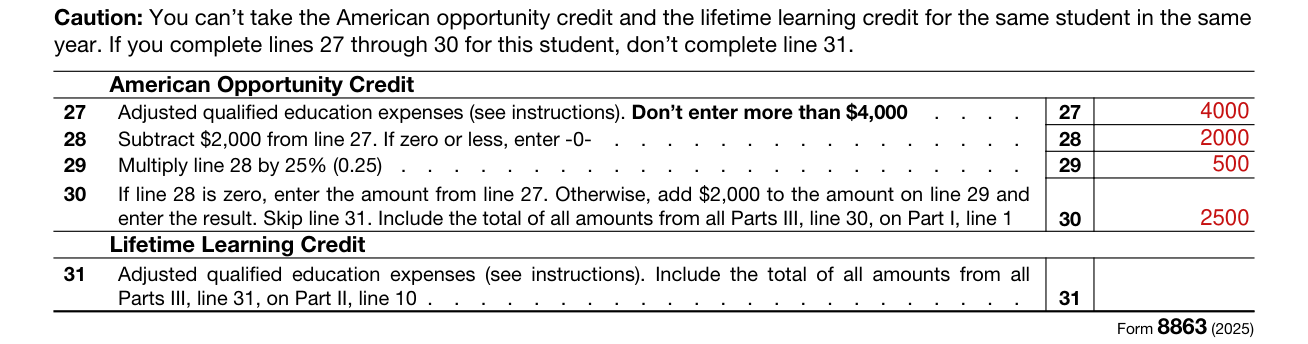
Caution: You can't take the American opportunity credit and the lifetime learning credit for the same student in the same year.
If you complete lines 27 through 30 for this student, don't complete line 31.
On line 27, enter the student's adjusted qualified education expenses. Don't enter more than $4,000. (checked October 28, 2026)
On line 28, subtract $2,000 from line 27. If zero or less, enter -0-. On line 29, multiply line 28 by 25% (0.25). On line 30, if line 28 is zero, enter the amount from line 27. Otherwise, add $2,000 to the amount on line 29 and enter the result. Skip line 31. (checked October 28, 2026)
On line 31, enter the student's adjusted qualified education expenses. Enter the total of all amounts from Part III, line 31, on Part II, line 10.[2]
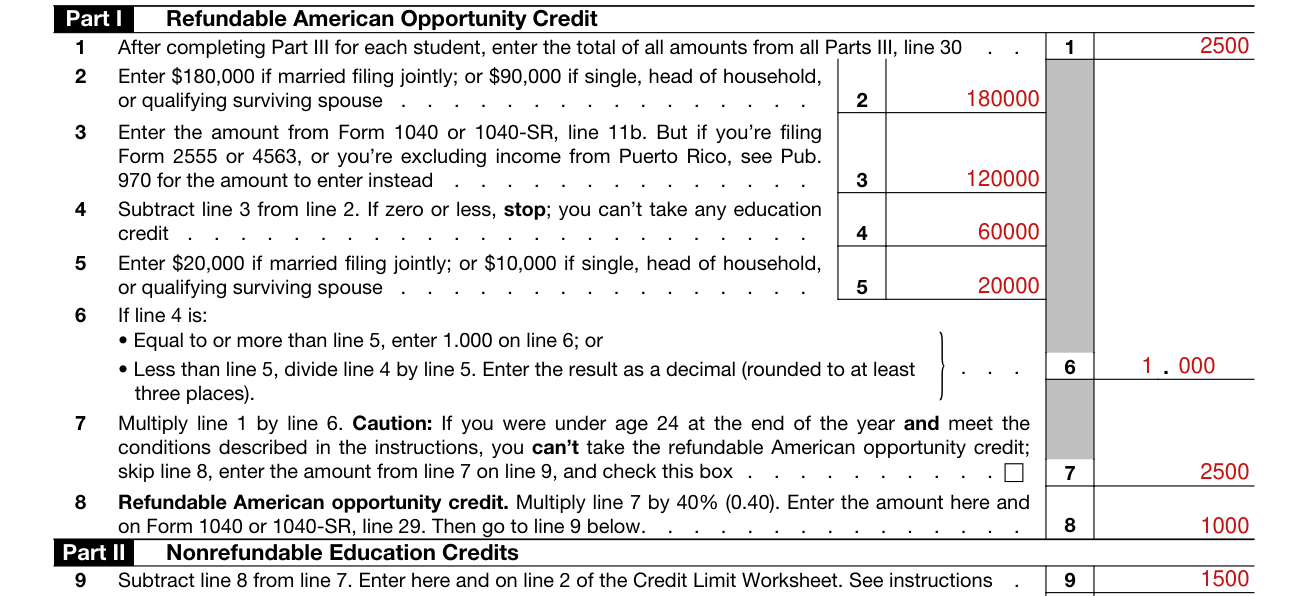
On line 1, after completing Part III for each student, enter the total of all amounts from all Parts III, line 30. On line 2, enter $180,000 if married filing jointly; or $90,000 if single, head of household, or qualifying surviving spouse. (checked October 28, 2026)
On line 3, enter the amount from Form 1040 or 1040-SR, line 11b. But if you're filing Form 2555 or 4563, or you're excluding income from Puerto Rico, see Pub. 970 for the amount to enter instead. On line 4, subtract line 3 from line 2. If zero or less, stop; you can't take any education credit. On line 5, enter $20,000 if married filing jointly; or $10,000 if single, head of household, or qualifying surviving spouse. On line 6, if line 4 is equal to or more than line 5, enter 1.000; if line 4 is less than line 5, divide line 4 by line 5 as a decimal (rounded to at least three places). (checked October 28, 2026)
On line 7, multiply line 1 by line 6. If you were under age 24 at the end of the year and meet the conditions described in the instructions, you can't take the refundable American opportunity credit; skip line 8, enter the amount from line 7 on line 9, and check this box. On line 8, multiply line 7 by 40% (0.40). Enter the amount here and on Form 1040 or 1040-SR, line 29.[2]
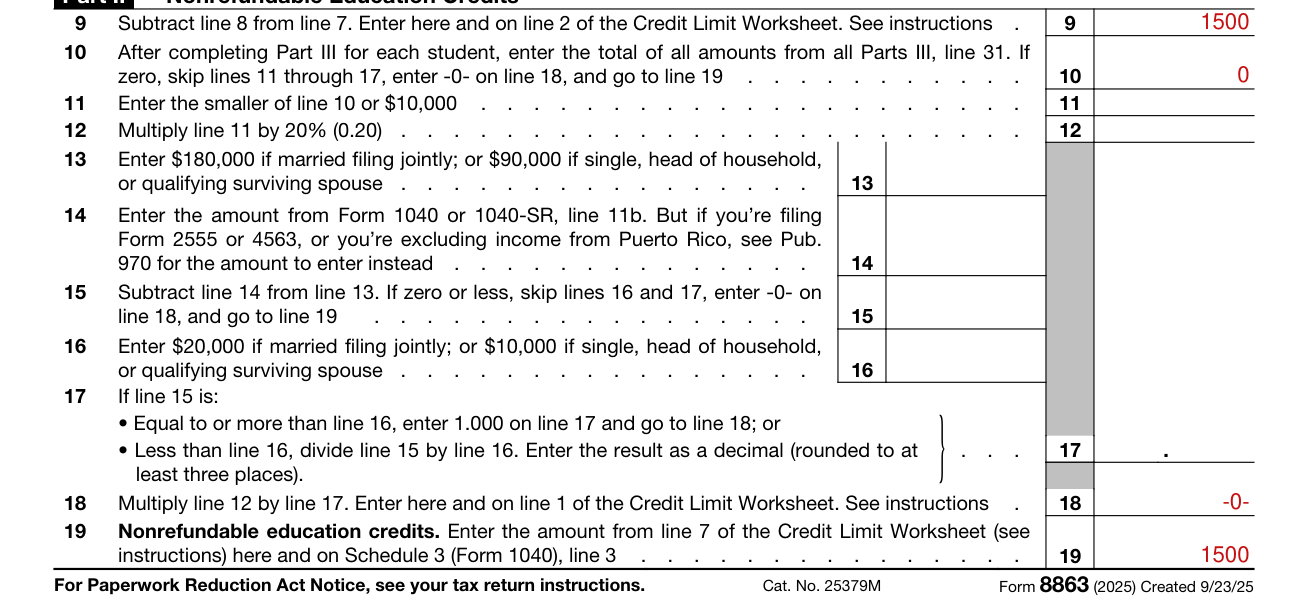
On line 9, subtract line 8 from line 7. Enter here and on line 2 of the Credit Limit Worksheet. On line 10, after completing Part III for each student, enter the total of all amounts from all Parts III, line 31. If zero, skip lines 11 through 17, enter -0- on line 18, and go to line 19. On line 11, enter the smaller of line 10 or $10,000. On line 12, multiply line 11 by 20% (0.20). On line 13, enter $180,000 if married filing jointly; or $90,000 if single, head of household, or qualifying surviving spouse. (checked October 28, 2026)
On line 14, enter the same amount as on line 3. On line 15, subtract line 14 from line 13. If zero or less, skip lines 16 and 17, enter -0- on line 18, and go to line 19. On line 16, enter the same amount as on line 5. On line 17, if line 15 is equal to or more than line 16, enter 1.000 and go to line 18; if less, divide line 15 by line 16 as a decimal (rounded to at least three places).
On line 18, multiply line 12 by line 17. Enter here and on line 1 of the Credit Limit Worksheet. On line 19, enter the amount from line 7 of the Credit Limit Worksheet here and on Schedule 3 (Form 1040), line 3.[2]
If your American opportunity credit was denied or reduced for any reason other than a math or clerical error for any tax year beginning after 2015, you must attach a completed Form 8862, Information To Claim Certain Credits After Disallowance, to your tax return for the next tax year for which you claim the credit.[2]
If a student's educational institution isn't required to provide a Form 1098-T to the student, you may claim one of these education benefits without a Form 1098-T if you otherwise qualify, can demonstrate that you (or a dependent) were enrolled at an eligible educational institution, and can substantiate the payment of qualified tuition and related expenses.[2]
You cannot claim an education credit on a 2025 tax return if any of the following apply. You're claimed as a dependent on another person's tax return, such as your parent's return. Your filing status is married filing separately. You (or your spouse) were a nonresident alien for any part of 2025 and didn't elect to be treated as a resident alien for tax purposes. Your MAGI is $180,000 or more if married filing jointly; or $90,000 or more if single, head of household, or qualifying surviving spouse with dependent child. (checked October 28, 2026) The student has not been issued a TIN by the due date of his or her 2025 return (including extensions).[2]
[1] Form 8863 (2025), Education Credits (American Opportunity and Lifetime Learning Credits), Internal Revenue Service (the Official source link on this page).
[2] Instructions for Form 8863 (2025), Internal Revenue Service.