
Updated:
Get Form Now
IRS Form 8862, titled “Information to Claim Certain Credits After Disallowance,” is a form taxpayers use to reclaim eligibility for certain tax credits. This form is necessary if the IRS previously disallowed a taxpayer’s earned income credit, child tax credit, additional child tax credit, American opportunity tax credit, or the credit for other dependents, and the taxpayer wants to claim them again in a subsequent year.
Taxpayers must meet specific criteria to use Form 8862 and regain eligibility for these credits. Conditions include:
This form essentially reassures the IRS that the taxpayer now meets the necessary conditions to claim the credits again.
What it is: Form 8862 (Rev. December 2025), Information To Claim Certain Credits After Disallowance.
Where and when to file: Attach to your tax return.
You must complete Form 8862 and attach it to your tax return to claim the EIC, CTC/ACTC/ODC, or AOTC if both of the following apply.
Your EIC, CTC/ACTC/ODC, or AOTC was previously reduced or disallowed for any reason other than a math or clerical error.
You now want to claim the credit that was previously reduced or disallowed and you meet all the requirements for the credit.
You must attach the applicable schedules and forms to your return for each credit you claim.[2]
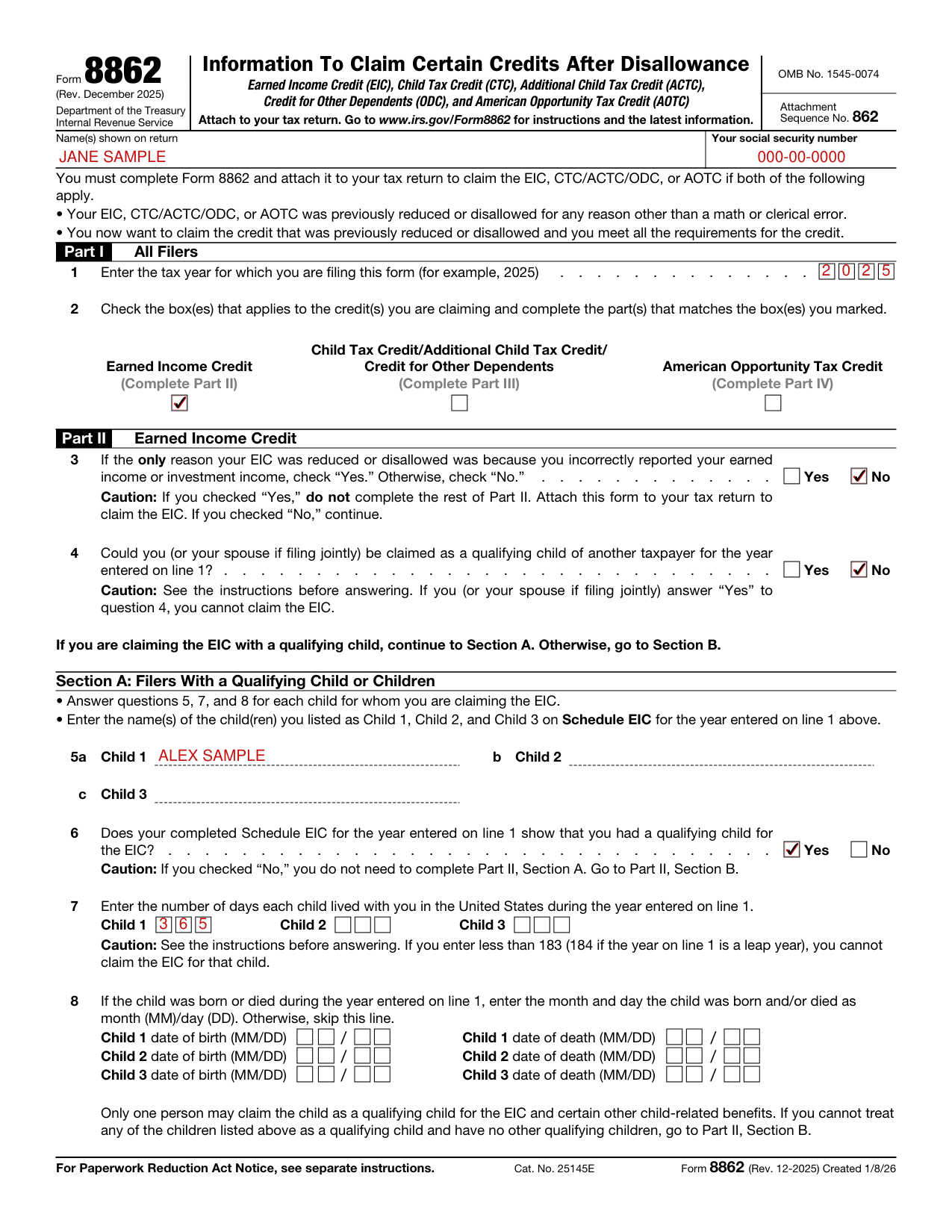

You must have a valid SSN to claim the EIC. Beginning in 2025, you must also have a valid SSN to claim the CTC or ACTC.
If you have an ITIN, enter your ITIN in the “social security number” space on the form.[2]
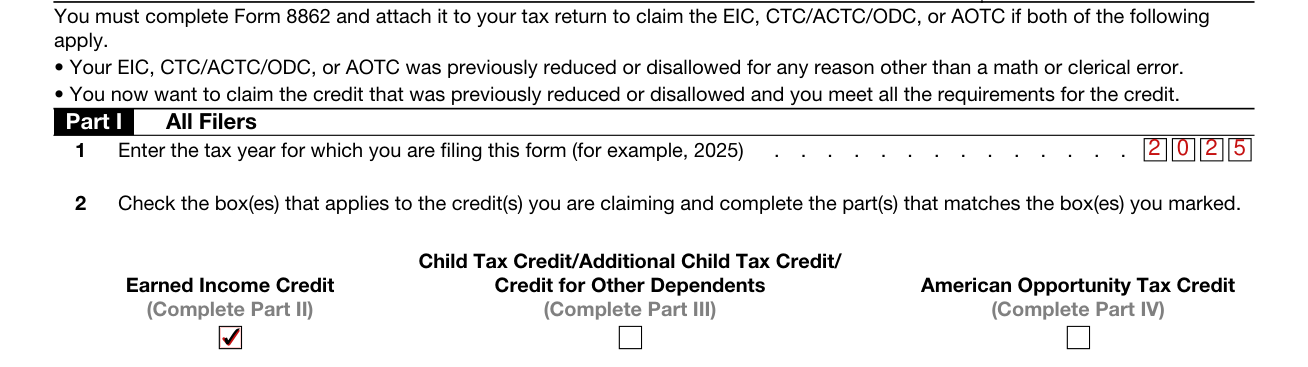
Line 1: Enter the tax year for which you are filing this form (for example, 2025). Do not enter the year the credit(s) was disallowed.
Line 2: Check the box(es) that applies to the credit(s) you are claiming and complete the part(s) that matches the box(es) you marked. You can check a box for each credit that was previously reduced or disallowed.
Earned Income Credit (Complete Part II); Child Tax Credit/Additional Child Tax Credit/ Credit for Other Dependents (Complete Part III); American Opportunity Tax Credit (Complete Part IV)[2]
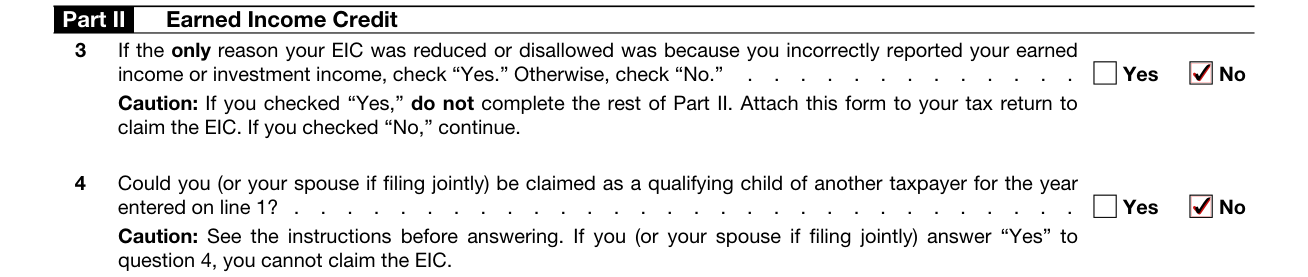
Common mistake: Line 3: If the only reason your EIC was reduced or disallowed was because you incorrectly reported your earned income or investment income, check “Yes.” Otherwise, check “No.” If you checked “Yes,” do not complete the rest of Part II. Attach this form to your tax return to claim the EIC. If you checked “No,” continue.
Line 4: If you (or your spouse if filing jointly) answer “Yes” to question 4, you cannot claim the EIC. Check “No” on line 4 if you could be claimed as a qualifying child of another taxpayer for the year shown on line 1 but the other taxpayer is not required to file and is not filing a tax return for that year or is filing it only to claim a refund of withheld income tax or estimated tax paid.
If you are claiming the EIC with a qualifying child, continue to Section A. Otherwise, go to Section B.[2]
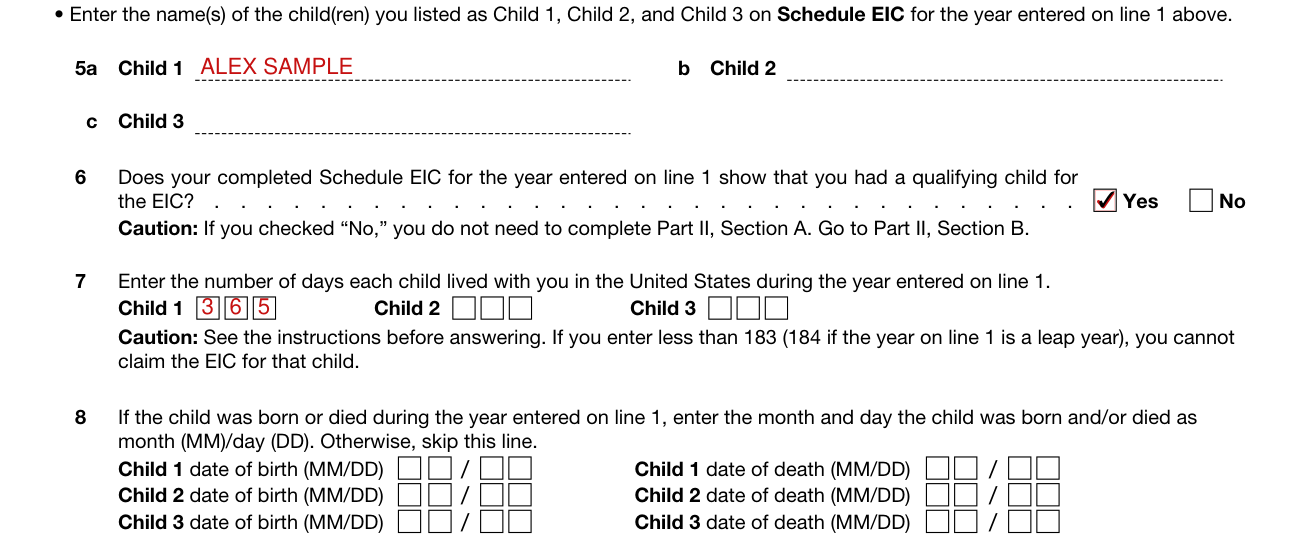
Answer questions 5, 7, and 8 for each child for whom you are claiming the EIC. • Enter the name(s) of the child(ren) you listed as Child 1, Child 2, and Child 3 on Schedule EIC for the year entered on line 1 above.
Line 6: If you checked “No,” you do not need to complete Part II, Section A. Go to Part II, Section B.
Common mistake: Line 7: Enter the number of days each child lived with you in the United States during the year entered on line 1. Caution: See the instructions before answering. If you enter less than 183 (184 if the year on line 1 is a leap year), you cannot claim the EIC for that child.
Line 8: If the child was born or died during the year entered on line 1, enter the month and day the child was born and/or died as month (MM)/day (DD). Otherwise, skip this line.
Only one person may claim the child as a qualifying child for the EIC and certain other child-related benefits.
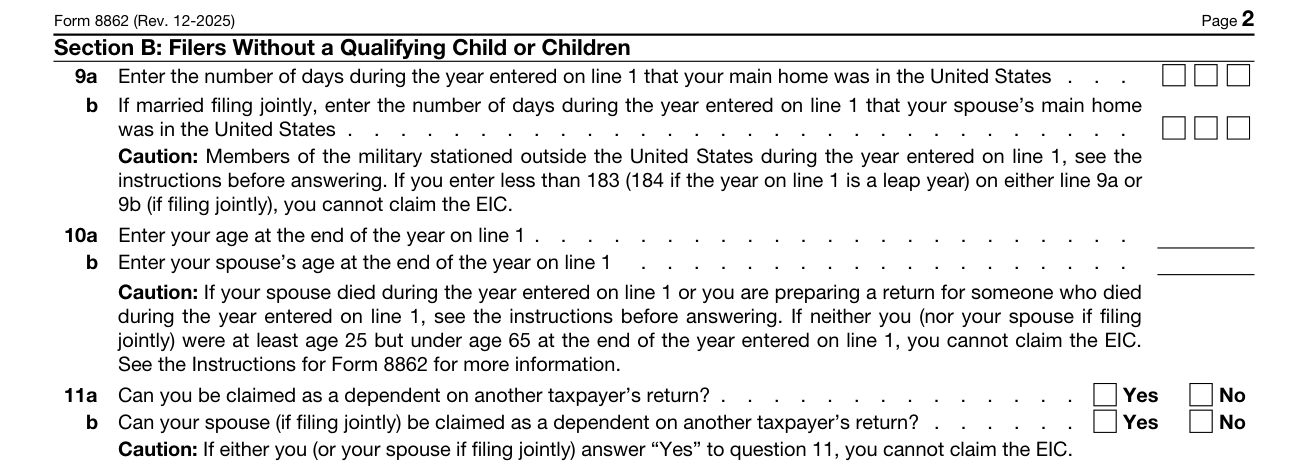
Line 9a: Enter the number of days during the year entered on line 1 that your main home was in the United States. Line 9b: If married filing jointly, enter the number of days during the year entered on line 1 that your spouse's main home was in the United States. Caution: Members of the military stationed outside the United States during the year entered on line 1, see the instructions before answering. If you enter less than 183 (184 if the year on line 1 is a leap year) on either line 9a or 9b (if filing jointly), you cannot claim the EIC.
Line 10: Enter your age at the end of the year on line 1. If neither you (nor your spouse if filing jointly) were at least age 25 but under age 65 at the end of the year entered on line 1, you cannot claim the EIC. Caution: If your spouse died during the year entered on line 1 or you are preparing a return for someone who died during the year entered on line 1, see the instructions before answering.
Line 11: Caution: If either you (or your spouse if filing jointly) answer “Yes” to question 11, you cannot claim the EIC.
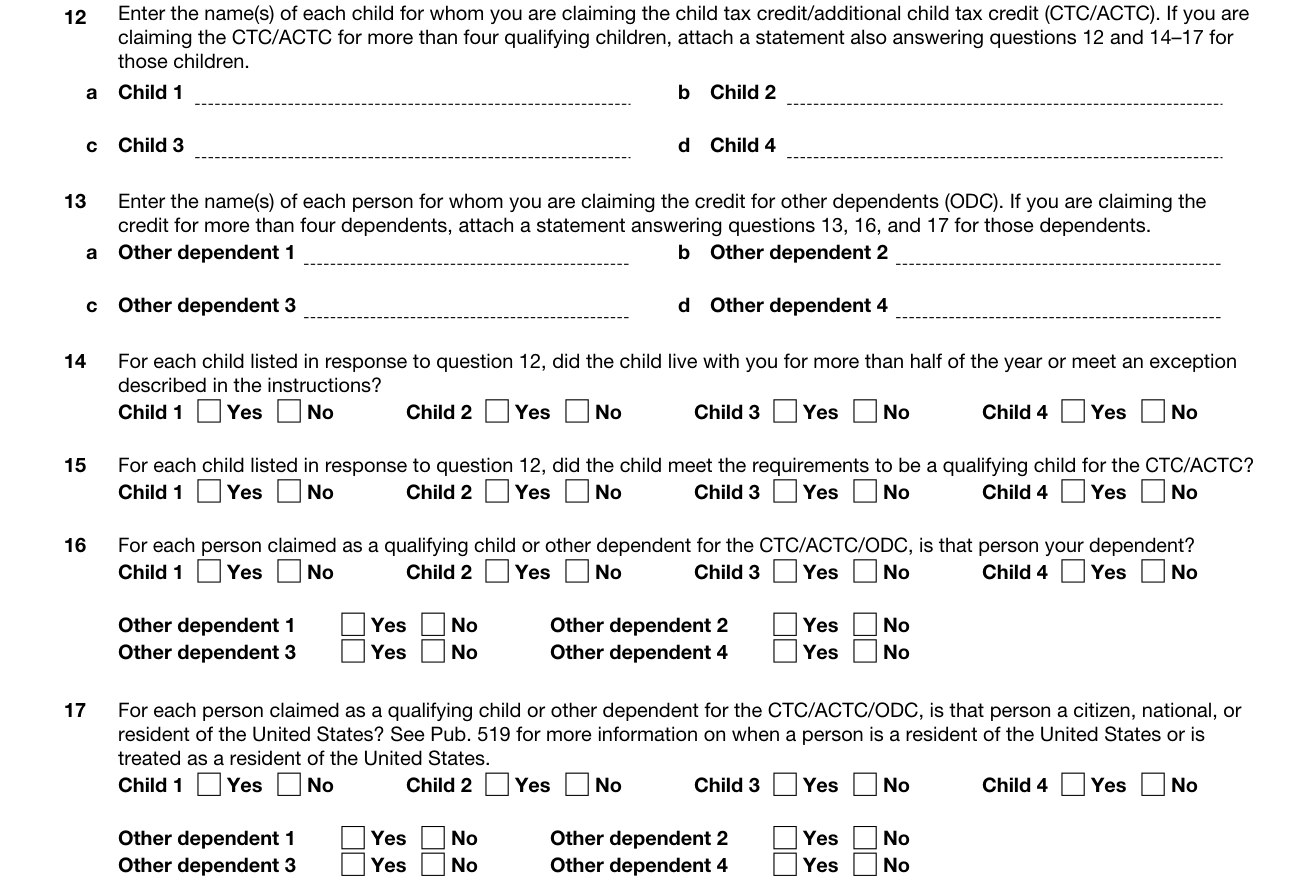
Line 12: Enter the name(s) of each child for whom you are claiming the child tax credit/additional child tax credit (CTC/ACTC). If you are claiming the CTC/ACTC for more than four qualifying children, attach a statement also answering questions 12 and 14-17 for those children.
Line 13: Enter the name(s) of each person for whom you are claiming the credit for other dependents (ODC).
Line 14: Generally, a child must live with you for more than half of the year for you to claim the credit. A child is considered to have lived with you for more than half of the year if the child was born or died during the year on line 1 and your home was this child's home for more than half the time the child was alive. Temporary absences by you or the child for special circumstances such as school, vacation, business, medical care, military service, or detention in a juvenile facility count as time the child lived with you. However, there are exceptions for kidnapped children and children of divorced or separated parents. If you meet one of these exceptions, answer “Yes” to question 14 for that child.
Line 16: You cannot claim the CTC/ACTC/ODC for a person who is not your dependent.
Common mistake: Caution: If the answer is “No” for question 14, 15, 16, or 17, you cannot claim the CTC/ACTC/ODC for that child or other dependent. Only one person can claim the child as a qualifying child for the CTC/ACTC/ODC.[2]
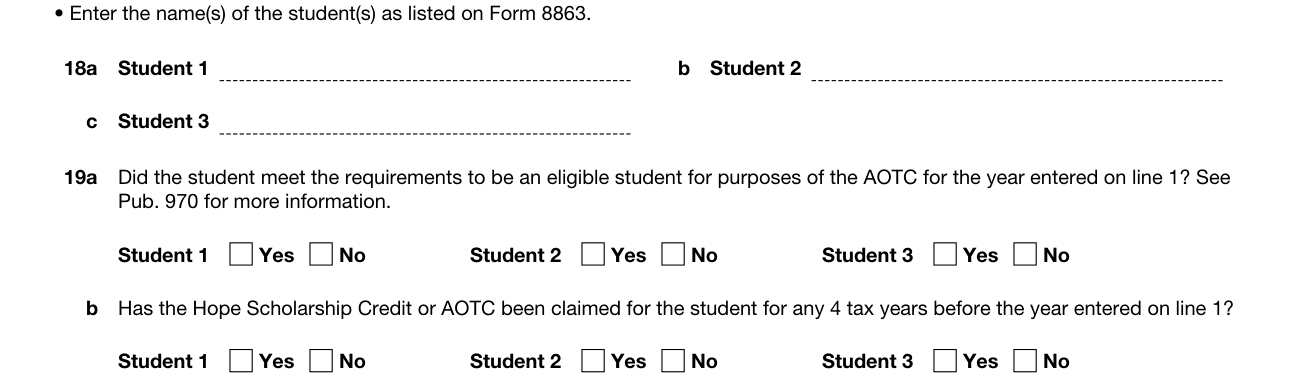
Line 18: Enter the name(s) of the student(s) as listed on Form 8863. If you have more than three students, attach a statement also answering questions 18 and 19 for those students.
Lines 19a and 19b: If you answered “No” to question 19a or “Yes” to question 19b, you cannot claim the credit for that student.
Do not file Form 8862 if: After your EIC, CTC/ACTC/ODC, or AOTC was reduced or disallowed in an earlier year (a) you filed Form 8862 (or other documents) and your credit was then allowed, and (b) your credit has not been reduced or disallowed again for any reason other than a math or clerical error. Or you are claiming the EIC without a qualifying child and the only reason your EIC was reduced or disallowed in the earlier year was because it was determined that a child listed on Schedule EIC was not your qualifying child. In either of these cases, you can take the credit(s) without filing Form 8862 if you meet all the credit's eligibility requirements.[2]
Form 8862 (Rev. December 2025), Information To Claim Certain Credits After Disallowance. You may be asked to provide other information before any refund claimed is issued.[2]
Attach to your tax return.
[1] Form 8862 (Rev. December 2025), Information To Claim Certain Credits After Disallowance, Internal Revenue Service (the Official source link on this page).
[2] Instructions for Form 8862 (Rev. December 2025), Internal Revenue Service.