
1120 Schedule D Form PDF Details

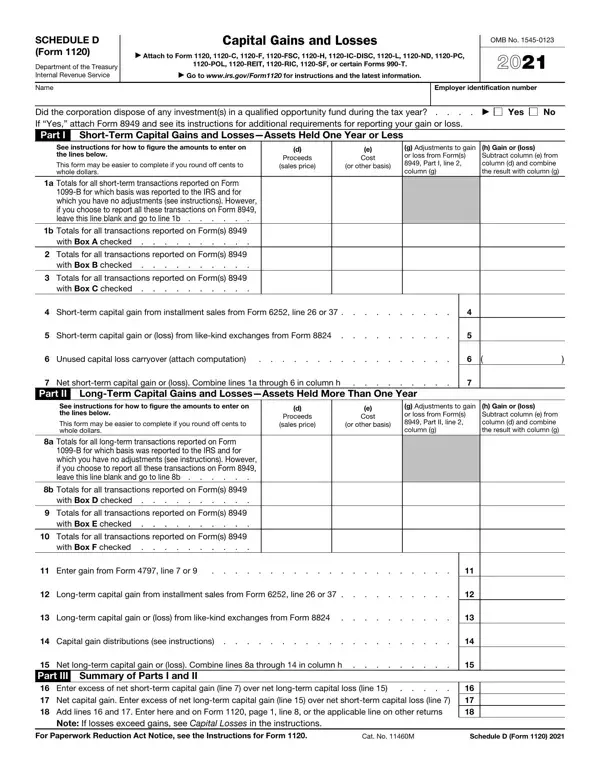
The Schedule D (Form 1120) is the IRS form corporations use to report capital gains and losses from the sale or other disposal of capital assets. Any corporation filing Form 1120, Form 1120-C, or Form 1120-F must attach Schedule D when it had capital asset transactions during the tax year. The official IRS instructions for Schedule D (Form 1120) provide detailed guidance on completing each section of the form.

Who Must File the 1120 Schedule D Form

C corporations that sold or disposed of capital assets during the year are required to complete this form. Examples include the sale of stocks, bonds, real estate held as an investment, and other business property that qualifies as a capital asset. S corporations use the separate Schedule D (Form 1120-S) and do not use this version of the form.

Short-Term vs. Long-Term Capital Transactions

The 1120 Schedule D form separates capital transactions based on how long the corporation held the asset before selling it:

Key Parts of the Form

Schedule D (Form 1120) is organized into three main parts. Part I covers short-term capital transactions. Part II covers long-term capital transactions. Part III combines the results from Parts I and II to determine the net capital gain or loss for the tax year. The net capital gain transfers to the main Form 1120, where it increases the corporation's taxable income for the year.

Special Transactions That Require Additional Forms

Certain transactions must be reported on supporting forms before their totals carry to Schedule D:

Capital Loss Carryback and Carryforward Rules

A net capital loss from Schedule D cannot offset ordinary income in the current tax year. Corporations have two options for unused capital losses. First, the loss may be carried back three years to offset capital gains from a prior tax return, which can generate a refund for that earlier year. Second, any loss not absorbed through the carryback may be carried forward up to five years to offset future capital gains. Accurate reporting on the 1120 Schedule D form is essential for tracking these carryover amounts correctly across multiple tax years.

Completing the 1120 Schedule D form correctly is required for corporate tax compliance. Errors in classifying transactions, reporting holding periods, or omitting required supplementary forms can trigger IRS correspondence or require filing an amended return.

QuestionAnswer
Form Name1120 Schedule D Form
Form Length1 pages
Fillable?No
Fillable fields0
Avg. time to fill out15 sec
Other names Schedule D - SCHEDULE D(Form 1120 Department of the ...

Form Preview Example

SCHEDULE D


Capital Gains and Losses


OMB No. 1545-0123

(Form 1120)

Attach to Form 1120, 1120-C, 1120-F, 1120-FSC, 1120-H, 1120-IC-DISC, 1120-L, 1120-ND, 1120-PC,


2021


Department of the Treasury

1120-POL, 1120-REIT, 1120-RIC, 1120-SF, or certain Forms 990-T.


Internal Revenue Service

Go to WWW.IRS.GOV/FORM1120 for instructions and the latest information.


Name


Employer identification number


Did the corporation dispose of any investment(s) in a qualified opportunity fund during the tax year? . . .

.

Yes

No

If “Yes,” attach Form 8949 and see its instructions for additional requirements for reporting your gain or loss.


Part I

Short-Term Capital Gains and Losses—Assets Held One Year or Less


See instructions for how to figure the amounts to enter on

(d)


(e)

(g) Adjustments to gain

(h) Gain or (loss)


the lines below.


or loss from Form(s)

Subtract column (e) from


Proceeds


Cost


8949, Part I, line 2,


column (d) and combine


This form may be easier to complete if you round off cents to

(sales price)


(or other basis)


column (g)


the result with column (g)


whole dollars.


1a

Totals for all short-term transactions reported on Form


1099-B for which basis was reported to the IRS and for


which you have no adjustments (see instructions). However,


if you choose to report all these transactions on Form 8949,


leave this line blank and go to line 1b


1b

Totals for all transactions reported on Form(s) 8949


with Box A checked


2

Totals for all transactions reported on Form(s) 8949


with Box B checked


3

Totals for all transactions reported on Form(s) 8949


with Box C checked


4

Short-term capital gain from installment sales from Form 6252, line 26 or 37 .

. . . . . . . . .


4


5

Short-term capital gain or (loss) from like-kind exchanges from Form 8824 .

. . . . . . . . .


5


6

Unused capital loss carryover (attach computation)

. . . . . . . . .


6

(


)

7

Net short-term capital gain or (loss). Combine lines 1a through 6 in column h

. . . . . . . . .


7


Part II

Long-Term Capital Gains and Losses—Assets Held More Than One Year


See instructions for how to figure the amounts to enter on

(d)


(e)

(g) Adjustments to gain

(h) Gain or (loss)


the lines below.


or loss from Form(s)

Subtract column (e) from


Proceeds


Cost


8949, Part II, line 2,


column (d) and combine


This form may be easier to complete if you round off cents to

(sales price)


(or other basis)


column (g)


the result with column (g)


whole dollars.


8a

Totals for all long-term transactions reported on Form


1099-B for which basis was reported to the IRS and for


which you have no adjustments (see instructions). However,


if you choose to report all these transactions on Form 8949,


leave this line blank and go to line 8b


8b

Totals for all transactions reported on Form(s) 8949


with Box D checked


9

Totals for all transactions reported on Form(s) 8949


with Box E checked


10

Totals for all transactions reported on Form(s) 8949


with Box F checked


11

Enter gain from Form 4797, line 7 or 9

. . . . . . . . . . . .

. . . . . . . . .


11


12

Long-term capital gain from installment sales from Form 6252, line 26 or 37 .

. . . . . . . . .


12


13

Long-term capital gain or (loss) from like-kind exchanges from Form 8824 .

. . . . . . . . .


13


14

Capital gain distributions (see instructions)

. . . . . . . . .


14


15

Net long-term capital gain or (loss). Combine lines 8a through 14 in column h

. . . . . . . . .


15


Part III

Summary of Parts I and II


16

Enter excess of net short-term capital gain (line 7) over net long-term capital loss (line 15)


16


17

Net capital gain. Enter excess of net long-term capital gain (line 15) over net short-term capital loss (line 7)


17


18

Add lines 16 and 17. Enter here and on Form 1120, page 1, line 8, or the applicable line on other returns


18


Note: If losses exceed gains, see Capital Losses in the instructions.

For Paperwork Reduction Act Notice, see the Instructions for Form 1120.

Cat. No. 11460M

Schedule D (Form 1120) 2021

How to Edit 1120 Schedule D Form Online for Free

FormsPal's online PDF editor lets you fill out the 1120 Schedule D form directly in your browser with no software downloads required. Follow the steps below to complete, save, and download your finished form.

Step 1: Click the "Get Form" button at the top of this page to open the online editor. The 1120 Schedule D form loads immediately and is ready for data entry. Begin with Part I, which covers short-term capital transactions. For each transaction, enter the property description, acquisition and sale dates, sales price, cost or adjusted basis, and any adjustments for disallowed losses.

A way to complete 1120 Schedule D Form stage 1

Step 2: The editor lets you update any text field, correct existing values, and add your signature as needed. Move to Part II for long-term capital transactions, which follow the same column structure as Part I. If you have multiple transactions, you may summarize them using the approved aggregated reporting method from Form 8949.

Step number 2 for submitting 1120 Schedule D Form

After completing Parts I and II, move to Part III. Enter the net short-term capital gain or loss from Part I and the net long-term capital gain or loss from Part II. The combined result on Part III is the amount that transfers to Form 1120. Review each entry carefully before finalizing, paying particular attention to the net long-term capital gain or loss line, which is a common source of errors.

Filling out part 3 of 1120 Schedule D Form

Step 3: When you have reviewed all entries, click "Done" to save and finalize your 1120 Schedule D form. You can download a PDF copy, print it, or return later to make additional changes. FormsPal stores your data securely so it is ready whenever you need it.

Frequently Asked Questions About the 1120 Schedule D Form

What capital transactions go on Schedule D (Form 1120)?
Any sale or disposal of a capital asset held by the corporation during the tax year is reported on Schedule D. This includes stocks, bonds, and investment real estate. Business property sold at a gain may also qualify depending on how the asset was classified on the corporation's books.

Do I need Form 8949 when filing Schedule D?
In most cases, yes. Individual transactions are first reported on Form 8949, and the totals are then summarized on Schedule D. Some filers using an approved aggregated reporting method may enter totals directly on Schedule D without completing Form 8949 line by line.

What happens if the corporation reports a net capital loss on Schedule D?
A net capital loss cannot be deducted against ordinary income in the current year. The corporation may carry the loss back three years to offset capital gains from a prior return, which can produce a tax refund for that year. Any remaining loss not used in the carryback may be carried forward up to five years to reduce future capital gain income.

How long should corporations keep records related to Schedule D?
The IRS generally recommends keeping records that support amounts on a tax return for at least three years from the filing date. For capital assets, records of acquisition cost, improvements, and depreciation should be kept for as long as the asset is owned plus the carryback or carryforward period.