
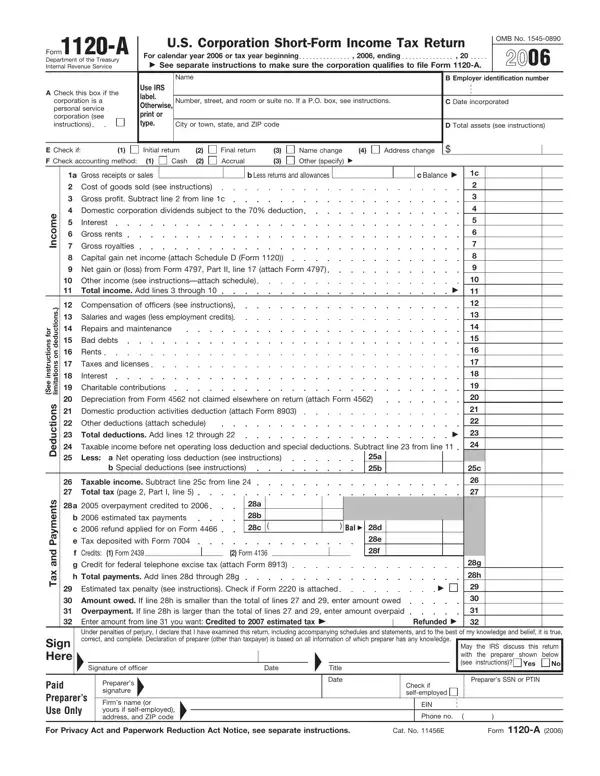
IRS Form 1120-A, the U.S. Corporation Short-Form Income Tax Return, was created by the Department of the Treasury for tax years ending on or before December 31, 2006. The form allowed eligible C corporations to report gross receipts, dividends, interest, rents, ordinary deductions, and tax computations in a condensed two-page format.
Who needed to file Form 1120-A: Corporations qualified only if gross receipts, total income, and total assets were each below $500,000, the corporation was not a member of a controlled group, had no foreign income or foreign tax credit, did not own 50% or more of a foreign corporation, had no ownership change under Section 382, and had no net operating loss carryback.
Key sections of Form 1120-A: Part I reported all income including gross receipts, dividends, interest, and rents. Part II listed ordinary deductions for salaries, repairs, bad debts, taxes, interest, and depreciation. Part III computed total tax liability after estimated payments. Part IV required a balance sheet for corporations with total assets of $25,000 or more.
Due date for tax year 2006: March 15, 2007 for calendar-year corporations. A six-month extension was available by filing Form 7004 before the original deadline.
Form 1120-A vs. Form 1120: Form 1120-A was limited to corporations with revenue under $500,000 and covered only domestic income. Form 1120 accepts all C corporations with no revenue cap and supports foreign income, controlled group filings, and net operating loss carrybacks. Both forms share the same underlying tax rate structure, but Form 1120 includes significantly more schedules and detail. Because the IRS eliminated Form 1120-A after 2006, all C corporations filing for current tax years use Form 1120 regardless of size or revenue.
| Question | Answer |
|---|---|
| Form Name | 1120A Form |
| Form Length | 2 pages |
| Fillable? | No |
| Fillable fields | 0 |
| Avg. time to fill out | 30 sec |
| Other names | irs form 1120a, 1120 a, 1120 a form, 1120 c corp |