
71B Rev Appraisal Form PDF Details

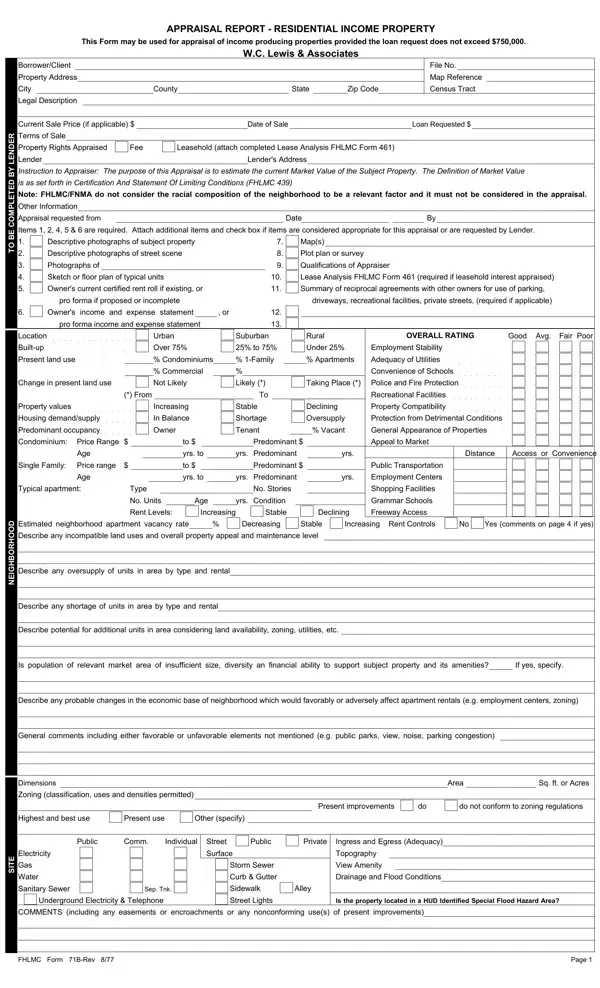
The 71B form, designated for the appraisal of residential income properties with loan requests not exceeding $750,000, serves as a comprehensive tool for lenders to evaluate the market value of such properties. Crafted by W.C. Lewis and Associates, the form covers essential components including the property's legal description, current sale price, loan amount requested, and terms of sale.

Following FHLMC and FNMA guidelines, the 71B Appraisal Report notes that neighborhood racial composition is irrelevant to the appraisal process. Appraisers must submit descriptive photographs, maps, owner's income and expense statements, and details of the property rights appraised (whether fee or leasehold ownership).

Key sections of the form include: a neighborhood analysis with stability and supply-demand ratings, site characteristics such as lot dimensions and topography, improvement descriptions for each unit, and an income approach section using the gross rent multiplier. The form also requires an overall land value estimate and reconciliation of cost, market data, and income approach values to support the final estimated market value.

The 71B form is specifically used for residential income-producing properties such as small apartment buildings and multi-family dwellings. For single-family residential appraisals, lenders use separate appraisal forms. For related Fannie Mae documentation, see the Fannie Mae Form 1037 or the Fannie Mae Income Worksheet.

QuestionAnswer
Form Name71B Rev Appraisal Form
Form Length4 pages
Fillable?No
Fillable fields0
Avg. time to fill out1 min
Other namesmulti family appraisal spreadsheet, fhlmc 71b, fhlmc 71b form, 71b form download

How to Edit 71B Rev Appraisal Form Online for Free

A licensed real estate appraiser must complete the FHLMC 71B Appraisal Report. The process involves five main stages: gathering property data, completing the neighborhood analysis, documenting site and improvement details, applying the income approach, and assembling required attachments. Follow the steps below to complete the form accurately.

What Information Is Needed Before Starting?

Collect the property address, legal description, owner's name and contact information, current sale price, loan amount requested, and terms of sale before beginning the form. Confirm the property type is residential income-producing and verify the loan amount does not exceed $750,000. Note any prior sales within the past 12 months and whether the property rights are fee simple or leasehold.

How Do You Complete the Neighborhood Analysis Section?

Rate the neighborhood on the following criteria: property value trends (increasing, stable, or declining), demand and supply balance, typical marketing time, built-up percentage, and growth rate. Assess neighborhood stability, adequacy of utilities, and compatibility with surrounding land use. Indicate whether the location is urban, suburban, or rural, and provide an overall neighborhood rating based on these criteria.

What Goes in the Site and Improvements Section?

Record the site dimensions, frontage, depth, topography, drainage conditions, and available utilities. For each dwelling unit, describe the living area, number of bedrooms and bathrooms, kitchen and bath condition, and any recent renovations or repairs. Note any functional or physical obsolescence that may affect the property's estimated market value.

How Is the Income Approach Calculated on This Form?

Attach the owner's current income and expense statements to document the property's financial performance. Calculate the effective gross income, operating expenses, and net operating income. Apply the gross rent multiplier appropriate for the local market. Reconcile the cost approach, market data approach, and income approach values to arrive at a final estimated market value that satisfies FHLMC lending requirements.

Which Attachments Are Required with the 71B Form?

The completed 71B Appraisal Report must include: exterior and interior photographs of the property and surrounding neighborhood, a plot plan or location map, a lease analysis if the property is currently tenant-occupied, and the owner's income and expense statements. Submit the complete package to the requesting lender for underwriting review.

Which Other Appraisal Forms Might You Need?

Depending on your appraisal scenario, you may also need the AIR Appraisal Certification Form, the Appraisal Form 13, or an Appraisal Contingency Addendum for your real estate purchase agreement.