
2045 Appraisal Form: PDF Details and Completion Guide

The 2045 Appraisal Form is a key document in the mortgage lending process. Licensed appraisers complete it to estimate the market value of single-family homes and individual condo units. Lenders require it before approving non-owner occupied refinance loans or purchase money mortgages.

Who Uses This Form?

Licensed real estate appraisers are the primary users of the 2045 form. Mortgage lenders, banks, and credit unions use the completed form to support their underwriting decisions. Buyers, sellers, and property owners may also review it to understand a property's appraised value.

What the Form Covers

The form collects detailed data about the subject property. It records the address, legal description, lot size, gross living area, and room count. It also notes the property's condition, any improvements, and relevant market trends for the local area.

The Sales Comparison Approach

Appraisers use the sales comparison approach to support their value conclusion. They select three to five comparable sales from nearby neighborhoods. Each comparable is adjusted for differences from the subject property, such as size, condition, and amenities. The adjusted values are then used to support a final opinion of market value.

Related Appraisal Forms

Other appraisal documents you may need include the standard Appraisal Form for general residential use, the AIR Appraisal Certification Form, and the Fannie Mae 1037 Form for desk review appraisals. For mortgage lending, the FHA Refinance Authorization is often submitted alongside the appraisal.

QuestionAnswer
Form Name2045 Appraisal Form
Form Length5 pages
Fillable?No
Fillable fields0
Avg. time to fill out1 min 15 sec
Other namesmae 2045, form 2045, 2045 appraisal 2055 get, 2045 fillabe mae pdf

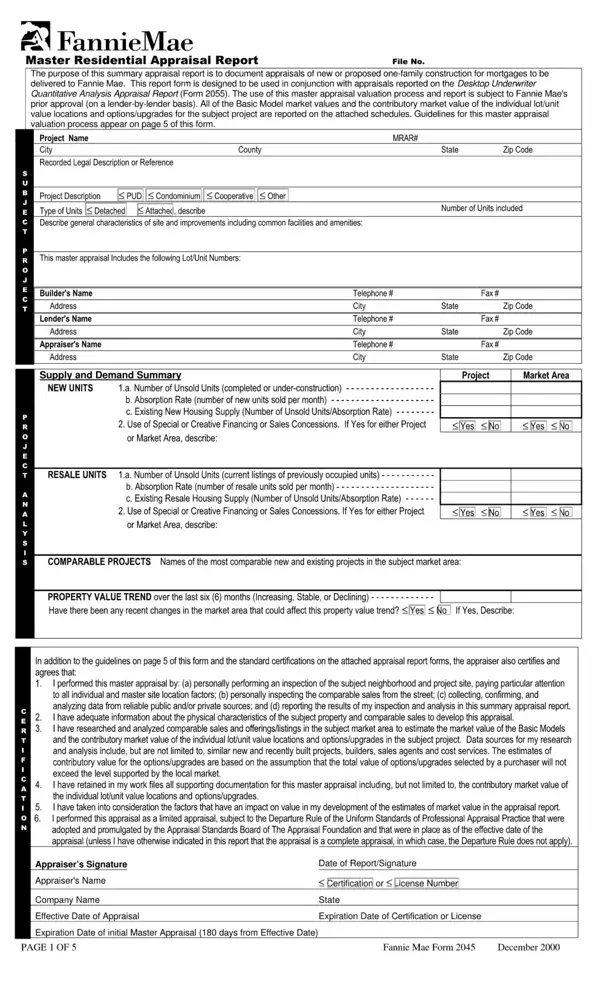
Form Preview Example

How to Edit 2045 Appraisal Form Online for Free

Follow the steps below to complete the 2045 Appraisal Form correctly and submit it to your lender.

Step 1: Enter Subject Property Data

Record the full property address, legal description, and current owner name. Indicate whether the property is a single-unit residence or a single-unit PUD. Note the loan type: purchase money mortgage or non-owner occupied refinance.

Step 2: Describe Property Characteristics

Enter the year built, lot size, total gross living area, and room count. Include the number of bedrooms and bathrooms. Record the property's overall condition using the standard rating scale.

Step 3: Document Market Conditions

Summarize local supply and demand trends for the subject's neighborhood. Note whether the market is expanding, stable, or declining. Include the typical marketing time for similar properties in the area.

Step 4: Select and Analyze Comparable Sales

Choose three to five recent sales of similar properties. Comparables should be from the same neighborhood or a competing area and sold within the past 12 months when possible. Adjust each comparable for differences from the subject property, including location, gross living area, condition, and features such as a garage or pool.

Step 5: Reach a Value Conclusion

After analyzing the comparables and making adjustments, enter your final market value estimate. Sign and date the certification section. Submit the completed form to the requesting lender.

For related mortgage documents, see the 71B Rev Appraisal Form and the FHA Refinance Authorization Form.