
Adult Immunization Record Form PDF Details

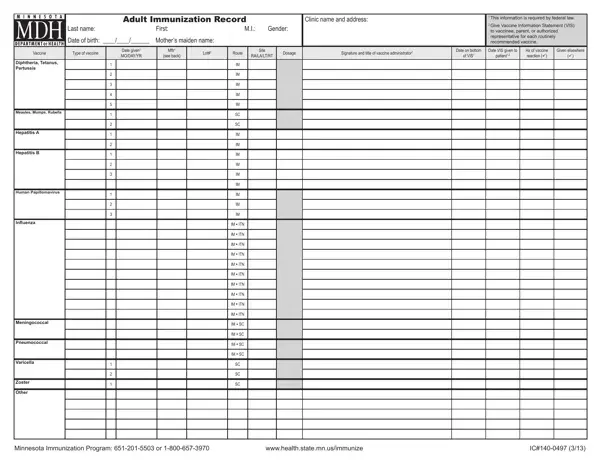
An Adult Immunization Record is a clinical document used to track an adult patient's complete vaccination history. The form captures personal details such as full name, date of birth, gender, and mother's maiden name, along with the name and address of the providing clinic.

Federal law requires healthcare providers to record specific details for every vaccine dose: the vaccine type, manufacturer name and lot number, route and site of injection, dosage amount, date the vaccine was given, date the Vaccine Information Statement (VIS) was provided, and the administrator's signature and title. These requirements come from the National Childhood Vaccine Injury Act and apply to adult vaccinations as well.

The form also documents any adverse vaccine reactions and explains how immunization information should be transferred between providers. Minnesota-based providers can register vaccination histories through the Minnesota Immunization Information Connection (MIIC), the state's centralized immunization registry. Related tracking forms include the general immunization record form and the vaccination record form.

Maintaining a complete adult immunization record supports ongoing care across providers, satisfies employer and school verification requirements, and documents compliance with travel vaccination requirements. Adults should request a copy from their provider after each vaccination and store it with personal health documents.

QuestionAnswer
Form NameAdult Immunization Record Form
Form Length2 pages
Fillable?No
Fillable fields0
Avg. time to fill out30 sec
Other namesMIIC, minnesota adult immunization record, adult immunization record, immunization records for adults

How to Edit Adult Immunization Record Form Online for Free

Filling out an adult immunization record accurately is important for maintaining a complete and legally compliant vaccination history. The form uses rows to document each vaccine dose. Follow these four steps to complete the record correctly.

Step 1: Enter patient and clinic information

Begin by recording the patient's last name, first name, and middle initial. Add the patient's date of birth, gender, and mother's maiden name in the designated fields. In the clinic section, write the full name and address of the healthcare facility administering the vaccines.

Step 2: Document each vaccine dose

For every vaccine given, fill in the vaccine name and brand, the manufacturer's name and lot number, the route and site of injection (for example, intramuscular in the left deltoid), and the dosage amount. Record the date the vaccine was administered and the date the Vaccine Information Statement (VIS) was provided to the patient. The administrator must also sign and write their professional title for each dose entry.

Step 3: Record combination vaccines and injection details

When a combination vaccine is given, document each component in its own row. Do not merge multiple vaccine names into a single entry. For injection routes, use standard abbreviations: IM for intramuscular, SC for subcutaneous, ID for intradermal, and IN for intranasal. For injection sites, note the limb and specific location, such as right arm or left thigh.

Step 4: Document reactions and transfer the record

If a patient reports or shows a reaction after receiving a vaccine, note the reaction date, the vaccine involved, and a brief description of the symptoms. Providers should keep the original record on file and give the patient a copy. When transferring care to another provider, forward the complete immunization history. Minnesota providers can also submit records to the Minnesota Immunization Information Connection (MIIC) for statewide tracking. The Michigan immunization record follows a similar structure for Michigan-based providers.

Frequently asked questions

Who is required to maintain an adult immunization record?
Healthcare providers are legally required to create and maintain this record for every patient who receives a vaccine. Patients are encouraged to keep a personal copy as well. An up-to-date record is often required for employment, school enrollment, military service, and international travel.

What vaccines are listed on an adult immunization record?
The record should include all vaccines administered in adulthood: annual influenza shots, COVID-19 doses and boosters, Tdap (tetanus, diphtheria, pertussis), shingles vaccine, pneumococcal vaccines, hepatitis A and B, and any travel-specific vaccines. Providers follow the CDC adult immunization schedule when recommending which vaccines are due.

How long should an adult keep an immunization record?
Adults should keep immunization records permanently. Vaccination history has no expiration date. Records from decades ago may still be needed to satisfy employer, school, or travel immunity requirements.

Is the Minnesota Adult Immunization Record different from other states?
The core required fields are standardized by federal law across all states. Minnesota's version adds a MIIC registry section specific to the state's centralized immunization information system. Other states maintain their own registries with comparable functionality.