
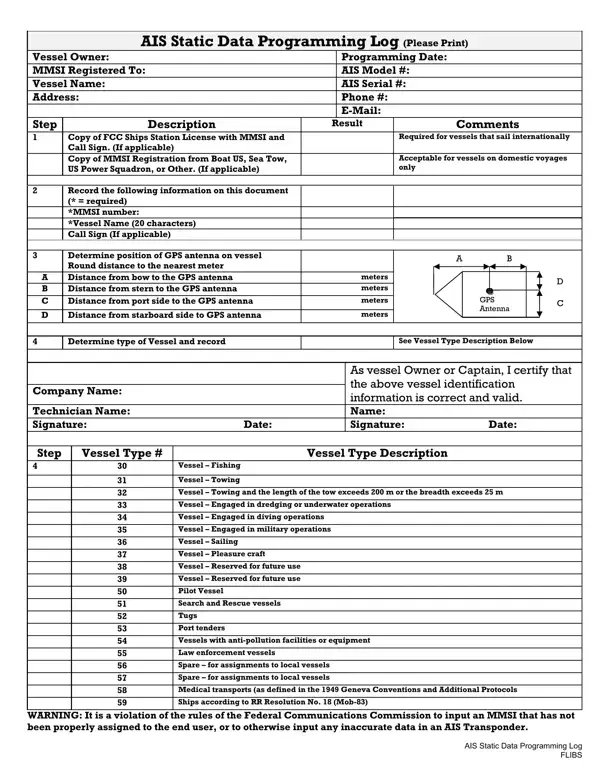
The AIS Static Data Programming Log is a standardized document used to configure an AIS transponder with accurate vessel identification data. This form captures the specific information that an AIS unit broadcasts to nearby ships and shore stations, making the vessel visible and identifiable on marine traffic monitoring systems.
Any vessel owner or operator installing or reprogramming an AIS transponder must fill out this form before the device is configured. Commercial vessels subject to U.S. Coast Guard carriage requirements must have accurate AIS data on file. Recreational boaters who voluntarily install AIS for collision avoidance also use this form to record their MMSI and vessel details. Marine electronics technicians keep completed forms as part of the installation documentation.
The Federal Communications Commission requires that every AIS transponder operating in U.S. waters be programmed with the MMSI number, vessel name, and call sign exactly as listed on the FCC Ships Station License. Operating an AIS device with incorrect or mismatched data is a regulatory violation. Vessels making international voyages must also record the FCC Ships Station License number in the AIS programming log before departure. Using an unassigned MMSI can result in FCC enforcement actions.
The AIS programming form covers all required static data fields:
Related documentation for vessel operators includes a marine regatta permit for organized events and an ARRL radiogram form for VHF radio communications.
| Question | Answer |
|---|---|
| Form Name | AIS Programming Form |
| Also known as | AIS Static Data Programming Log |
| Form Length | 1 pages |
| Fillable? | No |
| Avg. time to fill out | 15 min |
| Required by | FCC regulations for U.S. vessels using AIS |
| Other names | ais static data programming log, ais data programming online, ais programming pdf, mmsi programming data |