
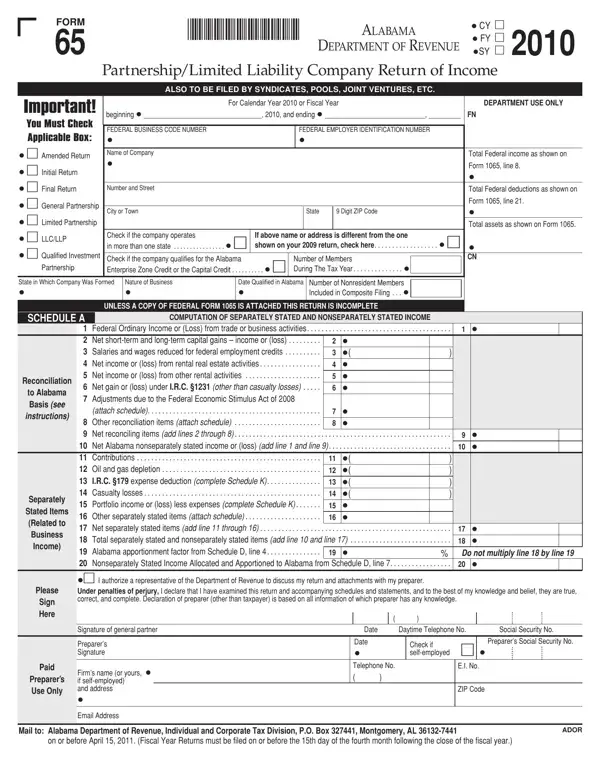
Alabama Form 65 is the Partnership/Limited Liability Company Return of Income required by the Alabama Department of Revenue. Partnerships, LLCs, syndicates, pools, and joint ventures operating in Alabama must file this return each year to report state income, deductions, and distributive share items.
Any partnership or LLC doing business in Alabama, earning income from Alabama sources, or owning property in the state must file. This includes multi-member LLCs treated as partnerships for federal tax purposes. Entities that file IRS Form 1065 at the federal level will generally owe a Form 65 return to Alabama as well. Partners who receive a Schedule K-1 may also need to file an Alabama individual tax return (Form 40A) to report their share of income.
The return includes several supporting schedules. Schedule A captures separately stated income and deductions reconciled from IRS Form 1065. Schedules B through E address apportionment factors such as property, payroll, and sales for entities with multi-state operations. Schedule K reports each partner's or member's distributive share of income, deductions, and credits. The state also allows qualifying entities to claim the Enterprise Zone Credit or the Alabama Capital Credit on this return.
Alabama Form 65 is due on the 15th day of the third month after the entity's tax year ends. Businesses operating as LLCs in Alabama should also have a signed Alabama LLC operating agreement to define member rights and obligations. For e-filing authentication purposes, some partnerships may need Alabama Form 8453.
| Question | Answer |
|---|---|
| Form Name | Alabama Form 65 |
| Form Length | 4 pages |
| Fillable? | No |
| Fillable fields | 0 |
| Avg. time to fill out | 1 min |
| Other names | form al 65, alabama form 65, FEIN, preparer |