Please rate Ancestor Chart

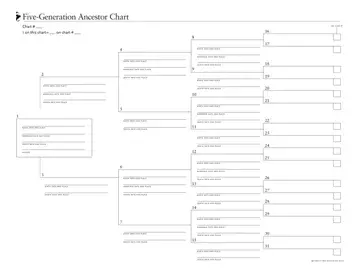
The ancestor chart is a standardized genealogy form used to document family history across five generations. Each entry has fields for a full name, birth date and location, marriage date and location, and death date and location. The form follows the Ahnentafel numbering system, where each ancestor receives a fixed number based on their position in the family line.
The chart organizes 31 ancestors across five generations:
Each row records the individual's full name, birthplace, date of birth, place of marriage, date of marriage, place of death, and date of death. A field for the spouse's name is included next to each ancestor entry.
Start by entering your own name and details in box 1. Fill in your father's information in box 2 and your mother's in box 3. Continue working back generation by generation, following the numbered pattern. Leave blank any entries where information is not yet known. Multiple charts can be joined together to continue research past five generations.
This form works well alongside a pedigree chart or a basic family tree form to build a complete family history record. For organizing research notes and source citations, a genealogy worksheet is a useful companion document.
Vital records are the most reliable sources for filling out an ancestor chart. Birth certificates, marriage licenses, death certificates, and census records provide accurate dates and locations. Church records, local historical societies, and online genealogy databases are also useful for tracing ancestors across multiple generations.
This ancestor chart was originally published by Family Tree Magazine. It is also known as a pedigree chart, a five-generation chart, or a generation chart, depending on the genealogy context.
| Question | Answer |
|---|---|
| Form Name | Ancestor Chart |
| Form Length | 1 pages |
| Fillable? | No |
| Fillable fields | 0 |
| Avg. time to fill out | 15 sec |
| Other names | printable ancestry charts, generation ancestor printable, fillable genealogy forms form, generation chart blank |
Ancestor Chart isn’t the one you’re looking for?
Please rate Ancestor Chart