Please rate Application Fee Waiver

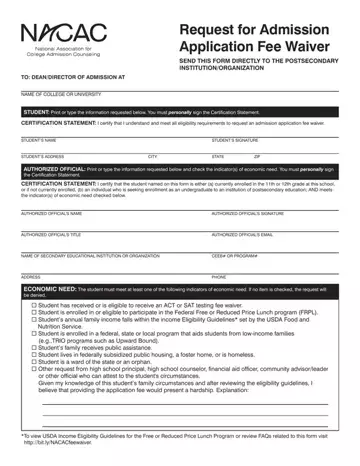
The Application Fee Waiver is an official document used by high school students in grades 11 and 12, as well as undergraduate applicants, to request that colleges and universities waive their admission application fees due to financial hardship. This form is recognized by hundreds of institutions across the United States, making it an essential resource for students from low-income households who want to pursue higher education without the burden of application costs.
Students may qualify for a college application fee waiver if they meet one or more of the following eligibility criteria. Your family participates in a federal food assistance program such as SNAP or WIC. You are enrolled in a federal free or reduced-price lunch program at your school. Your annual household income falls at or below the USDA Income Eligibility Guidelines. You are enrolled in or eligible for a TRIO program such as Upward Bound or Talent Search. You are living in a foster care setting, group home, or are a ward of the state. You have received a fee waiver for the SAT, ACT, or another standardized test. Your school counselor or financial aid officer can certify your financial need.
There are several types of application fee waivers available to eligible students. The NACAC fee waiver is the most widely accepted and is honored by hundreds of institutions. The Common App fee waiver is available through the Common Application platform and allows students to request waivers for multiple schools in a single process. The Coalition Application also provides its own fee waiver option. Individual colleges may have school-specific waivers as well. When filling out a college application form, students should check the fee waiver section to see which types the school accepts. A financial assistance application from the same institution may also help you access additional funding.
To complete the Application Fee Waiver, students typically need to provide their full name, current address, and contact information. They must also describe the specific financial circumstances that qualify them for a waiver. An authorized official such as a school counselor, principal, or college access program representative must sign the form to verify the student's financial need. Supporting documentation may include a financial affidavit confirming household income or an application for financial assistance from a government program. The authorized official's signature is a required field on most waiver forms and cannot be omitted.
Once the Application Fee Waiver form is complete and signed, students should submit it alongside their college application or send it directly to the admissions office. Many schools accept fee waivers electronically through their online application portals, while others require a physical or scanned copy. Students applying to multiple schools should prepare one waiver per institution unless applying through a centralized platform like the Common App. Keep copies of every signed waiver for your records and confirm receipt with each admissions office. Following up by email or phone ensures the waiver is associated with your application before the deadline.
| Question | Answer |
|---|---|
| Form Name | Application Fee Waiver |
| Form Length | 1 pages |
| Fillable? | No |
| Fillable fields | 0 |
| Avg. time to fill out | 15 sec |
| Eligible grades | 11th grade, 12th grade, and undergraduate applicants |
| Authorized by | NACAC (National Association for College Admission Counseling) |
| Requires official signature | Yes (school counselor, principal, or authorized official) |
| Other names | application fee waiver, nacac fee waiver, request admission application, application fee, waiver |
Application Fee Waiver isn’t the one you’re looking for?
Please rate Application Fee Waiver