
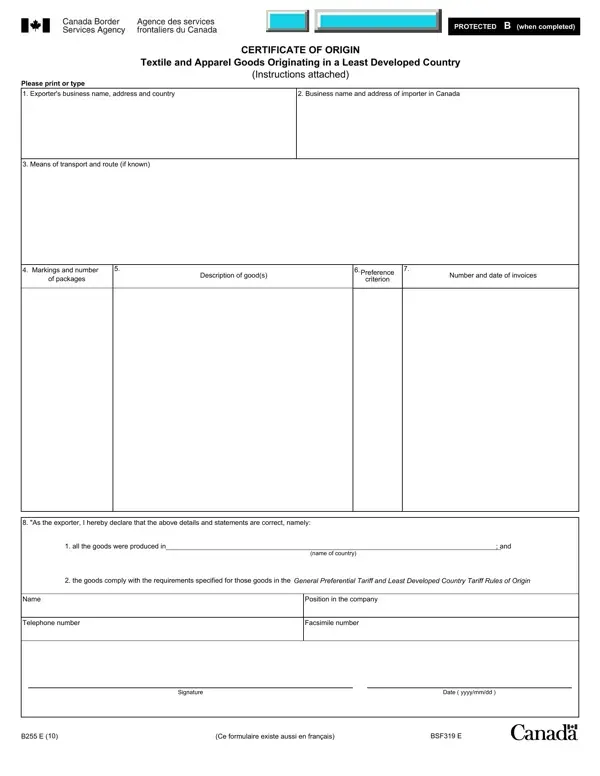
FormsPal's online PDF editor lets you complete the B255 certificate of origin digitally, fill in all required fields, apply your signature, and download the finished document without installing any software. Follow the steps below to get started.
Step 1: Click the "Get Form" button at the top of this page to open the B255 certificate in our free PDF editor. The form loads directly in your browser.
Step 2: Use the editor to fill in all required fields. You can type into blank form fields, upload or draw a signature, add images, and annotate the document. All changes are saved automatically as you work.
The certificate requires specific information in each section. Complete the following parts carefully:
1. Fill in the exporter's business name, address, country of origin, and the importer's contact details in Canada. Make sure the country name matches the LDC designation under CBSA's official list:
2. Complete the declaration section, including: "As the exporter I hereby declare," "all the goods were produced in [name of country]," "the goods comply with the [preference criterion]," and the exporter's name, telephone number, position in the company, and facsimile number:
Take extra care when entering the position in the company and name of country fields. These two fields are where errors most commonly occur and can lead to customs rejection.
Step 3: After completing all fields, click "Done" to finalize your certificate. Create a free FormsPal account to download, email, print, or securely store the completed document. Your data is protected by our encrypted platform and is never shared with third parties.
Key fields to complete accurately
Several fields on the B255 form carry significant legal weight. The goods description must precisely match the textile or apparel items being shipped and include the correct HS tariff codes for customs classification. Errors or omissions in this section give CBSA grounds to deny the preferential tariff claim.
The preference criterion field must accurately state the rule of origin the goods satisfy under the LDC rules. Common criteria include goods wholly produced in the LDC country, or goods that meet the required production or value-added thresholds set out in Canada's Customs Tariff schedules. When in doubt, consult the CBSA Memorandum D11-4-4, which outlines the rules of origin for GPT and LDCT purposes.
The exporter declaration at the bottom of the second page must carry a handwritten or electronic signature from an authorized representative of the exporting business. Unsigned B255 certificates are rejected at the Canadian border. Electronic signatures applied through FormsPal's editor are suitable for filing and record-keeping purposes.
Common questions about the B255 certificate
What is the purpose of the B255 form?
The B255 is a Certificate of Origin that proves textile and apparel goods exported to Canada originate in a Least Developed Country. It enables Canadian importers to claim preferential (reduced or zero-rate) customs duties under the General Preferential Tariff or the Least Developed Country Tariff programs administered by CBSA.
Who is responsible for completing the B255?
The exporter in the LDC country completes and signs the B255 form. The importer in Canada receives the original certificate and presents it to CBSA as part of the customs entry. Both parties should retain copies of the completed form for at least six years to satisfy Canadian customs record-keeping requirements.
Can I fill out the B255 form online for free?
Yes. Use FormsPal's free PDF editor to complete the B255 certificate of origin online. Open the form, fill in all required fields including the goods description, HS tariff codes, and preference criterion, apply an electronic signature, and download the completed PDF. No software download or installation is required.
What is the difference between the GPT and LDCT programs?
The General Preferential Tariff (GPT) offers reduced customs duty rates for goods from eligible developing countries. The Least Developed Country Tariff (LDCT) provides zero or near-zero duty rates specifically for goods from UN-designated Least Developed Countries. The B255 form is used when claiming either program for textile and apparel goods imported into Canada. Importers should confirm which program applies based on the exporting country's designation and the goods' HS classification.
How long should I keep a copy of the completed B255?
Both the Canadian importer and the exporting business in the LDC should retain the original signed B255 and all supporting trade documents for a minimum of six years from the date of importation. This meets the CBSA's record-keeping requirements under Section 40 of the Customs Act and allows for verification in the event of a post-importation audit.
Other Canada trade forms you may need
If your shipment involves goods from countries outside the LDC category, or under different trade agreements, FormsPal provides related documents including the Certificate of Origin form for general international trade, the Canada Customs Invoice for commercial imports into Canada, and the Certificate of Origin for Israel for exports under the Canada-Israel Free Trade Agreement.
