
Baltimore City Addendum Form PDF Details

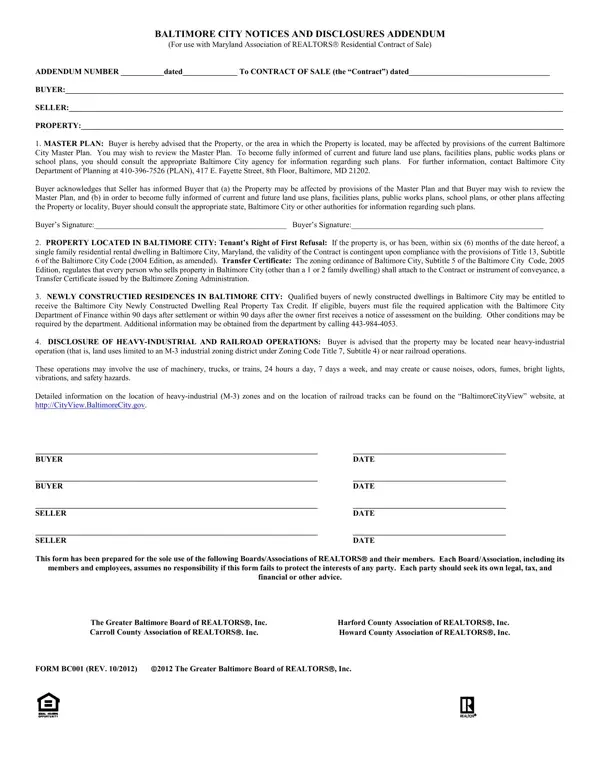
The Baltimore City Addendum (also known as Form BC001 or the Baltimore City Notices and Disclosures Addendum) is a legally required document for all residential property sales in Baltimore City, Maryland. It works alongside the Maryland Association of REALTORS® Residential Contract of Sale and addresses several unique local disclosure requirements that differ from standard statewide forms.

Below is an overview of the key sections and disclosures included in this addendum:

Baltimore City Master Plan

Buyers are required to review the Baltimore City Master Plan, which outlines current and future land use, public works projects, school facilities, and development plans for the city. The addendum advises buyers to consult with the appropriate Baltimore City agencies before closing to understand how these plans may affect the property and surrounding area. Changes in zoning or planned public projects can significantly impact property values and future use.

Tenant's Right of First Refusal

If the property being sold has been used as a single-family residential rental, the current tenant may have a legal right of first refusal. This means the tenant must be given the opportunity to purchase the property before it can be sold to another buyer. The addendum requires the seller to disclose whether this right applies and to confirm that the appropriate notifications have been made to the tenant.

Transfer Certificate Requirement

Before completing a sale in Baltimore City, sellers must obtain a Transfer Certificate from the city. This certificate confirms that the property is in compliance with applicable housing and building codes at the time of transfer. Without a valid Transfer Certificate, the sale cannot proceed. Buyers should verify that the seller has obtained this certificate or confirm the timeline for obtaining it.

Tax Credits for New Construction

Certain newly constructed dwellings in Baltimore City may qualify for tax credit programs available under local ordinances. The addendum requires disclosure of any known tax credit eligibility, allowing buyers to factor this into their financial planning. Buyers should consult with a tax advisor or Baltimore City agency to verify current eligibility criteria and the duration of available credits.

Heavy-Industrial and Railroad Proximity

If the property is located near heavy-industrial operations or railroad lines, the addendum requires disclosure of potential impacts including noise, vibration, odors, and environmental conditions. Buyers in these areas should review the disclosure carefully and, if desired, conduct additional inspections or environmental assessments before finalizing the purchase.

Zoning Ordinances

The addendum discloses the current zoning classification of the property and notes any restrictions under Baltimore City zoning ordinances. Buyers should confirm that their intended use of the property is permitted under the current zoning designation. If a buyer intends to operate a business, add an accessory dwelling unit, or make other changes, verifying zoning compliance is essential.

The Baltimore City Addendum applies to all residential property sales within city limits and must be signed by both the buyer and the seller. A signed copy should be attached to the purchase contract. Sellers are responsible for ensuring the addendum is complete and accurate. Buyers are encouraged to read each section carefully and ask their real estate agent or attorney about any disclosures they do not fully understand.

For additional Maryland real estate documents used in transactions, see our Maryland Real Estate Sales Agreement and our guide to real estate purchase agreement addendums. You may also need the seller property disclosure statement as part of a complete Maryland transaction package.

QuestionAnswer
Form NameBaltimore City Addendum Form
Form Length2 pages
Fillable?Yes
Fillable fields30
Avg. time to fill out6 min 30 sec
Other namesform bc001 baltimore, baltimore city notices disclosure addendum, 2012 baltimore city addendum, baltimore city addendum

How to Edit Baltimore City Addendum Form Online for Free

To complete the bc001 baltimore city notices form, use our free online PDF editor at the top of this page. No software installation is required. The editor works directly in your browser and saves your progress automatically so you can return to the form URL at any time.

Step 1: Click the "Get Form Button" at the top of this page to open our PDF editing tool. All required fields and signature areas are available in the editor.

Step 2: Use the editor to add text, correct existing entries, and add your electronic signature. You can customize the document in multiple ways within a few minutes.

This form requires specific information for each field. Review the sections carefully before filling them in.

1. Begin with the first section of the form, which contains the following fields:

Filling in part 1 in baltimore city notices and disclosures addendum

2. Complete the second section with all required entries: ADDENDUM NUMBER dated To CONTRACT, DATE, DATE, DATE, DATE, This form has been prepared for, members and employees assumes no, financial or other advice, The Greater Baltimore Board of, Harford County Association of, and FORM BC REV with the corresponding information. Double-check each entry before moving on.

How to fill in baltimore city notices and disclosures addendum part 2

Pay close attention to the DATE and FORM BC REV fields. These are required entries that must be accurate before the form is submitted.

Step 3: After completing all fields, click "Done" to save your finished document. You can download, print, or share it directly from the editor.

Who needs to sign the Baltimore City Addendum

Both the buyer and the seller must sign Form BC001. Real estate agents from both sides of the transaction should also be familiar with the form and its requirements. The signed addendum must be attached to the Maryland Association of REALTORS® Residential Contract of Sale before the transaction can be finalized.

If any disclosure in the addendum raises concerns, either party may request additional information or inspections before proceeding. Buyers are encouraged to consult a licensed Maryland real estate attorney for guidance on any disclosures they do not understand.

What to do after completing the form

Once the addendum is complete and signed by both parties, attach it to the main purchase contract. Keep a copy for your records. If the property requires a Transfer Certificate from Baltimore City, the seller should begin that process as early as possible to avoid delays at closing.

Buyers should also follow up on any Master Plan disclosures by contacting the Baltimore City Department of Planning. For properties near industrial or railroad areas, consider scheduling an environmental inspection through a licensed inspector before finalizing the sale.

Common questions about the Baltimore City Addendum

Who is required to use Form BC001?
Any buyer or seller involved in a residential property sale within Baltimore City limits must use this form. It is not optional. The form is required by the Greater Baltimore Board of REALTORS® and the Harford County Association of REALTORS® for all transactions covered by the Maryland Association of REALTORS® Residential Contract of Sale.

What is the difference between the Baltimore City Addendum and the Baltimore County Notices and Disclosures form?
These are two separate forms. The Baltimore City Addendum (BC001) applies to properties within Baltimore City limits, which is an independent city that is not part of Baltimore County. The Baltimore County Notices and Disclosures form applies to properties in Baltimore County. Buyers and sellers should confirm which form applies based on the property's location.

Does the tenant's right of first refusal always apply?
No. The tenant's right of first refusal applies only to properties that have been used as single-family residential rentals. If the property is owner-occupied or a different type of property, this provision may not apply. Sellers should confirm the rental history of the property with their agent or attorney before completing this section of the form.

How long does it take to get a Transfer Certificate in Baltimore City?
Processing times vary. Sellers in Baltimore City should contact the city's housing office well in advance of the anticipated closing date to avoid delays. In some cases, properties may need minor repairs or inspections before a certificate can be issued.

Can I fill out the Baltimore City Addendum online?
Yes. You can complete the form online using our PDF editor on this page. No account is required to fill out the form. After completing it, you can download or print a copy to sign with all parties involved in the transaction.

Where can I find other Baltimore City and Maryland real estate forms?
FormsPal offers a complete library of Maryland real estate documents. You can find the Baltimore City use and occupancy permit, the Maryland purchase agreement, and the declaration of buyer and seller on our platform. For general real estate addendums, visit our appraisal contingency addendum page.

Common mistakes to avoid when filling out Form BC001

Leaving required dates blank: The form contains multiple date fields for both the buyer and seller signatures. All date entries must be filled in. Leaving any date field blank can delay or invalidate the addendum.

Skipping the Transfer Certificate section: Some sellers overlook the Transfer Certificate requirement because they are unfamiliar with Baltimore City's local rules. Make sure this section is addressed early in the transaction to avoid closing delays.

Using the wrong form: Buyers and sellers sometimes confuse the Baltimore City Addendum with the Baltimore County form. Check the property's address carefully to confirm it falls within Baltimore City limits before selecting this form.

Not reviewing the Master Plan disclosures: The Baltimore City Master Plan can affect property values and permitted uses. Buyers who skip this section may be unaware of upcoming zoning changes or public projects that could impact the neighborhood.