
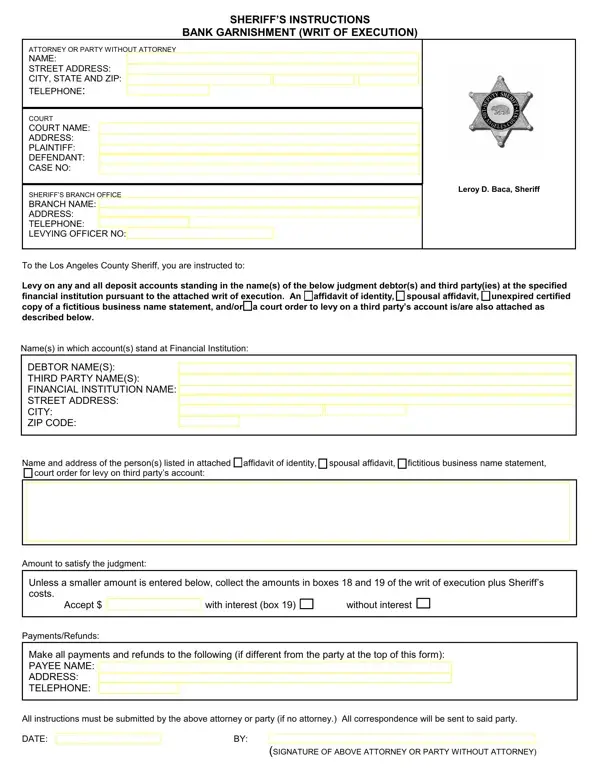
A bank writ directs the sheriff to levy funds in a debtor's deposit accounts at a named financial institution to satisfy a civil money judgment. When a creditor wins a court judgment and the debtor has not paid, the creditor may apply for a writ of execution and serve it on the bank where the debtor holds accounts. The garnishment captures available balances in checking accounts, savings accounts, and other deposit accounts, making it one of the most effective post-judgment collection tools available to creditors.
A writ of execution on a bank account, also called a bank levy or bank garnishment, allows a judgment creditor to collect money owed by freezing and transferring funds from the debtor's accounts at a specific financial institution. Unlike wage garnishment, which takes a portion of a debtor's ongoing wages from an employer, a bank levy can capture the full available balance in a deposit account at once. California courts commonly use the Los Angeles County Sheriff's Department to serve and execute writs of garnishment on local financial institutions, and the process is governed by the court judgment and applicable state law.
The garnishment process begins when the judgment creditor or their attorney files the completed writ with the clerk of court and delivers it to the sheriff's department. The sheriff serves the financial institution with the writ of garnishment. The bank or credit union is required by law to freeze any matching accounts and remit the available funds up to the judgment amount. The court retains jurisdiction throughout the process to address disputes, third-party claims, and debtor exemption requests.
This writ is appropriate in the following circumstances:
Before completing this legal document, gather the following information and supporting materials:
Understanding how the garnishment process works helps judgment creditors avoid delays and errors:
Debtors have important legal rights that creditors should understand before serving a writ of garnishment. State law protects certain property and income from garnishment. Debtors may file an exemption claim with the court to protect Social Security benefits, unemployment compensation, disability payments, and a minimum account balance in some jurisdictions. The court schedules a hearing when an exemption claim is filed, allowing both the debtor and the judgment creditor to present evidence before the court orders final disbursement of the garnished funds.
Third parties who co-own the accounts may also file claims to protect their share. The judgment does not cover property belonging to third parties, so the court reviews all third-party claims before ordering the financial institution to release the funds to the creditor.
All payments and refunds arising from the bank levy are channeled through the attorney or self-representing creditor who filed the writ. If the levy captures more than the outstanding judgment amount plus accrued interest and court fees, the financial institution must refund the excess to the debtor. The court confirms the final disbursement order, ensuring both the creditor and the debtor's claims are addressed according to the underlying court judgment and applicable state law.
| Question | Answer |
|---|---|
| Form Name | Bank Writ Form |
| Form Length | 1 pages |
| Fillable? | No |
| Fillable fields | 0 |
| Avg. time to fill out | 15 sec |
| Other names | bank writ execution los angeles, writ on bank account, bank writ los angeles, garnishment writ execution los angeles |