Baseball Tryout Evaluation Form PDF Details

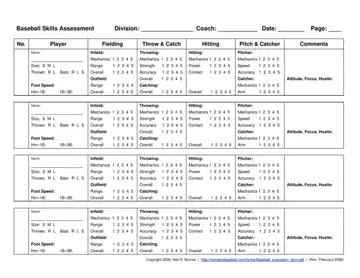
With the baseball evaluation form, coaches can review several players at once and compare scores on the fly.

You can add basic session details, such as division, coach name, and date, at the top of the page. It's all pretty straightforward. Each player has their own row with space for their name, size, throwing hand, and batting preference. A five-point scale is used for skill ratings, which remains easy to read even after a long day in the field.

This simple form also includes a comments column. Use it for quick notes, sharp observations, or reminders that don't fit neatly into numeric scores.

The middle of the form groups skills in a way that feels familiar to anyone who’s run a tryout:

✔️ Fielding ability for infield and outfield positions.

✔️ Throwing and catching mechanics, strength, and accuracy.

✔️ Hitting mechanics, power, and contact quality.

✔️ Pitching and catching performance, if the player tries those roles.

✔️ Foot speed, attitude, focus, and hustle.

With a player evaluation form like this, setup helps coaches stay fair. One great play won’t outweigh the steady performance of athletes, and one mistake won’t sink a solid tryout. Simple evaluation forms work really well for recreational leagues and large tryout groups.

What's good is that the same layout repeats several times on a single page, reducing paper use. At the same time, evaluations remain consistent for the team, from first player to last.

QuestionAnswer
Form Name Baseball Evaluation Form
Form Length 2 pages
Fillable? Yes
Fillable fields 32
Avg. time to fill out 20 min
Other names baseball evaluation form template, baseball tryouts evaluation form, baseball skills assessment form, baseball player evaluation form

Form Preview Example

Baseball Skills Assessment

Division: ________________ Coach: ____________

Date: ________

Page: ____


No.

Player

Fielding

Throw & Catch

Hitting


Pitch & Catcher

Comments


Name:


Infield:


Throwing:


Hitting:


Pitcher:


_________________

Mechanics 1 2 3 4 5

Mechanics 1 2 3 4 5

Mechanics 1 2 3 4 5

Mechanics 1 2 3 4 5


Size: S M L


Range

1 2 3 4 5

Strength

1 2 3 4 5

Power

1

2

3

4

5

Speed

1 2 3 4 5


Throws: R L

Bats: R L S

Overall

1 2 3 4 5

Accuracy

1 2 3 4 5

Contact

1

2

3

4

5

Accuracy

1 2 3 4 5


Outfield:


Overall

1

2

3

4

5


Catcher:


Attitude, Focus, Hustle:


Foot Speed:


Range

1 2 3 4 5

Catching:


Mechanics 1 2 3 4 5


Hm–1B:

1B–3B:

Overall

1 2 3 4 5

Overall

1

2

3

4

5

Overall

1 2 3 4 5

Arm

1 2 3 4 5


Name:


Infield:


Throwing:


Hitting:


Pitcher:


_________________

Mechanics 1 2 3 4 5

Mechanics 1 2 3 4 5

Mechanics 1 2 3 4 5

Mechanics 1 2 3 4 5


Size: S M L


Range

1 2 3 4 5

Strength

1 2 3 4 5

Power

1

2

3

4

5

Speed

1 2 3 4 5


Throws: R L

Bats: R L S

Overall

1 2 3 4 5

Accuracy

1 2 3 4 5

Contact

1

2

3

4

5

Accuracy

1 2 3 4 5


Outfield:


Overall

1

2

3

4

5


Catcher:


Attitude, Focus, Hustle:


Foot Speed:


Range

1 2 3 4 5

Catching:


Mechanics 1 2 3 4 5


Hm–1B:

1B–3B:

Overall

1 2 3 4 5

Overall

1

2

3

4

5

Overall

1 2 3 4 5

Arm

1 2 3 4 5


Name:


Infield:


Throwing:


Hitting:


Pitcher:


_________________

Mechanics 1 2 3 4 5

Mechanics 1 2 3 4 5

Mechanics 1 2 3 4 5

Mechanics 1 2 3 4 5


Size: S M L


Range

1 2 3 4 5

Strength

1 2 3 4 5

Power

1

2

3

4

5

Speed

1 2 3 4 5


Throws: R L

Bats: R L S

Overall

1 2 3 4 5

Accuracy

1 2 3 4 5

Contact

1

2

3

4

5

Accuracy

1 2 3 4 5


Outfield:


Overall

1

2

3

4

5


Catcher:


Attitude, Focus, Hustle:


Foot Speed:


Range

1 2 3 4 5

Catching:


Mechanics 1 2 3 4 5


Hm–1B:

1B–3B:

Overall

1 2 3 4 5

Overall

1

2

3

4

5

Overall

1 2 3 4 5

Arm

1 2 3 4 5


Name:


Infield:


Throwing:


Hitting:


Pitcher:


_________________

Mechanics 1 2 3 4 5

Mechanics 1 2 3 4 5

Mechanics 1 2 3 4 5

Mechanics 1 2 3 4 5


Size: S M L


Range

1 2 3 4 5

Strength

1 2 3 4 5

Power

1

2

3

4

5

Speed

1 2 3 4 5


Throws: R L

Bats: R L S

Overall

1 2 3 4 5

Accuracy

1 2 3 4 5

Contact

1

2

3

4

5

Accuracy

1 2 3 4 5


Outfield:


Overall

1

2

3

4

5


Catcher:


Attitude, Focus, Hustle:


Foot Speed:


Range

1 2 3 4 5

Catching:


Mechanics 1 2 3 4 5


Hm–1B:

1B–3B:

Overall

1 2 3 4 5

Overall

1

2

3

4

5

Overall

1 2 3 4 5

Arm

1 2 3 4 5


Copyright 2006, Neil R. Bonner | http://herndonbaseball.com/forms/Baseball_evaluation_form.pdf

| (Rev. February 2006)

Standard Structure for Baseball Tryouts & Skills Assessment

This standardized format may be used for all outdoor baseball tryouts. This structure is designed for evaluating players for All-Star travel teams but can also be used to evaluate players for draft purposes within “house” leagues.

Using the attached Baseball Skills Assessment Form, coaches should score each player according to the listed categories of skills. The evaluation form uses a five point scale to measure the various skills that a player should possess in order to play baseball at a competitive/competent level. A score of five (5) points should be awarded for any skill which the player demonstrates an exceptional level of ability relative to his peers. A score of one (1) point should be awarded for any skill which the player demonstrates an extremely poor level of ability relative to his peers. Score two, three or four points for levels of skill in-between the two extremes.

So that the All-Star selection process is fair to all players, the evaluators should use the quantitative scores to select the first eight (8) players on the team. The All-Star manager would then select the final four (or more) positions on the team using any criteria he sees fit. Managers can weight the categories according to their thoughts as to what makes a good team. The following is a suggestion for a balanced approach: Using the overall score in each of the following defensive categories: infield, outfield, throwing, and catching, there are a maximum of 20 points. For the hitting skills, coaches should count mechanics, power and contact for a maximum hitting total of 15 points.

Coaches should add 1 or 2 points to the players with the fastest times during the base running assessment and deduct 1 or 2 points to the slowest players. Coaches may award or deduct points based on a player’s demonstrated attitude, focus and hustle. Finally, coaches may wish to add between 1 and 5 points for pitching or catching skills as these positions are very important to a team.

Format of Tryouts

So that there be a well defined structure and opportunities for evaluation, the league should consider structuring the tryouts as follows. Everyone should plan on the tryouts taking between 2 and 2.5 hours to complete.

T im e

Ac t ivity

5 min.

Opening remarks by All-Star manager and/or tryouts coach.

0:05

Explain format of tryouts, how players will be evaluated, and


importance of behavior, hustle and good attitude.

10 min.

Warm up. Jog once around entire field, then warm-up by throwing

0:15

to a partner.

10 min.

Base Running skills. Lineup players at home plate. Time players

0:25

on their ability to go from the batter’s box to 1B. Afterwards, have


them run from 1B to 3B. Allow them to overrun 3B as you don’t


want them to slide into 3B. Make sure players tag each base. Use a


stopwatch to call out times.

20 min.

Infield skills. Lineup players in outfield just behind the shortstop.

0:45

Each player rotates through the positions starting with shortstop.


Coach hits five balls to shortstop who fields and makes a throw to


1B. Hit balls to left and right to evaluate range. Then hit one ball to


2Bman who throws it to the shortstop who then throws to 1B for a


double play. Players then rotate from SS to 2B to 1B to home.

5 min.

Water break. Have players return to dugout for a quick break.

25 min.

Outfield skills. Lineup players in deep outfield. If using a pitching

1:15

machine to simulate flyballs, have four small cones setup in a


square approximately 50 feet apart. Have the player start in the


center of the square. The flyball should come right to him. He then


rotates to each cone position and moves once the ball is “hit”. This


will test his range and the ability to catch. After each ball the player


throws the ball to 2B who throws it to 3B who throws it to the


player at home. Players rotate from OF to 2B to 3B to home.

5 min.

Water break. Have players return to dugout for a quick break.

35 min.

Hitting skills. Have about 1/3 of the players in the dugout ready to

1:55

hit. The other players field the batted balls. Rotate players as


needed. Recommend using pitching machine for consistency unless


several coaches with good pitching skills are available to throw


“batting practice” balls to each player. Give each player 5 to 8 good


pitches. Bunting first pitch is optional.

5 min.

Thank You. Have manager thank all players for attending the

2:00

tryouts. Let them know when a decision will be made regarding


who makes the team. Let them know that anyone not interested in


trying out as a pitcher or catcher may be dismissed.

20 min.

Pitchers & Catchers. Any player that would like to be considered

2:20

as a pitcher or catcher should tryout. Have pitchers throw


approximately 5 pitches. Catchers should catch at least two pitchers.

Copyright 2006, Neil R. Bonner | http://herndonbaseball.com/forms/Baseball_evaluation_form.pdf | (Rev. February 2006)

How to Edit Baseball Player Assessment Form Online for Free

Begin by clicking the Get Form Now button on the page. That’s it. The document loads instantly in the FormsPal PDF editor, keeping the original layout intact and ready for input.

Also, you can download this baseball tryout evaluation form for free and edit it on your device.

Step 1. Complete the Header Information

At the top of the page, enter:

  • Division,
  • Coach name,
  • Date of the evaluation,
  • Page number if using multiple pages.

Note that the baseball evaluation form uses a fixed layout and a five-point rating scale. Fill it out row by row, player by player, following the sections exactly as they appear on the form.

Step 2. Enter Player Identification Data

Move to the left side of the row and record the player’s basic information.

Write the player’s name, mark size (S, M, or L), and indicate throwing and batting preference. Do this before scoring anything else.

Step 3. Rate Fielding Skills

In the Fielding section, rate the infield and outfield skills on a scale of 1 to 5, as shown on the form. Evaluate the skills and abilities of the player, taking into account the specific aspects of the game that are relevant to the player's performance. Each line should contain only one number.

Here's a quick reminder! A score of 1 indicates very weak performance, while 5 indicates strong ability compared to other peers' performance during the same session.

baseball evaluation form spaces to fill out

Step 4. Score Throwing and Catching

In the Throw & Catch section:

  • Rate throwing mechanics, strength, accuracy, and overall ability,
  • If applicable, rate catching mechanics and overall catching skill.

Only score catcher-related fields if the player actually performs that role.

Step 5. Hitting Ability

Under the Hitting section, score mechanics, power, contact, and overall hitting performance. Use what you actually see during drills or live swings.

Numbers should reflect outcomes and form, not reputation or past seasons (tempting, but misleading).

Step 6. Pitching and Catcher Skills

In the Pitch & Catcher column, just fill in the roles the player attempted. Pitchers get rated on their mechanics, speed, and accuracy. Catchers can get points for their mechanics and arm strength.

Don't rate both unless the player really tries both positions.

Finishing baseball evaluation form part 2

Step 7. Record Foot Speed

Next, enter the base running performance in the foot speed fields. Record the times or relative results for home to first base and first base to third base.

Step 8. Add Comments

In the Comments column, you can write attitude, focus, hustle, and any standout strengths or concerns

Step 9. Repeat for Each Player

The same structure repeats multiple times on one page, so fill out each row independently.

Watch Baseball Player Assessment Form Video Instruction

Please rate Baseball Assessment

1 Votes
If you believe this page is infringing on your copyright, please familiarize yourself with and follow our DMCA notice and takedown process - click here to proceed .