
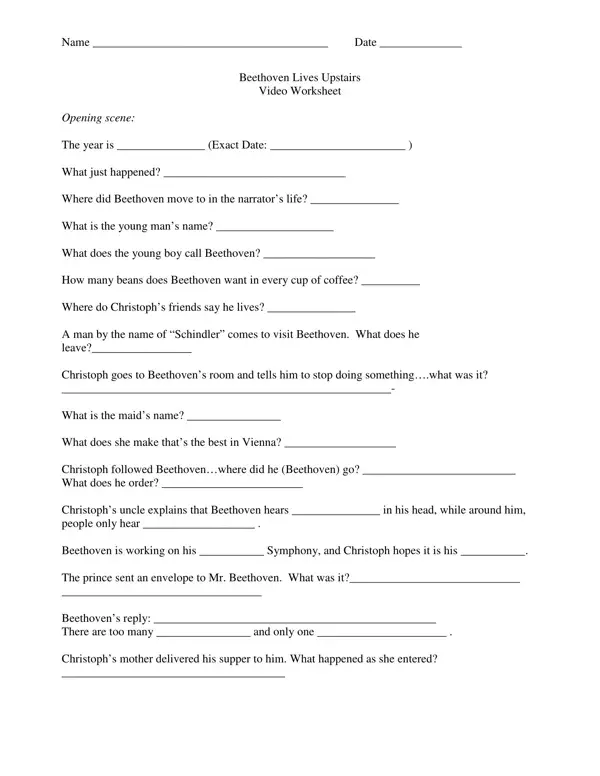
This worksheet accompanies the 1992 educational film "Beethoven Lives Upstairs." It draws students into the world of the celebrated composer during the final months of his life. The form includes questions about the film's plot, its characters, and the historical context of Vienna in 1827.
Released in 1992, "Beethoven Lives Upstairs" is an educational film designed for students in grades 4 through 8. The story is told through a series of letters between a young boy named Christoph and his uncle. Christoph lives in 19th-century Vienna. His household has just taken in a new tenant: the famous composer Ludwig van Beethoven.
At first, Christoph is annoyed by Beethoven's unusual habits. The composer bangs on the piano at odd hours, splashes water everywhere when he bathes, and behaves in ways that confuse the neighbors. Over time, Christoph begins to understand that Beethoven's behavior comes from his deep passion for music and his daily struggle with deafness. The film ends shortly before Beethoven's death in March 1827.
The movie is widely used in classrooms across North America as an introduction to classical music history. It combines storytelling with accurate historical detail, making Beethoven's world accessible to young viewers.
Ludwig van Beethoven was born on December 17, 1770, in Bonn, Germany. His father recognized his musical ability early and gave him intensive training as a child. Beethoven gave his first known public performance at age seven.
In 1792, Beethoven moved to Vienna, which was then the center of the musical world in Europe. He studied briefly with Joseph Haydn and quickly became known for his bold compositional style. By the early 1800s, he was one of the most celebrated composers on the continent.
Around 1798, Beethoven began to notice problems with his hearing. By 1814, he was almost completely deaf. He could no longer perform as a pianist and had to rely on conversation notebooks to communicate with visitors. He would write his thoughts on paper and hand the notebook to the person he was speaking with. They would write their reply in the same notebook.
Despite this profound challenge, Beethoven continued to compose. Some of his most celebrated works were written during or after his hearing loss. These include his Fifth Symphony (1808), his Seventh Symphony (1812), and the famous Ninth Symphony (1824). He completed the Ninth Symphony while almost entirely deaf. At its premiere in Vienna, he had to be turned around by a soloist to see the audience's standing ovation, because he could not hear the applause.
Beethoven was known for his intense personality. He argued frequently with publishers, patrons, and landlords. He moved often, sometimes living in several different apartments in the same year. He was deeply sensitive to criticism but also generous with music students he respected. He died on March 26, 1827, in Vienna. Tens of thousands of people reportedly attended or lined the streets during his funeral procession.
The film is set in Vienna during the early months of 1827. At this time, Vienna was the cultural capital of Europe. The city was home to many of the greatest composers, musicians, and performers of the era. Streets were filled with the sounds of music from theaters, salons, and public spaces.
Vienna in the early 19th century was also a place of strict social hierarchy. Noble families sponsored the arts and expected composers to perform on demand. Beethoven pushed back against this system throughout his career, insisting on his right to compose as he chose rather than as his patrons demanded. This independence was unusual for the time and made him both admired and controversial.
By 1827, Beethoven had lived in Vienna for 35 years. He was a familiar and sometimes difficult presence in his neighborhoods. Landlords complained about his noise and his failure to pay rent. Neighbors noticed his peculiar routines. Yet the city recognized him as one of the greatest musical minds of the age.
Christoph is the young narrator of the story. He is approximately nine years old and lives in Vienna with his mother. His father is working elsewhere. At the beginning of the film, Christoph sees Beethoven as a frightening and disruptive stranger. As the story unfolds, he learns to see the man behind the unusual behavior. By the end, Christoph has a genuine understanding of what it means to dedicate one's life to art.
Ludwig van Beethoven appears in the film as a complex and deeply human figure. He is shown composing at odd hours, losing his temper when interrupted, and sitting in long silences. He is not portrayed as a perfect or distant genius. Instead, viewers see him as a person who is struggling with isolation, physical limitations, and the pressure of his own creative standards.
Uncle Karl is Christoph's uncle. He corresponds with Christoph through letters. At first, he is skeptical about Beethoven and suggests the family move out. He calls the composer crazy and a nuisance. His tone gradually shifts as Christoph's letters reveal more about the true nature of their unusual tenant.
Christoph's mother serves as a steadying presence. She is patient with Beethoven and models kindness for her son. Her responses to Beethoven's eccentricities show Christoph a more empathetic way to view difficult people.
The form includes questions that span the full arc of the film. They fall into several categories:
This worksheet is used in music classes, history classes, and language arts settings. It gives students a structured way to practice active viewing and note-taking, two skills that transfer across many academic subjects.
Students who complete the form come away with a fuller picture of Beethoven as a real historical person. They learn that his genius coexisted with real limitations, including deafness, social conflict, and physical illness. This human portrait helps students connect to history in a way that a textbook listing of dates and compositions cannot.
For teachers, the form provides a consistent way to guide students through the film. It creates a written record of comprehension that can be used for class discussion, formative assessment, or independent review.
The worksheet also works well as part of a larger unit. Teachers often pair it with other materials about classical music, 19th-century European history, or biographical study of historical figures.
The film explores several themes that connect to broader academic and life lessons. These include:
Teachers typically screen the film over one or two class periods. Students use the form to record key details as they watch. After the film, the class reviews the questions together in discussion.
Students can also complete the form individually at home after watching a recording of the film. The step-by-step fill-in format makes it easy to use without additional instruction from a teacher.
The worksheet pairs naturally with other resources on music history, biography, and European history in the 19th century. It serves well as a standalone activity or as part of a multi-lesson unit.
| Question | Answer |
|---|---|
| Form Name | Beethoven Lives Upstairs Worksheet Form |
| Form Length | 4 pages |
| Fillable? | No |
| Fillable fields | 0 |
| Avg. time to fill out | 1 min |
| Other names | beethoven lives upstairs worksheet answers, beethoven lives upstairs youtube, beethoven lives upstairs questions, beethoven lives upstairs worksheet and answer key |