
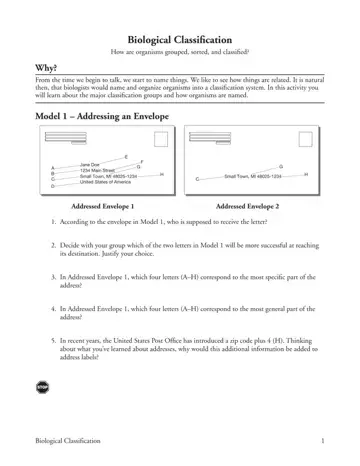
The Biological Classification Model 1 is a POGIL (Process Oriented Guided Inquiry Learning) activity widely used in high school and introductory college biology courses. POGIL activities are designed so that students work in small groups to build understanding through guided inquiry rather than direct instruction. This model focuses on taxonomy, the science of naming, describing, and classifying all living organisms on Earth. By working through this worksheet, students develop a concrete understanding of why scientists use a standardized classification system and how that system reveals evolutionary connections between species.
Swedish naturalist Carolus Linnaeus developed his classification framework in the 18th century and it remains the foundation of modern taxonomy. The system arranges all living things into seven major taxonomic ranks: Kingdom, Phylum, Class, Order, Family, Genus, and Species. This worksheet introduces the hierarchy using the analogy of a mailing address. Just as a postal address narrows from country down to a specific building, taxonomy narrows from the broadest grouping (Domain) down to individual species. For example, lions (Panthera leo), tigers (Panthera tigris), and house cats (Felis catus) all belong to Kingdom Animalia and Class Mammalia, but they diverge at the Genus level, showing that shared higher-rank placement indicates shared evolutionary ancestry.
Modern taxonomy recognizes three domains at the highest level of organism classification: Bacteria, Archaea, and Eukarya. This section of the form introduces students to the three-domain system, which replaced the older five-kingdom framework as molecular biology and DNA sequencing revealed deeper evolutionary relationships that appearance-based classification had missed. Within Eukarya, organisms are organized into the kingdoms Animalia, Plantae, Fungi, and Protista. The worksheet guides students through this updated framework, helping them understand why advances in science require revisiting earlier classification methods.
One of the most important concepts covered in this form is binomial nomenclature, the two-part system for assigning scientific names to organisms. The first part identifies the genus and is always capitalized. The second part identifies the species and is always lowercase. Both parts are italicized in print or underlined when handwritten. For example, the domestic dog is written as Canis lupus familiaris. This universal naming convention allows researchers worldwide to refer to the same organism without confusion across different languages. The worksheet walks students through applying these naming rules to real examples from the animal kingdom.
For additional biology and science PDF resources, explore the microbiology report form, the species form worksheet, and the Regents biology lab food chains worksheet for hands-on science practice.
| Question | Answer |
|---|---|
| Form Name | Biological Classification Model 1 |
| Form Length | 8 pages |
| Fillable? | No |
| Fillable fields | 0 |
| Avg. time to fill out | 2 min |
| Other names | biological classification pogil key, biological classification pogil answers, classification pogil answers, biological classification worksheet answer key |