
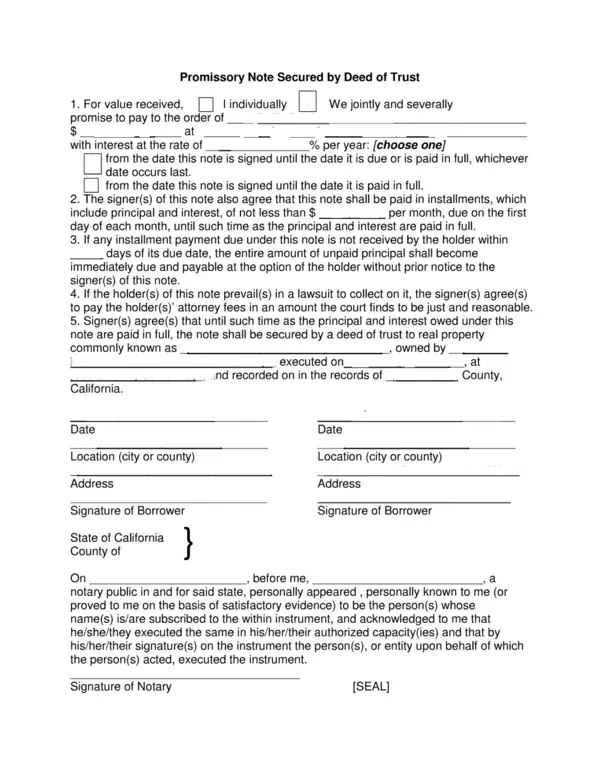
California Note Secured Form PDF Details

In the realm of real estate transactions within California, the security and clarity of agreements between lenders and borrowers are of paramount importance. A key instrument facilitating this clarity is the California Note Secured form, also known as a promissory note secured by deed of trust. This pivotal document outlines the terms under which money is lent and the specifications for its repayment. It serves as a legal agreement stipulating the interest rates, payment schedule, and consequences of non-compliance with the agreed terms.

The form plays a crucial role in securing the loan through a lien on the real property, offering lenders a level of protection and recourse should the borrower fail to meet their obligations. Key components captured in the California Note Secured form include the principal loan amount, the annual interest rate, the repayment schedule (monthly installments or a balloon payment), and a full legal description of the collateral property. The form also identifies the consequences of default, including the lender's right to accelerate the full balance and initiate foreclosure proceedings under California law.

By incorporating this form into their transactions, participants in the California real estate market can navigate the complexities of lending with a higher degree of confidence and legal backing. Whether you are a private lender, a buyer financing a home purchase, or a real estate investor arranging a secured loan, the California Note Secured form is the foundation of any collateralized lending arrangement in the state.

QuestionAnswer
Form NameCalifornia Note Secured Form
Form Length1 pages
Fillable?No
Fillable fields0
Avg. time to fill out15 sec
Other namesnote secured deed, promissory note secured by deed of trust california, promissory note secured by deed of trust template, california promissory note secured by deed of trust

How to Edit California Note Secured Form Online for Free

You could complete the California Note Secured form without difficulty using our PDFinity® PDF editor. To get started, follow these simple steps:

Step 1: Press the "Get Form" button at the top of this page to open our PDF tool.

Step 2: Using our state-of-the-art PDF editor, fill in all required fields, add custom text, or fine-tune the document's original content. You can also insert graphics and sign the file digitally.

Here is what you need to complete the california note secured form:

1. Start in the section with the following blank fields:

promissory note secured by deed of trust conclusion process outlined (portion 1)

2. Complete all of the following fields:

promissory note secured by deed of trust completion process explained (part 2)

Review what you have entered carefully before proceeding.

Step 3: Revise all entries and click "Done." Register at FormsPal for a 7-day free trial to instantly download the completed california note secured form. Your document will be saved securely in your FormsPal cabinet, and your data is never stored or shared.

What Is a California Note Secured Form?

A California Note Secured form is a legal document used in California real estate lending. The borrower promises to repay a specific loan amount to the lender at a stated interest rate over a defined period. Unlike an unsecured promissory note, this document is backed by collateral: the borrower's real property. If the borrower defaults, the lender can foreclose on that property through the accompanying deed of trust.

The California Note Secured form is used for several common purposes:

  • Purchase-money loans for California residential real estate
  • Refinancing transactions secured by residential or commercial property
  • Private lending arrangements where the borrower pledges property as security
  • Hard-money loans for real estate investors in California

Key Components of the California Note Secured Form

Understanding each section of the California Note Secured form helps ensure both parties meet their legal obligations. The primary fields include:

  • Principal Amount: The total dollar amount borrowed, stated clearly at the beginning of the document.
  • Interest Rate: The annual percentage rate charged on the outstanding balance. California usury laws cap interest rates for certain private lenders, so confirm the rate complies with California law before signing.
  • Payment Schedule: Whether payments are monthly, quarterly, or in a lump sum at maturity. The note must specify the due date for each installment.
  • Maturity Date: The date by which the full loan balance, including any accrued interest, must be paid in full.
  • Collateral Description: A legal description of the California real property securing the note. This connects the note to the accompanying deed of trust.
  • Default and Remedies: Terms specifying what constitutes default (such as a missed payment or breach of covenants) and the lender's rights, including the right to foreclose.
  • Prepayment Terms: Whether the borrower may pay off the loan early without a penalty. California law restricts prepayment penalties on certain residential loans.

California Legal Requirements for Secured Promissory Notes

California imposes specific requirements on promissory notes secured by real property. Key rules include:

  • Written form required: California's statute of frauds (Civil Code Section 1624) requires that any agreement involving real property must be in writing and signed by the parties.
  • Usury limits: For non-exempt lenders, California's usury law generally caps interest at 10 percent per year on personal loans. Many institutional lenders are exempt, but private lenders should confirm compliance.
  • Recording the Deed of Trust: While the promissory note itself is not recorded, the accompanying deed of trust must be recorded with the county recorder's office to establish priority against third parties.
  • Notarization: The deed of trust accompanying this note typically requires notarization before recording. The note itself does not require notarization but may need witnesses depending on the lender's preference.

Consequences of Defaulting on a California Secured Promissory Note

If a borrower fails to make required payments or breaches the note's terms, the lender has significant remedies under California law:

  • Acceleration: Most California promissory notes secured by deed of trust include an acceleration clause, which makes the entire outstanding balance immediately due upon default.
  • Non-judicial foreclosure: California Civil Code Section 2924 permits the lender to initiate a non-judicial foreclosure (trustee's sale) without filing a court lawsuit. This process involves a Notice of Default, a waiting period, a Notice of Trustee's Sale, and ultimately a public auction.
  • Anti-deficiency rules: After a trustee's sale, California's anti-deficiency statutes (Code of Civil Procedure Sections 580b and 580d) may limit the lender's ability to pursue the borrower for any remaining balance. Understanding these rules before signing is critical for both parties.
  • Credit impact: Default and foreclosure carry severe long-term consequences for the borrower's credit and ability to obtain future financing in California.

Related California Legal Documents

The California Note Secured form is typically used alongside other legal documents. You may also need the following: