
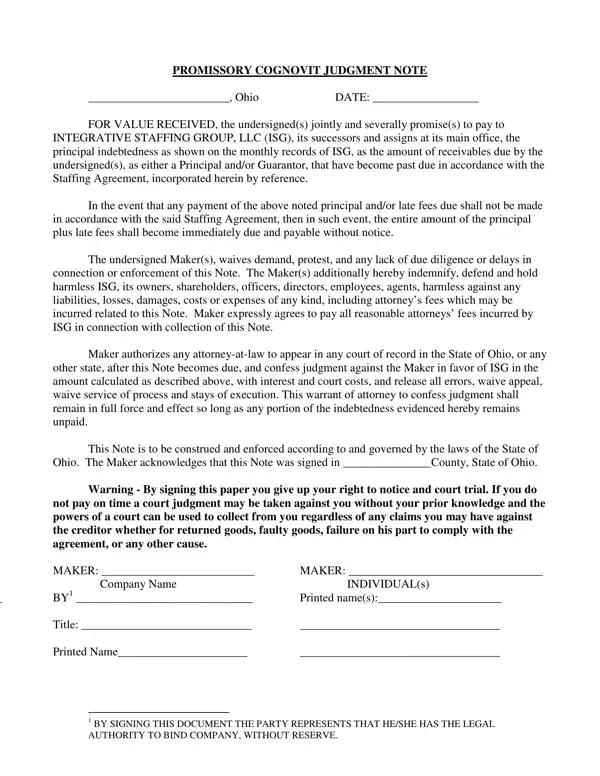
In financial and business transactions, a cognovit note serves as a specialized legal instrument that combines the features of a standard promissory note with a confession of judgment clause. When a debtor signs this document, they agree in advance to allow a creditor to obtain a court judgment against them without a full trial if the debtor defaults on the agreed payment terms. This preauthorized judgment clause gives the creditor a powerful and expedited avenue for debt collection, making the cognovit note a significant legal commitment for any signer.
The process begins when a debtor and creditor agree to a financial obligation, such as a business loan, a staffing arrangement, or a commercial transaction. The debtor signs the cognovit note, which includes a power of attorney clause authorizing an attorney, typically one designated by the creditor, to appear in court on the debtor's behalf and formally confess judgment against them. If the debtor fails to make the required payments, the creditor can immediately file for a court judgment without providing the debtor with advance notice or an opportunity to contest the debt in a traditional hearing. This means a creditor can move directly to collection actions such as wage garnishment or bank account levies far faster than through standard litigation.
A typical cognovit note includes several critical provisions that define the rights and obligations of both parties. The principal amount states the total debt owed under the agreement. The payment schedule establishes when and how repayment must occur, including the frequency and amount of each installment. A late fee provision specifies additional charges that apply when payments are missed. The confession of judgment clause is the core feature that grants the creditor the right to seek a court judgment automatically upon default. An indemnification clause typically requires the debtor to cover the creditor's reasonable attorney fees and costs incurred during collection. The warning section, which is legally required in Ohio, must be printed in bold type and clearly advise the debtor of the rights they are waiving before they sign. The maker must print their name and sign the document while acknowledging full awareness of these terms.
Ohio is one of the few states in the United States that continues to recognize and enforce cognovit notes. Ohio Revised Code Section 2323.13 governs the use of these instruments and establishes the statutory requirements for their valid execution. For a cognovit note to be enforceable under Ohio law, the document must clearly state the nature of the obligation and include the required warning language notifying the debtor that they are waiving significant legal rights. The note must also contain a warrant of attorney authorizing a licensed Ohio attorney to confess judgment on the debtor's behalf. Courts in Ohio have consistently upheld properly executed cognovit notes as valid collection tools, provided the creditor can demonstrate that the debtor signed voluntarily and with full understanding of the terms. Businesses operating in Ohio, including staffing agencies, lenders, and service providers, frequently use cognovit notes to strengthen their position in credit and service agreements.
Signing a cognovit note means surrendering significant legal protections that debtors would normally have under civil procedure rules. The debtor waives the right to receive advance notice before a judgment is entered, the right to appear in court to dispute the validity or amount of the debt, and in most cases the right to a jury trial on the underlying claim. These waivers allow a creditor to obtain an enforceable judgment and begin collection actions much faster than through conventional litigation. Because of these serious implications, anyone considering signing a cognovit note should seek independent legal counsel before executing the document. An attorney can review the specific terms, explain the potential consequences of default, and advise on whether the terms are reasonable given the transaction involved.
| Question | Answer |
|---|---|
| Form Name | Cognovit Note Form |
| Form Length | 1 pages |
| Fillable? | No |
| Fillable fields | 0 |
| Avg. time to fill out | 15 sec |
| Other names | ohio cognovit note form, promissory cognovit note template, cognovit note ohio template, cognovut form get |