Case Information Statement: Definition, FAQ, and PDF Details

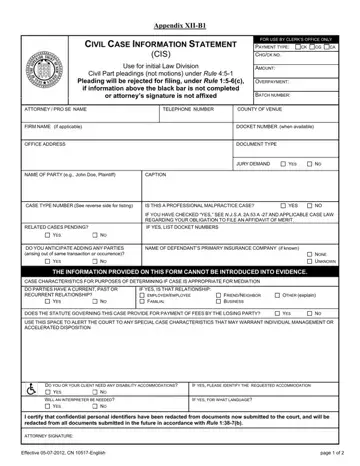
The Civil Case Information Statement (CIS) is a mandatory New Jersey court form that must accompany all initial Law Division Civil Part pleadings, including complaints, counterclaims, and cross-claims. The form is governed by Rule 4:5-1. Failure to properly complete the CIS results in rejection of the pleading by the court clerk under Rule 1:5-6(c).

Both attorneys and self-represented litigants, known as pro se litigants, must complete the CIS. Filing requirements are published by the New Jersey Courts Civil Division. Attorneys provide their name, bar number, firm name, and contact information. Pro se litigants enter their own details in the attorney fields. The form must be signed by the filing party to certify the accuracy of the information provided.

After the initial pleading and CIS are accepted for filing, the court clerk assigns a docket number and routes the case to the appropriate courthouse division. The CIS information is used at this stage to place the case on the correct discovery track. Cases on Tracks I, II, and III receive a standard scheduling order. Track IV cases are assigned to a complex litigation judge who sets a customized discovery and trial schedule at an early case management conference.

The case category on the CIS also determines whether early intervention is scheduled. Cases involving multiple parties, related litigation in other courts, or significant insurance coverage disputes may be called for a conference before discovery begins. At that conference, the assigned judge reviews the CIS, resolves any contested track designations, and issues the initial scheduling order for the case.

The CIS collects detailed information about the nature of the case. The form covers a broad range of civil action types, including:

When professional malpractice is alleged, the form requires confirmation that an affidavit of merit has been filed as required under N.J.S.A. 2A:53A-27. The CIS also asks whether a jury trial is being demanded and the dollar amount of damages claimed.

New Jersey courts assign each case to one of four discovery tracks based on the complexity of the litigation. Track I provides up to 150 days of discovery for straightforward cases. Track II is the standard civil track and provides 300 days. Track III covers complex litigation with up to 450 days. Track IV provides active judicial case management for the most demanding matters, including environmental litigation and mass torts, with discovery timelines set by the assigned judge. Selecting the right track early avoids costly case management disputes later in the litigation.

The CIS also captures special case characteristics. The form asks whether the case requires mediation, whether individual case management is needed, and whether the case qualifies for accelerated disposition. It also asks whether related cases are pending in other courts, whether additional parties may be joined, and whether primary insurance coverage applies to the claim. Disability accommodations and interpreter needs are also noted on the form.

Some civil actions require disclosures beyond the standard CIS fields. Mass tort cases must identify the specific tort cluster. Environmental cases must note whether the site or substance is subject to a state or federal remediation program. Commercial cases may qualify for the Special Civil Part Business Court if the parties consent. Attorneys with cases that may qualify for specialized programs should review the applicable court rules before completing the CIS.

If your case involves a claim subject to the New Jersey Tort Claims Act or any other statutory notice requirement, that notice must be served before the initial pleading is filed. The CIS does not substitute for any pre-suit notice. The court clerk cannot waive or extend notice deadlines based on the CIS alone. Consult counsel or review the applicable statute before filing if you are unsure whether a pre-filing notice applies to your case.

A required certification confirms that all confidential personal identifiers, including Social Security numbers and financial account numbers, have been redacted from all documents submitted to the court. This certification is required under Rule 1:38-7(b) to protect sensitive personal information from public disclosure. Failure to include this certification is grounds for rejection.

Other forms often filed at the start of a New Jersey civil action include the New Jersey Civil Form, the Summons and Complaint Form, and the Civil Case Information Sheet.

QuestionAnswer
Form NameCase Information Statement
Form Length2 pages
Fillable?No
Fillable fields0
Avg. time to fill out30 sec
Other namescivil nj jersey, nj form statement, superior court of new jersey civil case information statement, nj cis

How to Edit Case Information Statement Online for Free

This page includes a PDF editor that allows you to complete the CIS form directly in your browser without downloading any software or creating an account. The editor supports text entry, field highlighting, content removal, and document export. Once all sections are complete, you can save the finished file to your device or send it to an email address.

Steps to Complete Your CIS Online

Completing the case information statement nj through our PDF editor takes just a few minutes. The steps below walk you through the entire process from start to finish.

Step 1: Click the orange "Get form now" button on this page. The form opens in our online editor right away. No software installation is required.

Step 2: Use the toolbar to enter your information. You can add text, erase content, highlight fields, or adjust any entry already in the document. The editor supports all standard editing actions.

step 1 to filling out civil nj court

Step 3: Complete the case characteristics section. Enter the relationship between the parties, note any governing statute, and add any court notifications that apply to your situation.

Finishing civil nj court stage 2

Step 4: Identify the correct discovery track. Choose Track I (up to 150 days) for straightforward matters, Track II (up to 300 days) for standard civil litigation, Track III (up to 450 days) for complex cases, or Track IV for matters requiring active judicial case management. Mark only the track that fits your case.

Filling in civil nj court stage 3

Step 5: Complete the remaining fields covering class action status, applicable titles, and the effective date of the pleading.

Finishing civil nj court step 4

Step 6: Click the Done button when all sections are complete. You can download the finished form to your device or send it to an email address. Keep a copy for your own records as a safeguard in case questions arise during the case.

Frequently Asked Questions About the CIS

What is the Case Information Statement?

The Case Information Statement is a court form required by New Jersey Rule 4:5-1 for all initial pleadings in the Law Division Civil Part. It provides the court with the essential details needed to categorize the case, assign a discovery track, and identify any special management requirements. Without a properly completed CIS attached to the filing, the court clerk will return the document unfiled.

Who must file the CIS?

Any person filing an initial pleading in the NJ Law Division Civil Part must submit the CIS. This includes attorneys representing clients and pro se litigants who are representing themselves. The CIS is not required for motions. It is only required for the initial pleadings that open a case, such as complaints, counterclaims, and cross-claims.

What happens if the CIS is not filed correctly?

The court clerk will reject the pleading under Rule 1:5-6(c). The filing is returned to the attorney or pro se litigant without being accepted. The case cannot move forward until the complete filing package, including a properly completed CIS, is resubmitted. Errors in the form, such as a missing signature or an incorrect case category, can also result in rejection. If the same filing is returned a second time for CIS deficiencies, the judge may schedule a status conference to address the compliance issue directly.

What are the four discovery tracks?

Track I covers straightforward cases with up to 150 days of discovery. Track II is the standard track for most civil actions and allows up to 300 days. Track III is for complex cases and provides up to 450 days. Track IV involves active judicial oversight for the most demanding matters, such as mass torts, environmental cases, and complex commercial litigation. Each track has different timelines and management expectations, so choosing the right one at the start affects how quickly a case moves through the court system.

Can the CIS be amended after filing?

Yes. If case circumstances change after the initial filing, the CIS can be updated. For example, if new parties are added or the case type designation changes, the filing party should notify the court and submit an amended form. The court uses the information on the CIS throughout pre-trial proceedings, so keeping it current is important.

When is the CIS not required?

The CIS is required only for initial pleadings that open a new case in the New Jersey Law Division Civil Part. It is not required for motions, appeals, or post-complaint filings of any kind. If you are filing a motion in a pending case, do not attach the CIS. The form applies only to the pleadings that establish a new docket number, not to subsequent filings within an existing case.

What information does the attorney section require?

Attorneys must enter their full name, law firm name, mailing address, daytime phone number, and New Jersey bar identification number. The bar number is printed on the attorney's bar card and is also available through the New Jersey Judiciary. The signature on the CIS certifies that all information in the form is accurate and that the filing complies with applicable court rules. Attorneys who have changed firms or addresses should update their contact information before signing the form, because the clerk uses the CIS contact details for all case-related correspondence.

How do I identify the correct case category?

The CIS lists the major civil action types recognized by the New Jersey Law Division. Read your complaint carefully and select the category that describes the primary cause of action. If the complaint asserts more than one theory of liability, select the category that covers the dominant claim. An incorrect category can delay initial case management, but it is a correctable error. Contact the clerk's office or review Rule 4:5-1 if you are uncertain which category applies to your specific pleading.

What does checking the jury trial box on the CIS mean?

Checking the jury trial box asserts the right to have the case decided by a jury rather than a judge sitting alone. This demand is made under New Jersey Court Rule 4:35-1, which permits a party to demand a jury trial in writing at or near the time the initial pleading is filed. The CIS is a recognized vehicle for making that demand. If the jury trial box is not checked and no separate demand is filed on time, the court may treat the case as a bench trial. Both parties can also agree in writing to waive a jury demand after the case is filed.

What is the affidavit of merit and when is it required?

An affidavit of merit is a signed statement from a licensed professional in the same field as the defendant, confirming that the defendant's conduct fell below the applicable standard of care. Under N.J.S.A. 2A:53A-27, this affidavit is required in malpractice actions against licensed professionals, including physicians, nurses, attorneys, engineers, and architects. The affidavit must be served within 60 days of the filing of the defendant's answer, unless the court grants an extension. When the CIS indicates a malpractice claim, the court expects a corresponding affidavit to be filed within the required window. Failure to serve the affidavit on time can result in dismissal of the malpractice counts.

Can I complete the CIS without an attorney?

Yes. Self-represented filers, called pro se litigants, must complete the CIS using their own name and contact information in the fields labeled for attorney use. The form instructions accommodate pro se filers by noting that the attorney signature line may be signed by the litigant personally. Courts hold pro se filers to the same procedural requirements as attorneys, including the requirement to attach a completed CIS to every initial pleading filed in the Law Division Civil Part.

What does the personal identifier certification mean?

Before submitting documents to the court, every page must be reviewed for sensitive personal information. Rule 1:38-7(b) requires that Social Security numbers, financial account numbers, dates of birth, driver's license numbers, and home addresses be removed or blacked out before filing. The certification checkbox on the CIS confirms that this review has been completed. Submitting documents with unredacted personal identifiers can result in the filing being stricken from the public record and may expose the filer to sanctions.

What is the difference between Track I and Track II?

Track I is intended for cases that do not require extensive discovery. It allows up to 150 days, making it appropriate for matters with limited witnesses, straightforward liability questions, and modest damages. Track II is the default track for most civil actions and allows up to 300 days of discovery. Cases with disputed liability, multiple expert witnesses, or significant damages are generally better suited for Track II. When in doubt, filing parties often request Track II to avoid an early discovery cutoff that could limit the development of the evidentiary record before trial.

Who decides the final discovery track assignment?

Both parties select a preferred discovery track on the CIS, but the assigned judge has final authority to place the case on the track that best fits its actual complexity. If the parties disagree about the appropriate track, the judge may convene an early case management conference to resolve the dispute. Courts may also reclassify a case to a higher track during litigation if the case develops into a more complex matter than the original CIS indicated. Attorneys who believe the assigned track is inappropriate may file a motion to modify the discovery schedule. Unilateral deviations from the assigned track are not permitted without court approval.

See also the New Jersey Civil Form and the NJ Family Court Motion form for related New Jersey court filings.

Please rate Case Information Statement

1 Votes
If you believe this page is infringing on your copyright, please familiarize yourself with and follow our DMCA notice and takedown process - click here to proceed .