
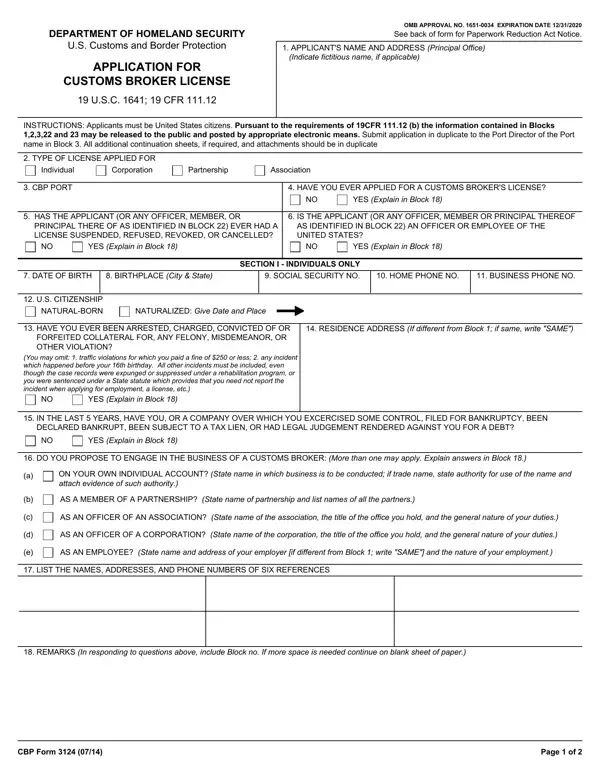
CBP Form 3124 is the official Application for a Customs Broker License issued by U.S. Customs and Border Protection (CBP) under the authority of 19 U.S.C. 1641 and 19 CFR 111.12. Any individual or business entity that intends to transact customs business on behalf of importers in the United States must obtain a customs broker license by submitting this application and meeting all CBP eligibility requirements.
You must complete the customs broker license application if you are an individual seeking a personal license, or if you represent a partnership, corporation, or association applying for an entity-level broker's license. Individual applicants must be U.S. citizens, at least 21 years of age, and must not have been convicted of a felony. Corporations, partnerships, and associations applying for a license are required to designate at least one individually licensed customs broker to supervise all customs business activities conducted on behalf of the entity. Each type of applicant has specific sections within the form tailored to their organizational structure.
The form is organized into three main sections. Section I collects personal biographical data, employment history, previous applications for a customs broker's license in any CBP district, and any criminal background that could affect the applicant's eligibility. This section applies to all types of applicants. Section II requires full financial disclosures, including any history of bankruptcy or outstanding federal or state tax liens that might raise questions about the applicant's financial reliability. Section III contains the certification and signature block confirming that all information in the application is complete, true, and accurate to the best of the applicant's knowledge. This must be signed by the individual applicant or by a qualified officer in the case of a corporate or association applicant.
Individual applicants must pass the Customs Broker License Examination (CBLE) before CBP will issue a personal broker's license. The CBLE is administered twice each year by CBP and covers U.S. customs law, regulations, entry procedures, tariff classification, and trade compliance requirements. After passing the examination and submitting a complete CBP Form 3124, CBP conducts a background investigation. Applicants who meet all criteria receive a license that is valid nationwide. A separate district permit must be obtained from each port where the broker plans to conduct business.
The form includes Privacy Act and Paperwork Reduction Act notices, which inform applicants about how CBP collects and uses their personal information. The OMB approval number and the form's expiration date are printed on the document to confirm its current legal authority. Applicants are reminded that providing false or misleading information on this application is a federal offense and can result in denial of the license, revocation of an existing license, and criminal penalties.
Customs brokers and importers regularly work with other CBP forms alongside the license application. The CBP Form 3078 is the application for a customhouse cartman or lighterman license. The CBP Form 3171 is used for customs entry and manifest procedures at U.S. ports. For standard customs declarations at ports of entry, importers file the CBP Form 6059B. Brokers coordinating freight transportation may also use the Broker Carrier Agreement Form to define terms with carriers.
| Question | Answer |
|---|---|
| Form Name | Cbp Form 3124 |
| Form Length | 2 pages |
| Fillable? | No |
| Fillable fields | 0 |
| Avg. time to fill out | 30 sec |
| Other names | cbp application license, form customs broker, form application customs broker, cbp form application |