
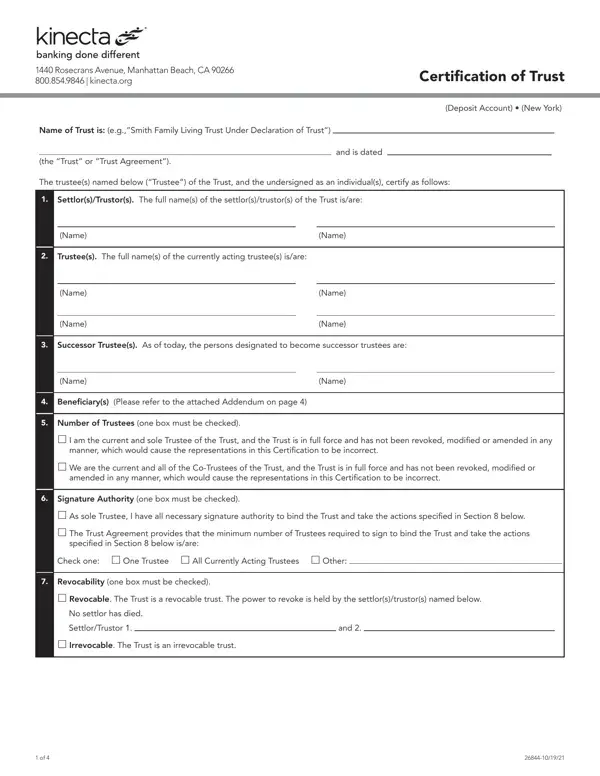
A certification of trust is a condensed version of a trust agreement that verifies the trust's validity without disclosing private details about assets or distributions. Trustees present this document to banks, brokerages, and title companies when they need to open accounts, transfer real estate, or conduct other transactions on behalf of the trust. The form typically runs 2 to 4 pages and covers the trust name, the date it was created, the names of all current trustees, and whether the trust is revocable or irrevocable.
Most financial institutions accept a certification of trust in place of the full trust document. This protects the privacy of beneficiaries and the specifics of asset distribution while still giving third parties enough legal assurance to proceed. Under California Probate Code Section 18100.5, any person who receives this certification in good faith may rely on it without demanding the full trust instrument. A third party who refuses to accept a valid certification may be held liable for resulting damages, including attorney fees.
Several common situations call for a certification of trust. Banks require it when you open a checking, savings, or investment account in the name of the trust. Title companies ask for it during real estate closings where the property is held in or being transferred to a trust. Insurance companies and retirement plan custodians may also request one when you name a trust as beneficiary or change ownership of a policy. Brokerage firms ask for it before allowing a trustee to trade securities or manage investment portfolios on behalf of the trust. Any time a third party needs proof that the trust exists and that you have authority to act on its behalf, this form is the standard way to provide it.
The certification identifies the trust by its full legal name and the date it was originally executed. It names every current trustee and, in some versions, lists successor trustees who would step in if a current trustee dies or becomes incapacitated. If you need to formally name a new successor, the appointment of successor trustee form is the appropriate document for that step. The form also specifies the number of trustees, their collective or individual signature authority, and whether the trust is revocable (can be changed or dissolved by the settlor) or irrevocable (cannot be altered without beneficiary consent). Some versions include the trust's tax identification number and a list of the powers granted to the trustee, such as the ability to buy and sell property, open financial accounts, and borrow money on behalf of the trust.
A common question is why not simply hand over a copy of the full trust agreement. The answer comes down to privacy. A complete trust document contains detailed information about every asset held in the trust, the distribution plan for beneficiaries, and any special provisions the settlor included. Sharing that information with a bank teller or title agent is unnecessary and exposes private family financial details. A certification of trust solves this by giving the third party only what they need: confirmation that the trust is real, who manages it, and what authority those managers have. For a slightly different format that some lenders accept interchangeably, see the certificate of trust template. Both documents serve the same purpose, but the specific format required depends on the institution and the state.
The form must be signed by all acting trustees and notarized by a licensed notary public. The notary verifies each trustee's identity through government-issued photo identification and confirms they signed voluntarily. Without notarization, most financial institutions will not accept the document. The trustees sign under penalty of perjury, affirming that every statement in the certification is true and that the trust has not been revoked, amended in a way that contradicts the certification, or terminated. If any information on the certification changes after it is filed, the trustees are responsible for providing an updated version to all parties who relied on the original.
The most frequent error is entering the trust name incorrectly. Even a minor difference between the name on the certification and the name in the original trust agreement can cause a bank or title company to reject the document. Always copy the trust name directly from the first page of the trust agreement. Another common mistake is selecting the wrong signature authority. If the trust agreement requires all trustees to sign together but the certification states that any one trustee can sign alone, the institution may process unauthorized transactions. Failing to update the certification after an amendment is also a problem, because the document then misrepresents the trust's current terms. Trustees should file a new certification whenever the trust agreement is amended, a trustee is added or removed, or the trust's revocability status changes.
There is no fixed expiration date written into the form itself. However, many banks and financial institutions set their own internal policies requiring a certification that was signed within the last 12 to 24 months. Some institutions accept a certification of any age as long as the trustee confirms in writing that no amendments have been made since it was signed. Before submitting the document, check with the requesting institution to find out whether they have a recency requirement. If your certification is more than two years old, consider signing a new one to avoid delays. The cost of notarization for an updated certification is typically between 5 and 15 dollars per signature, depending on the state.
The revocability status on the certification affects how third parties handle the trust's assets. A revocable trust allows the settlor to modify or dissolve the trust at any time during their lifetime. Banks treat revocable trusts similarly to personal accounts, because the settlor retains full control. An irrevocable trust, by contrast, cannot be changed or terminated without the consent of the beneficiaries. Financial institutions apply stricter rules to irrevocable trusts, often requiring additional documentation before approving transactions. On the certification, the trustee checks the appropriate box (revocable or irrevocable) and confirms that this status has not changed since the trust was established or last amended. Misrepresenting the revocability status can lead to legal liability and unauthorized account activity.
| Question | Answer |
|---|---|
| Form Name | Certification Of Trust Form |
| Form Length | 4 pages |
| Fillable? | No |
| Fillable fields | 0 |
| Avg. time to fill out | 1 min |
| Notarization required | Yes |
| Applicable law | California Probate Code 18100.5 |
| Other names | ca probate code 18100 5, wells fargo certificatin of trust, certification of trust wells fargo, certification of trustee form wells fargo |
Certification Of Trust Form isn’t the one you’re looking for?