
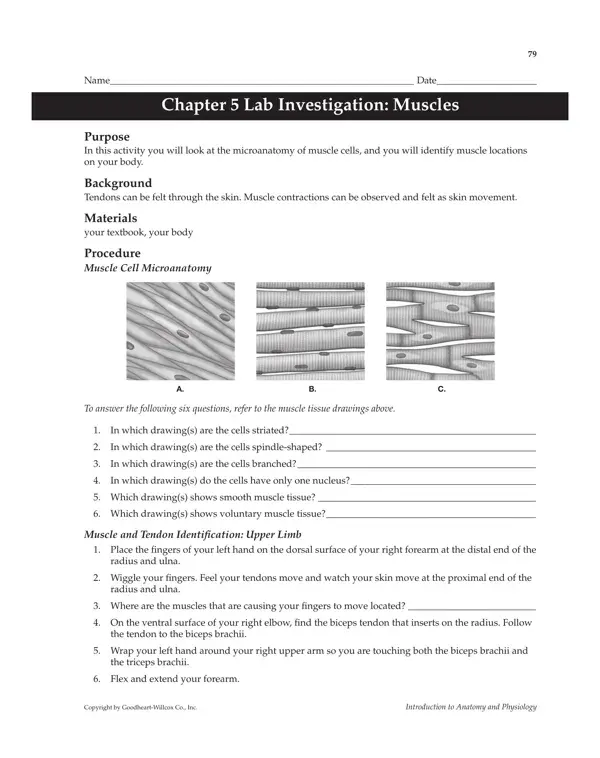
The intricate workings of human muscles and tendons come alive in the Chapter 5 Lab Investigation Muscles form, an engaging and educational journey into the microanatomy of muscle cells alongside a hands-on exploration of muscle locations on the body. Through a series of questions and physical tasks, participants use their textbook and their own bodies as the primary materials for discovery. The form guides learners through identifying different types of muscle cells based on characteristics such as striation, shape, and the presence of nuclei.
A core part of this investigation focuses on the three main types of muscle tissue: skeletal, smooth, and cardiac. Students identify which drawings show smooth muscle cells and which show voluntary muscle action. Skeletal muscle tissue, which makes up the large muscle groups that support and protect the body, is striated and voluntary in nature. Smooth muscle tissue lines the walls of internal organs and is involuntary. Cardiac muscle, found only in the heart, shares features of both skeletal and smooth tissue. Understanding these specific differences in muscle tissue helps students build a solid base in human anatomy and biology.
The lab investigation guides students through a set of hands-on activities designed to identify key muscles and tendons in the upper and lower limbs and the head. Participants locate the biceps brachii, sternocleidomastoid, and Achilles tendon by performing simple movements such as flexing the forearm, rotating the head, or contracting the lower leg muscles. These activities help students understand where various muscle groups insert, how they function, and what physical forces cause them to move.
This process of locating and palpating real muscles provides a learning experience that textbooks alone cannot match. By using their own bodies as a reference, students gain a specific understanding of how muscles support, protect, and move the skeletal frame. Each activity builds on the previous one, creating a structured path from simple identification to complex analysis.
The final portion of the form asks students to draw conclusions about muscle contractions and movements. Questions probe the relationship between the nervous system signal and the resulting muscle action, including which muscles cause the fingers to flex and extend and how muscles on opposite sides of a joint work together. Students also examine how different muscle groups protect joints and organs, and how the size and arrangement of muscle fibers relate to the force and range of motion they produce.
This investigation provides a medical-level understanding of human movement and anatomy in a biology classroom setting. It connects theoretical information about muscle tissue to real-world body functions, offering students the information needed to understand how muscles rotate limbs, support posture, and respond to signals from the nervous system. The form is a valuable tool for learning about the muscular system in a structured, engaging way.
| Question | Answer |
|---|---|
| Form Name | Chapter 5 Lab Investigation Muscles Form |
| Form Length | 2 pages |
| Fillable? | No |
| Fillable fields | 0 |
| Avg. time to fill out | 30 sec |
| Other names | chapter 5 lab investigation muscles answers, chapter 5 lab investigation muscles, introduction to anatomy and physiology chapter 5 lab investigation muscles answer key, chapter 5 lab investigation muscles answers key |
Chapter 5 Lab Investigation Muscles Form isn’t the one you’re looking for?