
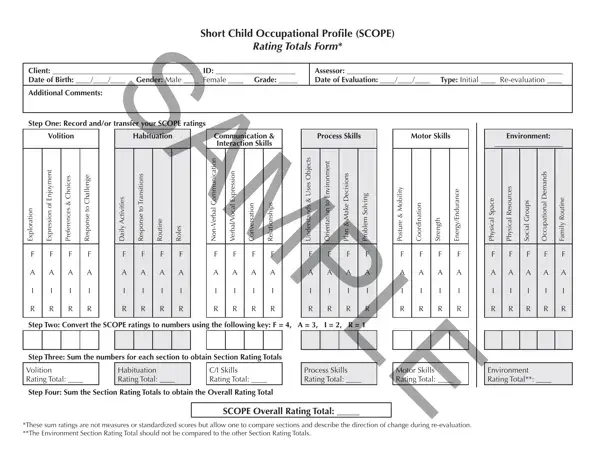
The Child Occupational Self Assessment (COSA) is a self-report instrument developed within the Model of Human Occupation (MOHO), a theory of occupational therapy created by Gary Kielhofner and colleagues. Designed for youth ages 6 to 17, the COSA invites children to rate their competence in everyday activities and the personal importance of those activities. Therapists use this evaluation to set therapy goals and track progress over time.
The assessment contains 25 items spanning four performance areas: Volition (motivation and personal values toward activities), Habituation (daily routines and roles at school and home), Communication and Social Skills (peer interactions and community participation), and Process and Motor Skills (cognitive and physical task performance). For each item, a child selects a competence rating ranging from "I have a lot of trouble doing this" to "I am really good at doing this," plus an importance rating on a three-point scale.
Research by Kramer and Federico provides evidence of strong construct validity for the COSA as an occupational therapy evaluation instrument. The COSA manual provides detailed administration guidelines, and version 2.2 was updated by Ten Velden and Kielhofner. The non-standardized score totals serve to identify where changes are occurring, guiding therapy interventions tailored to each child's needs. Download the Occupational Therapy Referral Checklist for additional therapy intake documentation.
| Question | Answer |
|---|---|
| Form Name | Child Occupational Self Assessment (COSA) Form |
| Target Age Range | Youth ages 6 to 17 |
| Assessment Type | Self-report occupational therapy evaluation instrument |
| Theory Base | Model of Human Occupation (MOHO) by Gary Kielhofner |
| Current Version | COSA 2.2, updated by Ten Velden and Kielhofner |
| Form Length | 1 page |
| Fillable? | No |
| Avg. time to complete | 15 minutes |
| Other names | COSA assessment, occupational self assessment, Short Child Occupational Profile (SCOPE), self assessment cosa, cosa self report |
Child Occupational Self Assessment Form isn’t the one you’re looking for?