
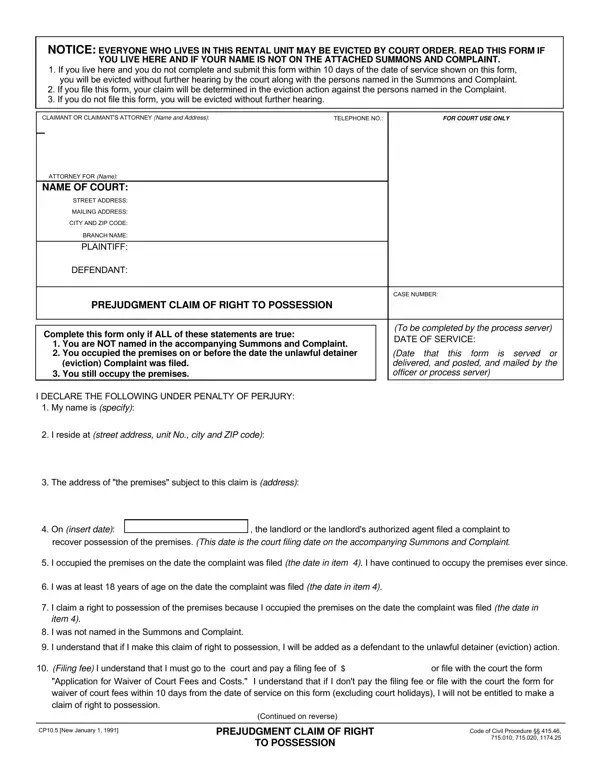
In situations where residents of a rental unit face the possibility of eviction, understanding the legal protections and processes available is crucial. The Prejudgment Claim of Right to Possession form serves as a vital tool for individuals who find themselves in this precarious position but were not named in the eviction summons and complaint originally filed with the court. This document allows a person who is living in a property subject to an eviction lawsuit, yet not officially named in the lawsuit, to assert their right to remain on the premises. To avoid eviction without a court hearing, it is imperative for these occupants to complete and submit the form within a specific timeframe, usually within 10 days from when the form was served. This submission not only informs the court of their presence and assertion of right to the property but also includes them in the eviction proceeding, where their right to possession will be adjudicated alongside the original defendants named in the lawsuit. Additionally, the form outlines the need for either a filing fee or an application for a waiver of those fees to be submitted, emphasizing the urgency and procedural requirements for those wishing to assert their rights under the law. Failure to act within the specified period results in the occupants' eviction by court order, without further hearing.
You need to file the CP10 form if you are living in a rental property that is subject to an eviction lawsuit, but your name is not listed on the original eviction summons and complaint. This commonly applies to subtenants, adult family members, roommates, or any occupant who resides at the property under a California lease agreement but was not listed as a named defendant. If you received a 3-day notice to vacate or a pay or quit notice, and your name does not appear on the related unlawful detainer lawsuit, filing this form is your only opportunity to be heard in court before an eviction order is issued against all occupants.
To assert your right to possession, submit the completed CP10 form to the court before the 10-day deadline. You must also include a filing fee (which varies by county) or a completed fee waiver application. Attach any documentation that confirms you reside at the property, such as a copy of your rental agreement, a utility bill, or mail addressed to you at that address. Once the court receives your filing, it will schedule a hearing where you can present your case alongside the other named defendants.
What happens if I do not file in time?
If you fail to file the form within the required window, the court can issue an eviction order that covers all occupants of the property. You lose the right to a hearing and cannot contest the eviction, even if you have valid legal grounds to remain.
Can I file after the deadline?
Courts typically enforce the 10-day filing window strictly. If you missed the deadline, contact a legal aid organization or tenant advocacy group right away to determine whether any further options remain available to you.
Do I need an attorney?
You are not required to hire an attorney to file the form, but legal guidance is strongly recommended given the serious consequences of an eviction order. Many California courts provide free self-help resources for tenants who choose to represent themselves.
| Question | Answer |
|---|---|
| Form Name | Claim Of Right To Possession Form |
| Form Length | 2 pages |
| Fillable? | Yes |
| Fillable fields | 1 |
| Avg. time to fill out | 42 sec |
| Other names | affidavit of adverse possession, adverse possession california, adverse possession forms, sample affidavit of adverse possession form |
Claim Of Right To Possession Form isn’t the one you’re looking for?