
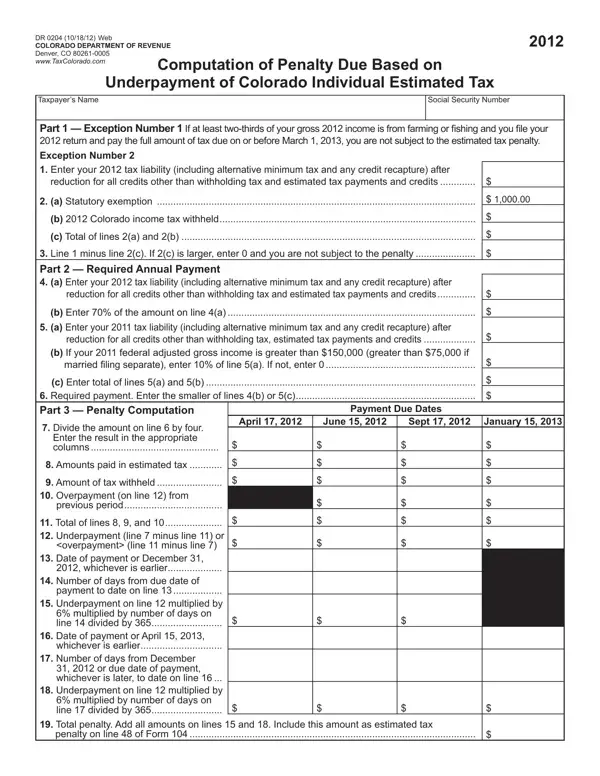

Form DR 0204 at a glance
What it is: Form DR 0204 is the Computation of Penalty Due Based on Underpayment of Colorado Individual Estimated Tax from the Colorado Department of Revenue.
Part 1: Generally you are subject to an estimated tax penalty if your current year estimated tax payments are not paid in a timely manner. The estimated tax penalty will not be assessed if either of the exceptions are met.
A filled-in Form DR 0204 example: a filer owes no penalty
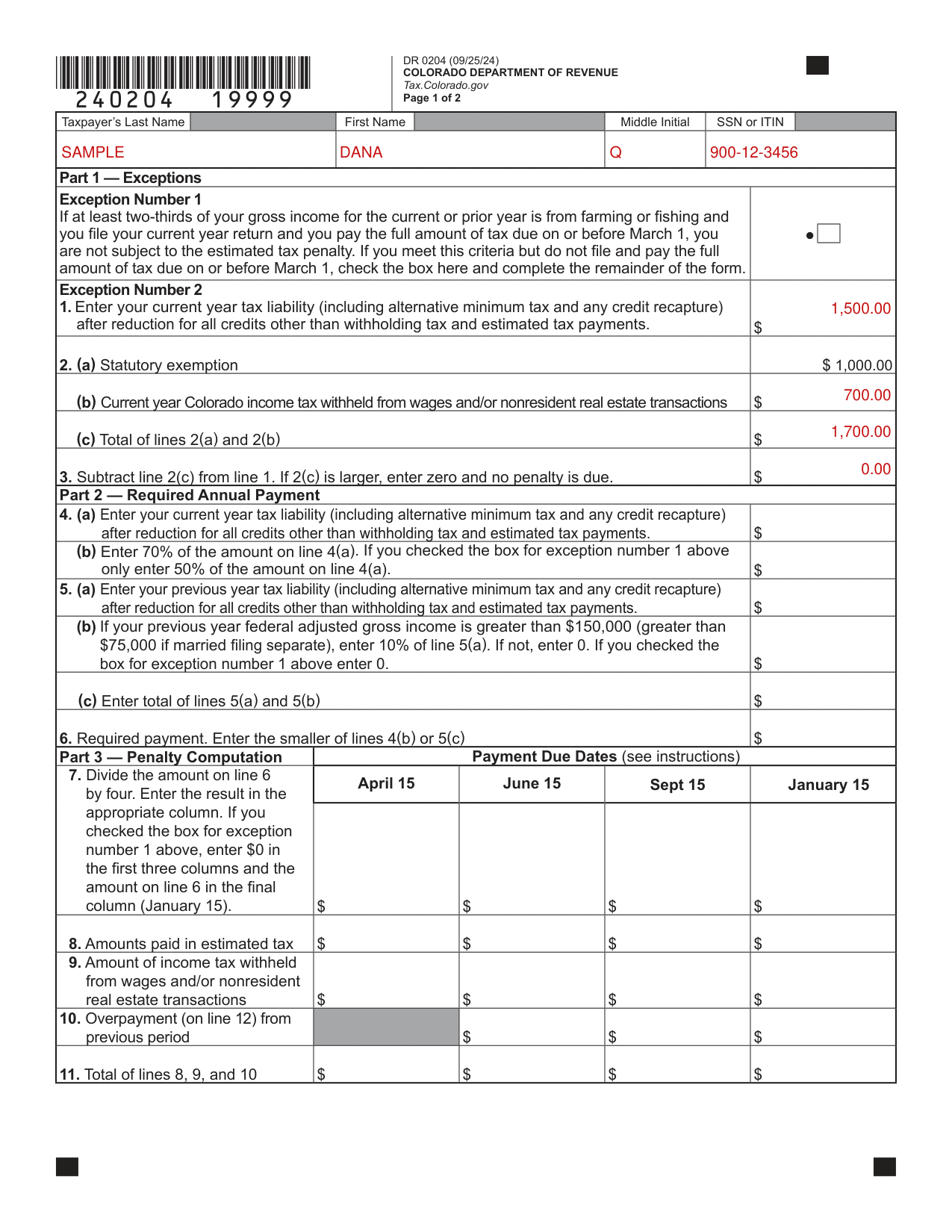
How to fill out Form DR 0204, box by box
Taxpayer's Last Name, First Name, Middle Initial and SSN or ITIN

Enter the Taxpayer's Last Name, First Name, Middle Initial and SSN or ITIN.
Part 1 - Exceptions: Exception Number 1

Exception Number 1: If at least two-thirds of your gross income for the current or prior year is from farming or fishing and you file your current year return and you pay the full amount of tax due on or before March 1, you are not subject to the estimated tax penalty. If you meet this criteria but do not file and pay the full amount of tax due on or before March 1, check the box here and complete the remainder of the form.
Part 1 - Exceptions: Exception Number 2
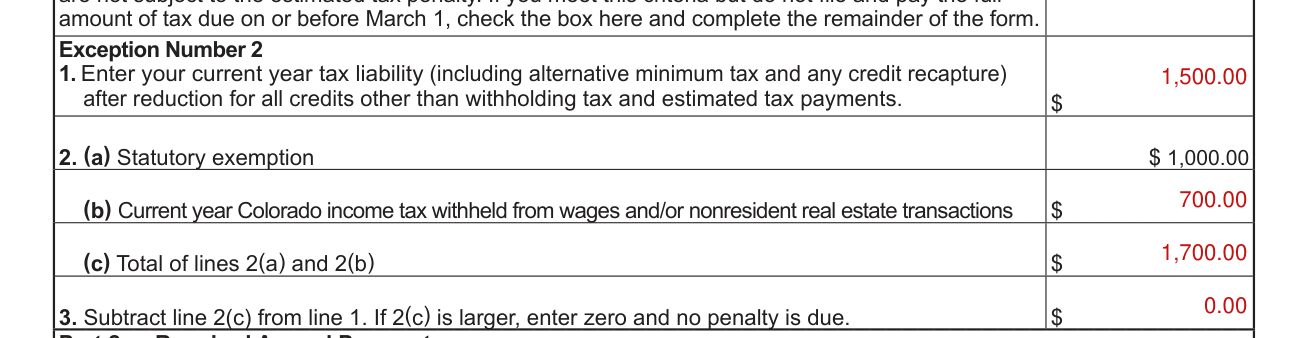
Exception Number 2. On line 1, enter your current year tax liability (including alternative minimum tax and any credit recapture) after reduction for all credits other than withholding tax and estimated tax payments.
Line 2(a) is the Statutory exemption of $ 1,000.00 (checked November 2, 2026). On line 2(b), enter the current year Colorado income tax withheld from wages and/or nonresident real estate transactions. On line 2(c), enter the total of lines 2(a) and 2(b).
On line 3, subtract line 2(c) from line 1. If 2(c) is larger, enter zero and no penalty is due. Part 2 - Required Annual Payment, line 4.
Part 2 - Required Annual Payment
The required annual amount to be paid is the lesser of: 70% of actual current year net Colorado tax liability, or 100% of preceding year's net Colorado tax liability, or 110% of preceding year's net Colorado tax liability. The 100% amount only applies if the preceding year was a 12-month tax year, and the individual filed a Colorado return, and the federal adjusted gross income for the preceding year was $150,000 or less, or $75,000 or less if married filing separate (checked November 2, 2026). The 110% amount only applies if the preceding year was a 12-month tax year and the individual filed a Colorado return.
On line 4(a), enter your current year tax liability (including alternative minimum tax and any credit recapture) after reduction for all credits other than withholding tax and estimated tax payments. On line 4(b), enter 70% of the amount on line 4(a). If you checked the box for exception number 1 only enter 50% of the amount on line 4(a).
On line 5(a), enter your previous year tax liability (including alternative minimum tax and any credit recapture) after reduction for all credits other than withholding tax and estimated tax payments. On line 5(b), if your previous year federal adjusted gross income is greater than $150,000 (greater than $75,000 if married filing separate), enter 10% of line 5(a) (checked November 2, 2026). If not, enter 0. If you checked the box for exception number 1 enter 0.
Enter total of lines 5(a) and 5(b) on line 5(c).
On line 6, Required payment, enter the smaller of lines 4(b) or 5(c). Part 3 - Penalty Computation, Payment Due Dates (see instructions), line 7.
Part 3 - Penalty Computation
If no exception applies to you, compute your penalty on lines 7 through 19 of DR 0204. Complete each column before going on to the next column. Allocate estimated tax payment on line 8. The amount entered on line 10 is the net overpayment from the preceding period. On line 17, if the payment was made prior to January 1 enter "0." If the tax return is filed and any tax due is paid by January 31 no penalty will be computed in column four. Estimated tax payments from a farmer or fisherman are due in a single payment by January 15 and only column four is used to compute the penalty. If the due date falls on a weekend or legal holiday, payment will be due the next business day.
Under Part 3 - Penalty Computation, Payment Due Dates (see instructions), on line 7, divide the amount on line 6 by four (line 6 is the smaller of lines 4(b) or 5(c)). Enter the result in the appropriate column. If you checked the box for exception number 1, enter $0 in the first three columns and the amount on line 6 in the final column (January 15) (checked November 2, 2026).
Line 8 is Amounts paid in estimated tax. Line 9 is Amount of income tax withheld from wages and/or nonresident real estate transactions. Line 10 is Overpayment (on line 12) from previous period. Line 11 is Total of lines 8, 9, and 10.
Line 12 is Underpayment (subtract line 11 from line 7) or
Line 15 is Underpayment on line 12 multiplied by 11% multiplied by number of days on line 14 divided by 365 (366 for leap year). Line 16 is Date of payment or April 15, whichever is earlier. Line 17 is Number of days from December 31, or due date of payment, whichever is later, to date on line 16. Line 18 is Underpayment on line 12 multiplied by 12% multiplied by number of days on line 17 divided by 365 (366 for leap year).
Total penalty: add all amounts on lines 15 and 18. Include this amount as estimated tax penalty on line 43 of form DR 0104. Part 4 - Annualized Installment Method Schedule, line 20.
Part 4 - Annualized Installment Method Schedule
Taxpayers who do not receive income evenly during the year may elect to use the annualized income installment method to compute their estimated tax payments if they elect annualized installments for the payment of their federal income tax. Complete the annualized installment method schedule to compute the amounts to enter on line 7.
More rules for Form DR 0204
This form should be included with your completed DR 0104 form.
Sources
[1] Form DR 0204 (09/25/24), Computation of Penalty Due Based on Underpayment of Colorado Individual Estimated Tax, Colorado Department of Revenue (the Official source link on this page).