
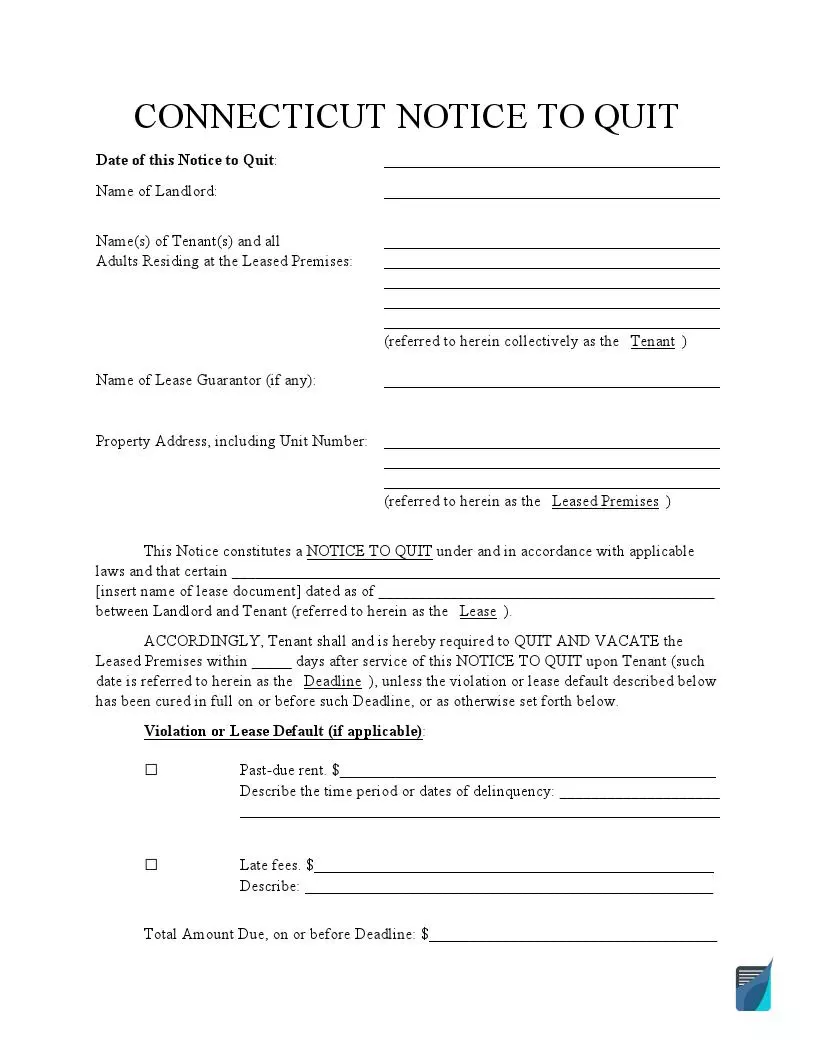
A Connecticut eviction notice is a written notice a landlord serves on a tenant to end the tenancy for nonpayment of rent, a lease violation, or without cause. Connecticut law calls it a notice to quit possession or occupancy, and the tenant must get it at least three days before the date to move out.
Last Updated: September 2026. This guide is reviewed and updated regularly to reflect current Connecticut law. If you notice an error or outdated information, please contact us.
Build Your Document
Answer a few simple questions to make your document in minutes
Save and Print
Save progress and finish on any device, download and print anytime
Sign and Use
Your valid, lawyer-approved document is ready
Landlords use this notice most often when a tenant is behind on rent or has broken a lease term. The notice itself does not remove the tenant. If the tenant does not pay, fix the problem, or move out by the date given, the landlord must then file a summary process case in court for a judgment of possession.
Connecticut eviction law lives mostly in Title 47a, Chapter 832 of the Connecticut General Statutes. Before going to court, a landlord must give the tenant a written notice to quit possession or occupancy. The minimum notice period is three days before the move-out date, whether the reason is nonpayment of rent or a lease violation.[1.1]
Connecticut’s notice to quit possession or occupancy is also called a notice to vacate or an eviction notice. All three names refer to the same written notice a landlord serves before filing an eviction case in court.
State law sets out what the written notice must include, substantially in the form the statute prints.[1.2]
The statute’s own form reads:
"I (or we) hereby give you notice that you are to quit possession or occupancy of the (land, building, apartment or dwelling unit, or of any trailer or any land upon which a trailer is used or stands, as the case may be), now occupied by you at (here insert the address, including apartment number or other designation, as applicable), on or before the (here insert the date) for the following reason (here insert the reason or reasons for the notice to quit possession or occupancy using the statutory language or words of similar import, also the date and place of signing notice)."
State law also sets out how the notice must reach the tenant. A copy must be delivered to each tenant or occupant, or left at the tenant’s home or, for commercial property, at the place of business, by a proper officer or an indifferent person. Delivery may happen on any day of the week, including weekends.[1.1] If a subtenant or other occupant also lives at the property, the landlord must serve that person too before a court can grant a judgment for possession against them.[1.10]
A landlord may combine this notice with a termination notice required under federal law, or add a use and occupancy disclaimer, without weakening the notice to quit.[1.1] The disclaimer tells the tenant that any rent accepted after the move-out date is for use and occupancy only, not as new rent, so accepting a late payment does not cancel the eviction.[1.3]
A landlord may not force a tenant out. Connecticut law makes it a crime, called criminal lockout, for a landlord, owner, or their agent to deprive a tenant of access to the unit or their belongings without a court order, even after the notice period ends.[2]
Rent also has a statutory grace period. If rent is unpaid when due and the tenant does not pay within nine days, or within four days for a one-week tenancy, the landlord may terminate the rental agreement under Sections 47a-23 to 47a-23b (Conn. Gen. Stat. § 47a-15a(a)).[3.1]
For a material noncompliance with the rental agreement, the landlord first delivers a written notice that specifies the acts or omissions and states that the rental agreement terminates on a date not less than 15 days after the tenant receives it. If the breach can be remedied by repair or payment of damages and the tenant remedies it within those 15 days, the rental agreement does not terminate (Conn. Gen. Stat. § 47a-15).[3.2]
| Notice for Nonpayment of Rent | At least 3 days before the move-out date.[1.1] |
| Notice for a Lease Violation | At least 3 days before the move-out date.[1.1] |
| Notice Delivery | By a proper officer or indifferent person, any day of the week.[1.1] |
| State Law | Connecticut General Statutes, Chapter 832, Sections 47a-23 to 47a-26h |
Connecticut law sets the same minimum notice period for the two most common reasons a landlord ends a tenancy. The landlord must give the tenant a written notice to quit at least three days before the termination date, whether the notice is for nonpayment of rent or for a lease violation. For a month-to-month or week-to-week tenancy, a notice based on nonpayment ends that rental period once delivered and converts the tenancy to a tenancy at sufferance, even if delivered after the month or week the rent was due.[1.1]
Two narrower rules apply in less common situations.
You can count any of these notice periods with our deadline calculator.
Connecticut recognizes a few eviction notice types, each tied to a different reason for ending the tenancy. Which one applies depends on whether the tenant owes rent, has broken a lease term, or the landlord wants to end a periodic tenancy for no stated cause.
Some Connecticut tenants have added protection from eviction under state law. Where this protection applies, a landlord may end the tenancy only for a reason the statute lists.[1.6]
A landlord renting a unit in a building or complex of five or more units, or in a manufactured home park, must give the tenant written notice of these protections when the tenancy begins or renews. A tenant who claims the protection must provide proof of it within thirty days of the landlord’s request, and any rent increase for a protected tenant must stay fair and equitable under the statutory criteria.[1.6]
Valid eviction process in Connecticut starts with the written notice to quit and follows a strict court timeline if the tenant does not leave.[1.1] A landlord may never remove a tenant without a court order, even after the notice period ends.[2]
Filing an eviction case in Connecticut court means preparing several forms in addition to the notice to quit. The forms below cover the complaint, the tenant’s response, and what happens if the tenant does not respond or does not leave after judgment.
A complaint explains why the case should proceed and why the tenant should leave. Connecticut recognizes two complaint types, one for nonpayment of rent and one for a lapse of time. The landlord files this form to start the case in court.
This form lets the tenant respond to the landlord’s claims in writing.
A tenant files this form together with the answer to tell the court the tenant plans to take part in the case.
If the tenant has not moved out after the notice period, the landlord completes a summons form and files it with the court clerk.
After the landlord wins, execution is stayed for five days, not counting Sundays and legal holidays. If the tenant still has not left, the landlord can get a summary process execution, which a state marshal serves on the tenant. The marshal must give the town 24 hours' notice before the removal (Conn. Gen. Stat. §§ 47a-35 and 47a-42).[1.11]
If a tenant does not follow the terms of a stipulated agreement filed with the court, the landlord uses this form to notify the court of the non-compliance.
If a tenant does not appear or respond in court, the landlord files this motion asking the court to enter judgment, following the process described above.
Popular Local Eviction Notice Forms

General information, not legal or tax advice.
Unless noted otherwise, the sources below are from the Conn. Gen. Stat..
