


DA Form 5304 at a glance
What it is: DA Form 5304 is the Family Care Plan Counseling Checklist.
Who signs: The soldier and the commanding officer (or designated representative) will initial each item on the checklist.
Pregnant soldiers, single parents, and dual-military couples with family members will be counseled in accordance with AR 600-20.
The principal purpose is to emphasize to soldiers the significance of their responsibilities to the military service and their family members while performing required military duties.
A filled-in DA Form 5304 example: a divorced soldier with a child
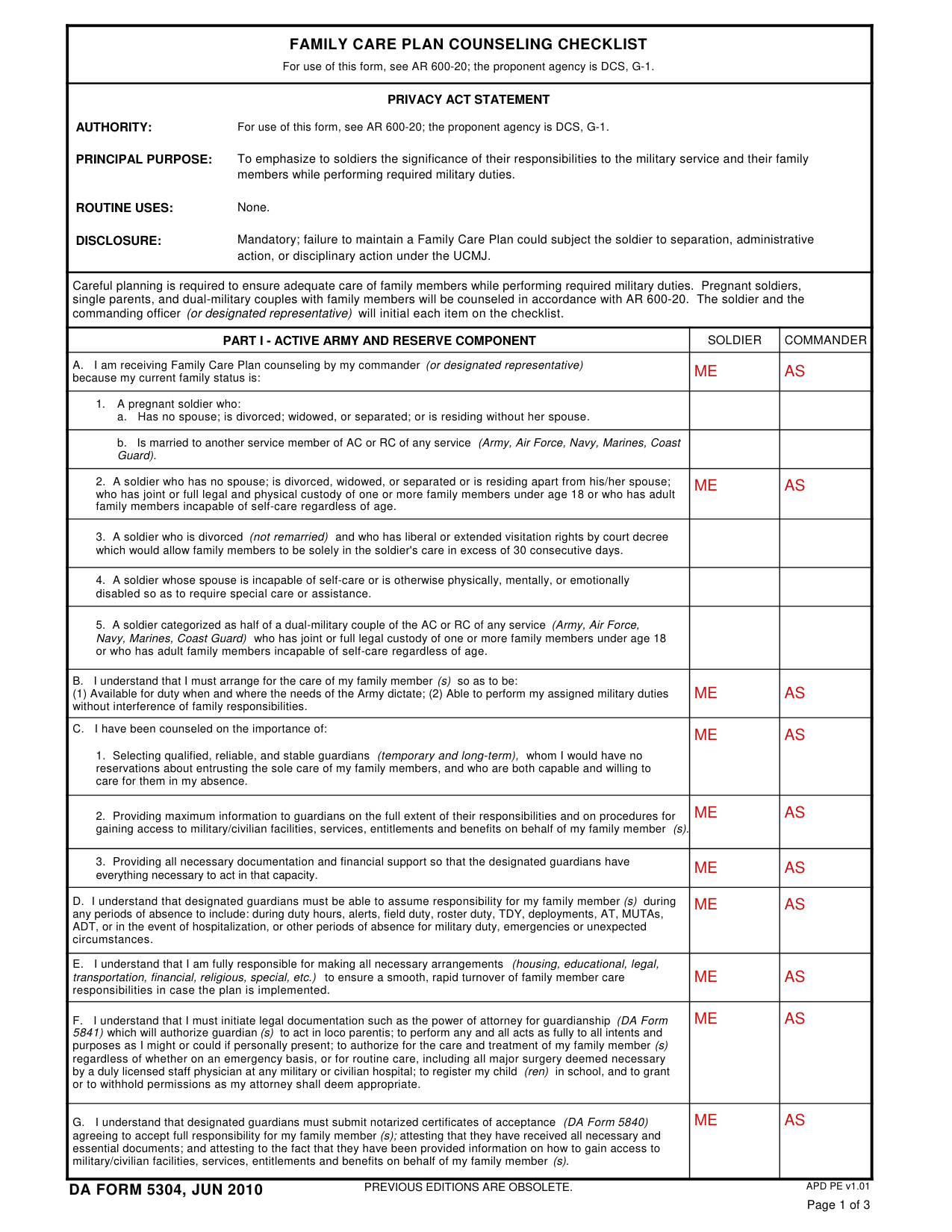
How to fill out DA Form 5304, box by box
Your family status
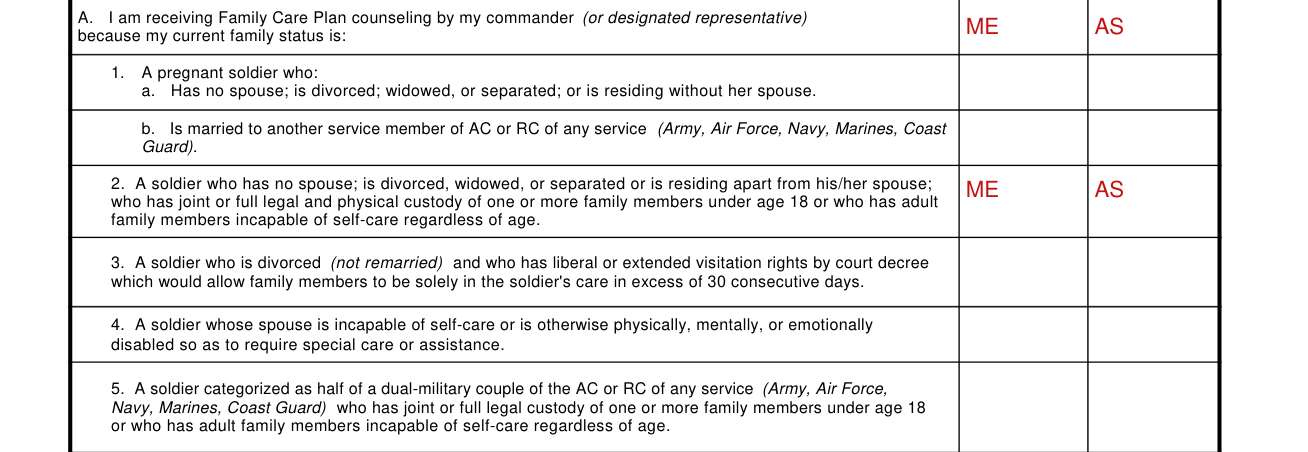
You are receiving Family Care Plan counseling by your commander (or designated representative) because of your current family status.
1. A pregnant soldier who: a. Has no spouse; is divorced; widowed, or separated; or is residing without her spouse.
b. Is married to another service member of any service (Army, Air Force, Navy, Marines, Coast Guard).
2. A soldier who has no spouse; is divorced, widowed, or separated or is residing apart from his/her spouse; who has joint or full legal and physical custody of one or more family members under age 18 or who has adult family members incapable of self-care regardless of age.
3. A soldier who is divorced (not remarried) and who has liberal or extended visitation rights by court decree which would allow family members to be solely in the soldier's care in excess of 30 consecutive days.
4. A soldier whose spouse is incapable of self-care or is otherwise physically, mentally, or emotionally disabled so as to require special care or assistance.
5. A soldier categorized as half of a dual-military couple of the AC or RC of any service (Army, Air Force, Navy, Marines, Coast Guard) who has joint or full legal custody of one or more family members under age 18 or who has adult family members incapable of self-care regardless of age.
Arranging care for your family members
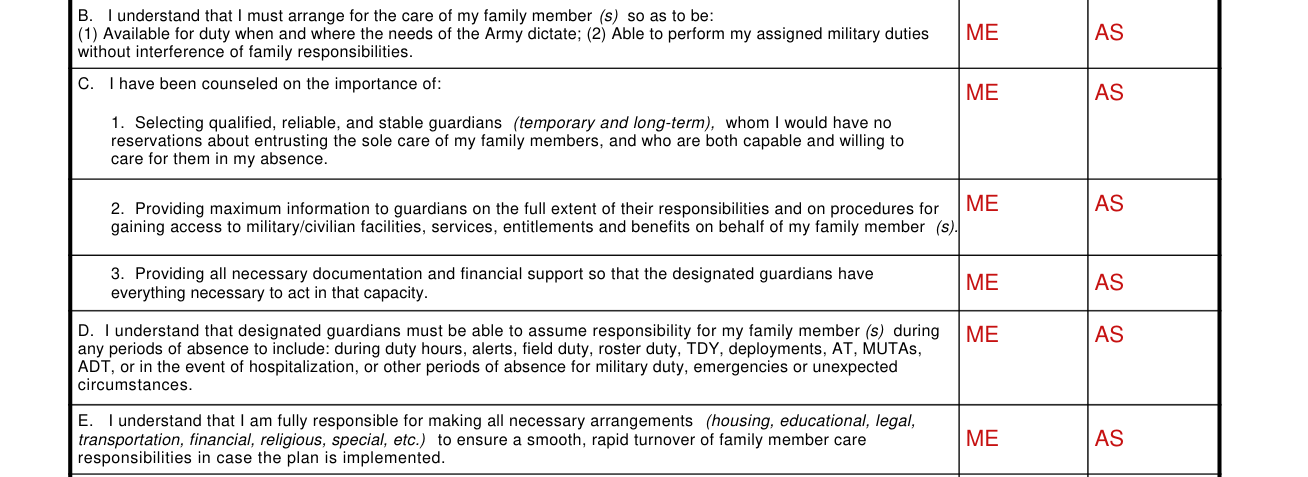
You must arrange for the care of your family member (s) so as to be: (1) Available for duty when and where the needs of the Army dictate; (2) Able to perform your assigned military duties without interference of family responsibilities.
You have been counseled on the importance of selecting qualified, reliable, and stable guardians (temporary and long-term), whom you would have no reservations about entrusting the sole care of your family members, and who are both capable and willing to care for them in your absence.
You have been counseled on the importance of providing maximum information to guardians on the full extent of their responsibilities and on procedures for gaining access to military/civilian facilities, services, entitlements and benefits on behalf of your family member (s).
You have been counseled on the importance of providing all necessary documentation and financial support so that the designated guardians have everything necessary to act in that capacity.
Designated guardians must be able to assume responsibility for your family member (s) during any periods of absence to include: during duty hours, alerts, field duty, roster duty, TDY, deployments, AT, MUTAs, ADT, or in the event of hospitalization, or other periods of absence for military duty, emergencies or unexpected circumstances.
You are fully responsible for making all necessary arrangements (housing, educational, legal, transportation, financial, religious, special, etc.) to ensure a smooth, rapid turnover of family member care responsibilities in case the plan is implemented.
Legal documentation for guardians

You must initiate legal documentation such as the power of attorney for guardianship (DA Form 5841) which will authorize guardian (s) to act in loco parentis; to perform any and all acts as fully to all intents and purposes as you might or could if personally present; to authorize for the care and treatment of your family member (s) regardless of whether on an emergency basis, or for routine care, including all major surgery deemed necessary by a duly licensed staff physician at any military or civilian hospital; to register your child (ren) in school, and to grant or to withhold permissions as your attorney shall deem appropriate.
Designated guardians must submit notarized certificates of acceptance (DA Form 5840) agreeing to accept full responsibility for your family member (s).
Identification cards, annual update and will

Your Family Care Plan must be updated and recertified by your commander at least annually (more often if required by your commander or mission of your unit), or in the event of any change in your family status, guardians, legal custody, duty station, etc.
You must maintain in your Family Care Plan, a DD Form 1172 for each family member to ensure the issue/renewal of Uniformed Services Identification Cards in your absence.
It is strongly encouraged (though not mandatory) that you ensure that you have an updated will which specifies your desires concerning custody of your family member (s) in the event of your death.
Separation and transportation

There are voluntary and involuntary procedures for your separation from military service when your parental responsibilities interfere with the performance of your military duties.
You are fully responsible for all transportation arrangements and costs pertaining to transportation of family member(s) to guardian or guardian to dependent family member (s).
If you are assigned OCONUS

If you are assigned OCONUS, you must identify an escort for your family member (s) in the event that Noncombatant Evacuation Operations (NEO) are put into effect.
Dual-military couples

Members of a dual-military couple may submit the same basic Family Care Plan to both commanders, provided that neither military member is identified as the long-term guardian in the plan.
Letters of instruction

You should provide letters of instruction outlining all special arrangements and instructions the guardians or escort should be aware of (See Figure 5-4, AR 600-20).
Time limits for submitting the plan

You must submit the complete Family Care Plan with all attendant documents to your commander within the time limits specified by your commander (or designated representative): AA 30 days from date of this counseling session.
For RC, the time limit is 60 days from date of this counseling session.
The commander is authorized to grant a one-time extension of 30 days based on extenuating circumstances.
It is your responsibility to notify your commander in advance if you are aware of any circumstances beyond your control that might prevent you from meeting the submission deadlines.
Part II reassignment eligibility (A to E)
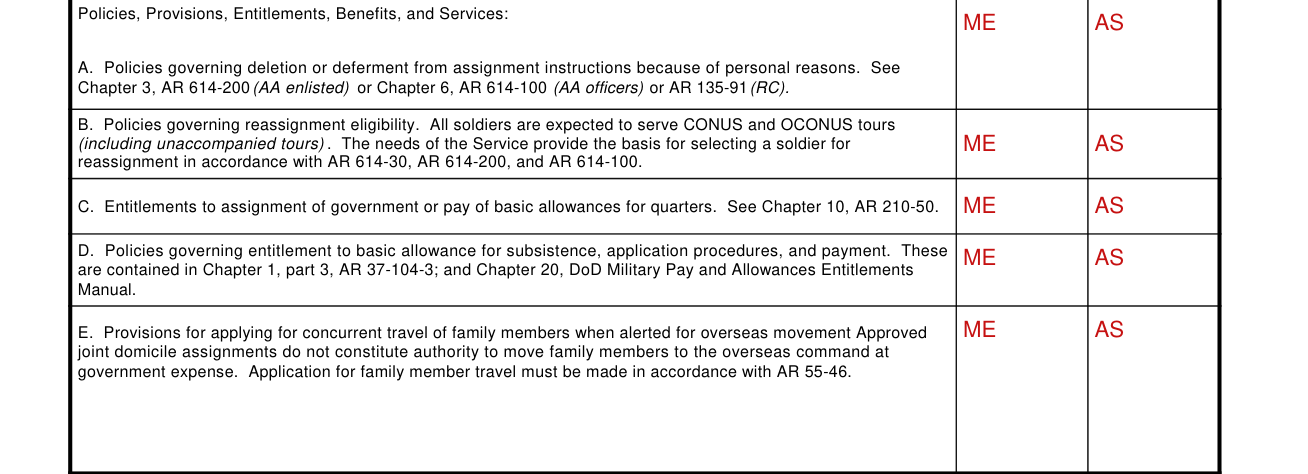
Policies governing reassignment eligibility. All soldiers are expected to serve CONUS and OCONUS tours (including unaccompanied tours). The needs of the Service provide the basis for selecting a soldier for reassignment in accordance with AR 614-30, AR 614-200, and AR 614-100.
Part II transportation (F to L)
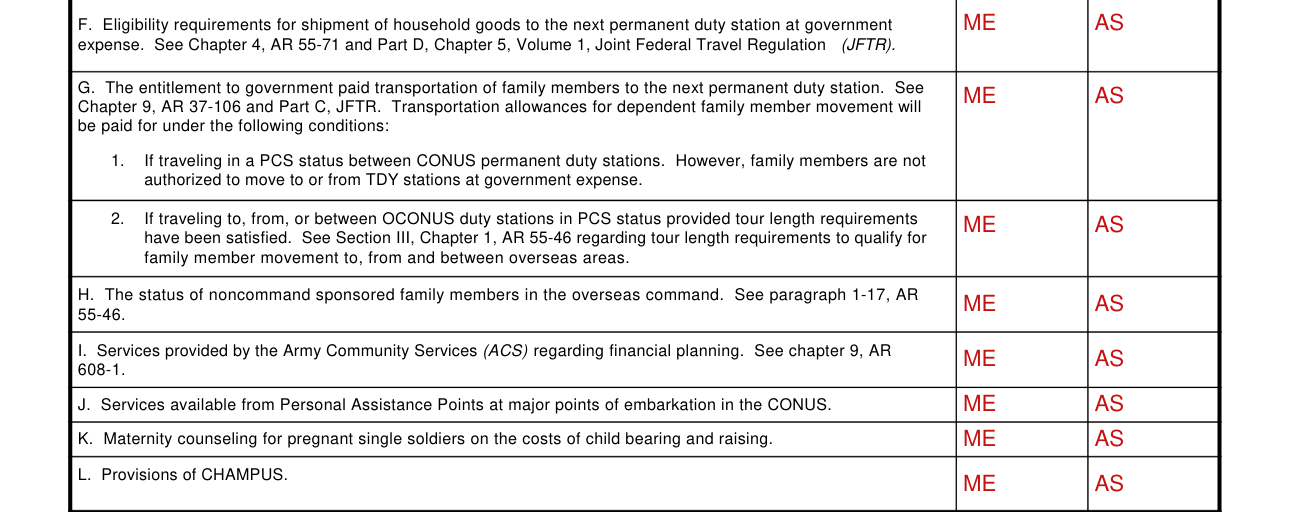
The entitlement to government paid transportation of family members to the next permanent duty station: transportation allowances for dependent family member movement will be paid for under the following conditions: 1. If traveling in a PCS status between CONUS permanent duty stations. However, family members are not authorized to move to or from TDY stations at government expense.
2. If traveling to, from, or between OCONUS duty stations in PCS status provided tour length requirements have been satisfied.
Part III, military spouse and spouse's commander certification
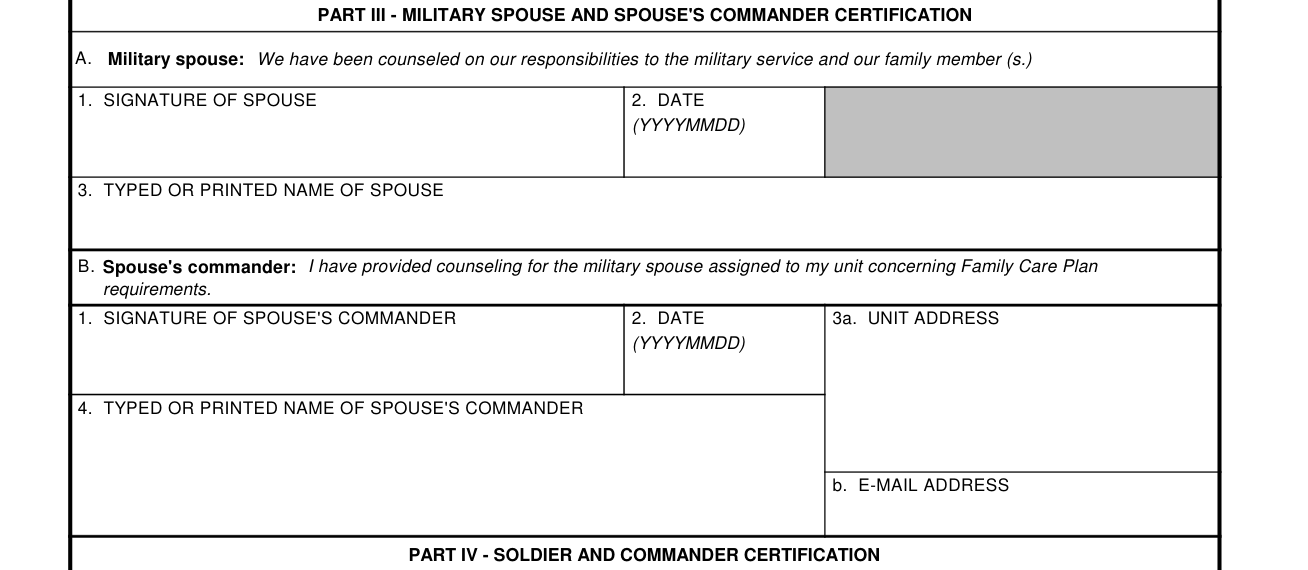
Spouse's commander: I have provided counseling for the military spouse assigned to my unit concerning Family Care Plan requirements.
Part IV, soldier and commander certification
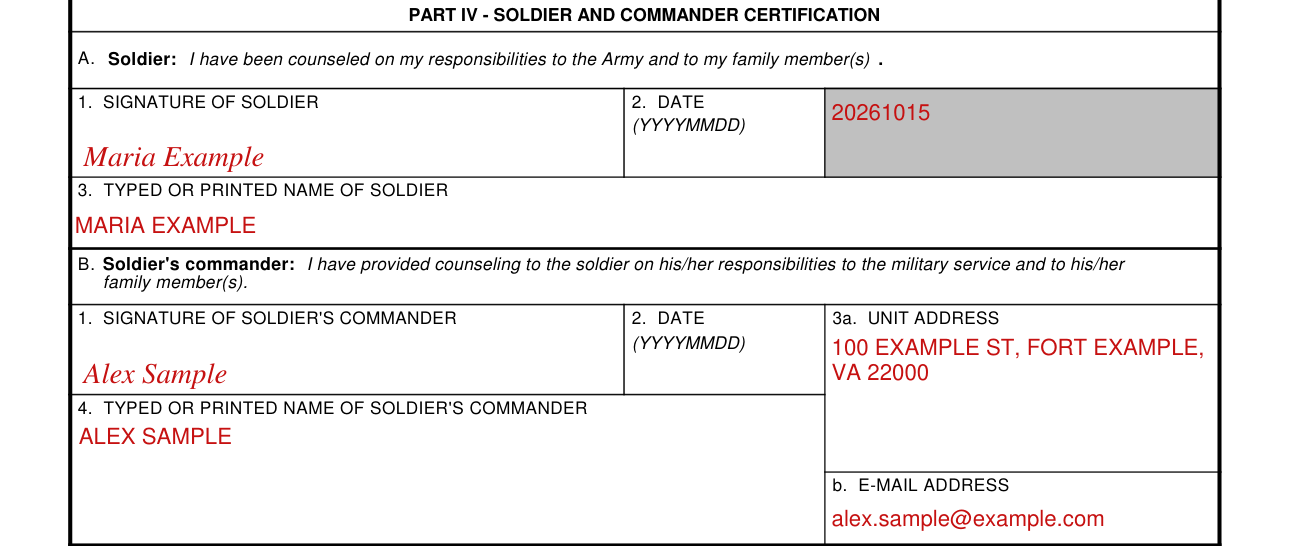
Soldier: I have been counseled on my responsibilities to the Army and to my family member(s).
Soldier's commander: I have provided counseling to the soldier on his/her responsibilities to the military service and to his/her family member(s).
May designate an authorized representative to conduct Family care plan counseling using DA Form 5304, and to initial and sign the counseling form in the commander’s behalf.[2]
More rules for DA Form 5304
Mandatory; failure to maintain a Family Care Plan could subject the soldier to separation, administrative action, or disciplinary action under the UCMJ.
Sources
[1] DA Form 5304 (JUN 2010), Family Care Plan Counseling Checklist, Department of the Army (the Official source link on this page).
[2] armypubs.army.mil, line_part4_b1_explanation_s29_1. Accessed October 20, 2026.