

DA Form 7566 at a glance
What it is: DA Form 7566 is the Composite Risk Management Worksheet; for use of this form, see FM 5-19.
Who signs: Risk Decision Authority is signed by the appropriate level of command.
A filled-in DA Form 7566 example: a platoon leader assesses a road march
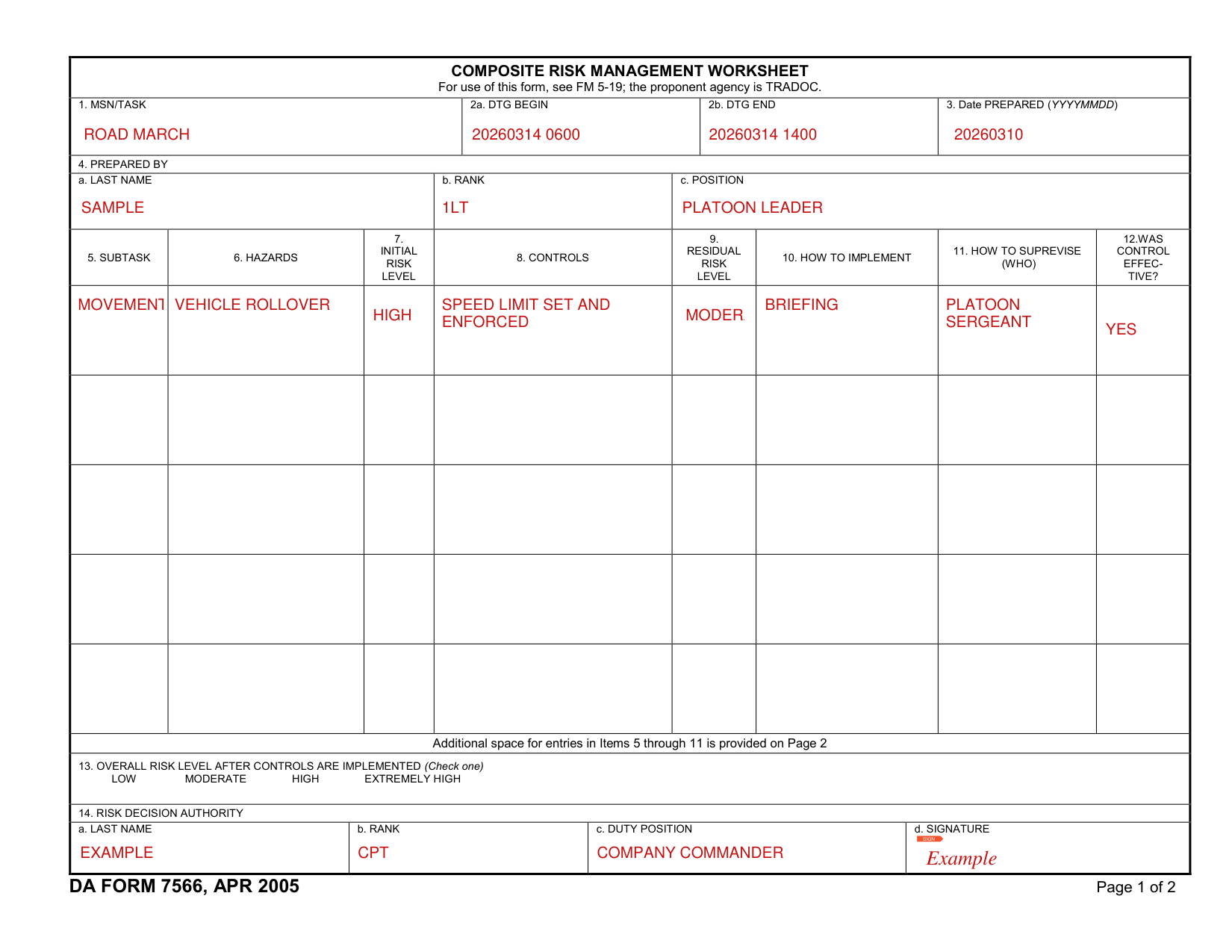
How to fill out DA Form 7566, box by box
ITEM 1 THROUGH ITEM 4, Date PREPARED and 5. SUBTASK
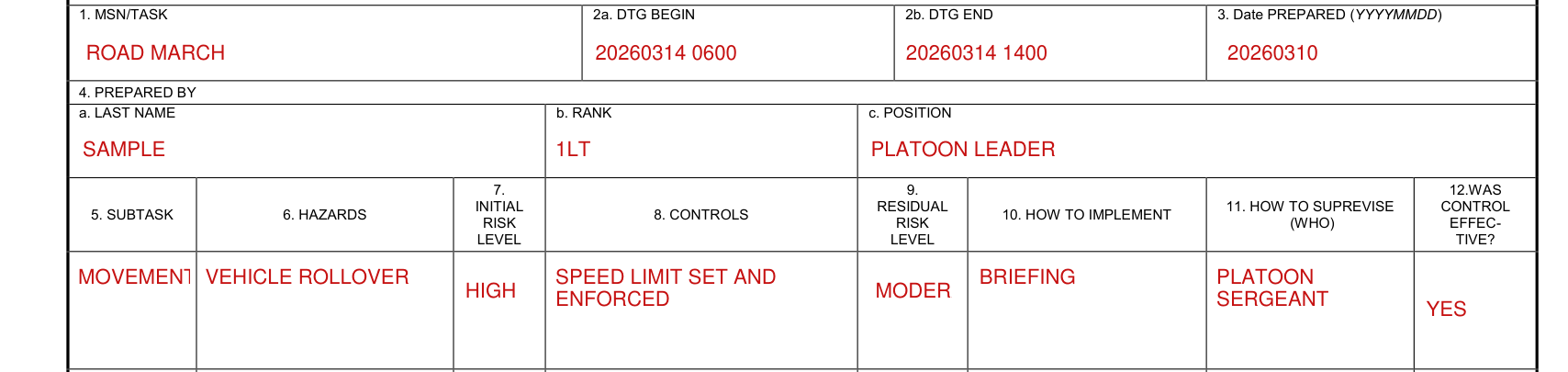
Item 1 through Item 4 are self explanatory. In Item 5, enter the subtask relating to the mission or task in block 1.
Enter the Date PREPARED (YYYYMMDD).
6. HAZARDS

In Item 6, identify hazards by reviewing METT-TC factors for the mission or task.
Additional factors include historical lessons learned, experience, judgment, equipment characteristics and warnings, and environmental considerations.
7. INITIAL RISK LEVEL

In Item 7, enter the risk level for each hazard.
Initial Risk Level includes historical lessons learned; intuitive analyses, experience, judgment, equipment characteristics and warnings; and environmental considerations.
8. CONTROLS

In Item 8, develop one or more controls for each hazard that will either eliminate the hazard or reduce the risk (probability and/or severity) of a hazardous incident.
Specify who, what, where, why, when, and how for each control.
9. RESIDUAL RISK LEVEL

In Item 9, determine the residual risk for each hazard by applying the risk assessment matrix; enter the residual risk level for each hazard.
10. HOW TO IMPLEMENT and 11. HOW TO SUPREVISE (WHO)

In Item 10, HOW TO IMPLEMENT, decide how each control will be put into effect or communicated to the personnel who will make it happen (written or verbal instruction; tactical, safety, garrison SOPs, rehearsals).
In Item 11, HOW TO SUPREVISE (WHO), plan how each control will be monitored for implementation (continuous supervision, spot-checks) and reassess hazards as the situation changes.
Determine if the controls worked and if they can be improved.
Was Control Effective and 13. OVERALL RISK LEVEL AFTER CONTROLS ARE IMPLEMENTED

In Item 12, indicate "Yes" or "No." In Item 13, select the highest residual risk level and circle it.
This becomes the overall mission or task risk level.
The commander decides whether the controls are sufficient to accept the level of residual risk.
If the risk is too great to continue the mission or task, the commander directs development of additional controls or modifies, changes, or rejects the COA.
14. RISK DECISION AUTHORITY

Risk Decision Authority is signed by the appropriate level of command.
More rules for DA Form 7566
The instructions for preparing DA Form 7566 say to see FM 5-19 for supplemental information and general information; all entries explained are for electronic or typewrite completion.
If computer or typewrite is not available, print in black or blue-black ink insuring a legible image on all copies.
When space for a particular item is insufficient, insert “see addendum” and continue the information on a separate page.
Additional space for entries in Items 5 through 11 is provided on Page 2.
Sources
[1] DA Form 7566 (APR 2005), Composite Risk Management Worksheet.
