

DA Form 8001 at a glance
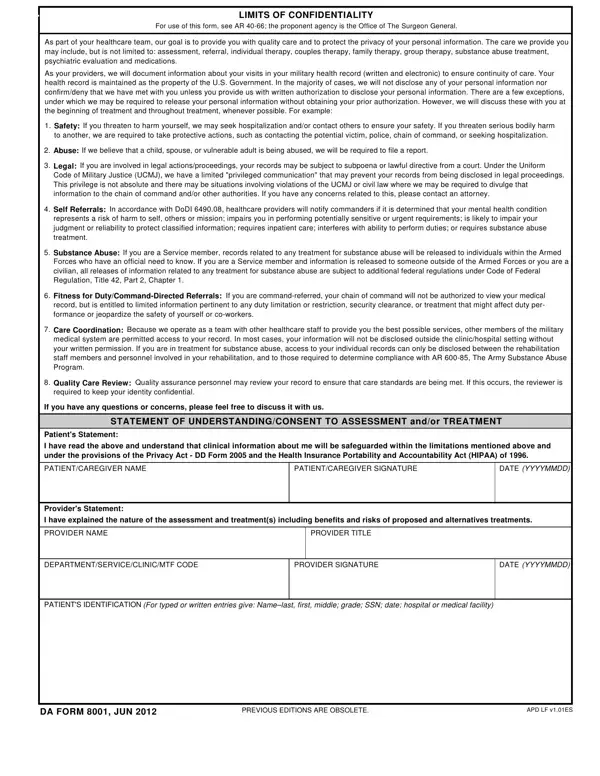
What it is: DA Form 8001 is the Limits of Confidentiality and the Statement of Understanding/Consent to Assessment and/or Treatment.
Who signs: Add the PATIENT/CAREGIVER SIGNATURE and the PROVIDER SIGNATURE.
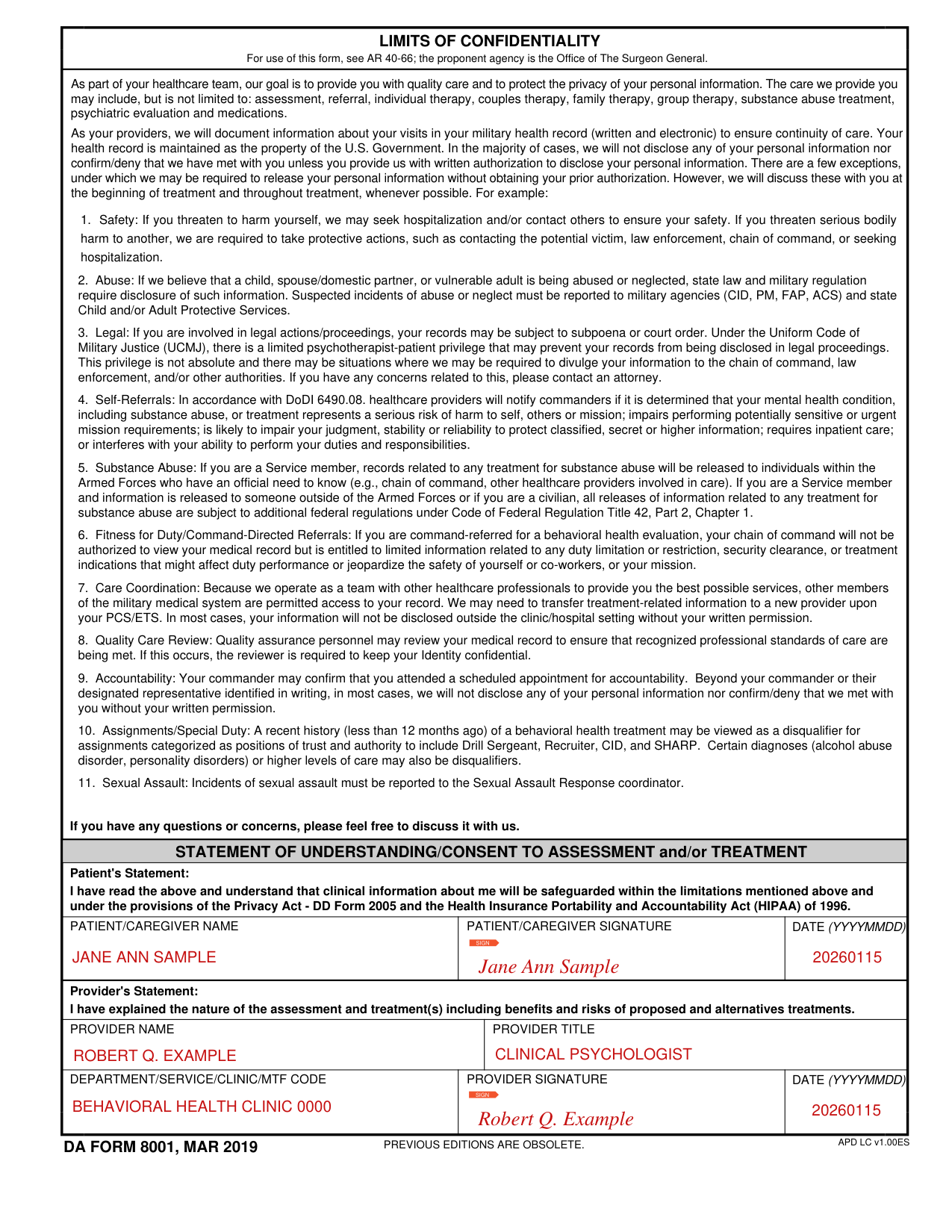
A filled-in DA Form 8001 example: a first visit with a clinical psychologist
How to fill out DA Form 8001, box by box
Patient's Statement
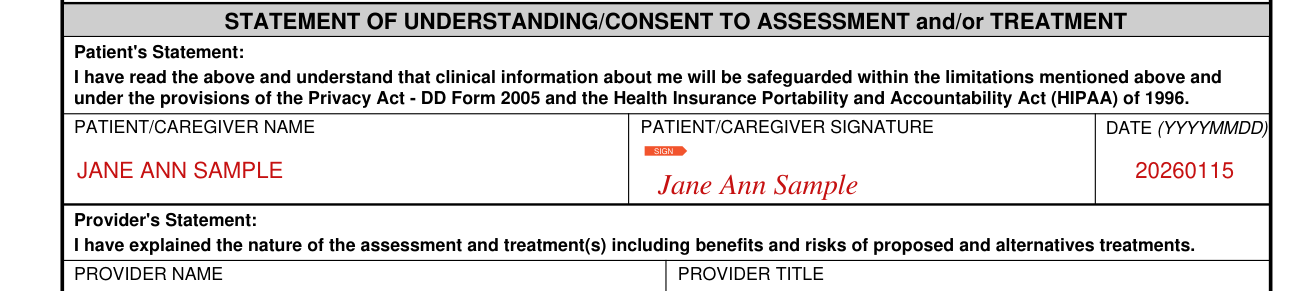
Patient's Statement: I have read the Limits of Confidentiality and understand that clinical information about me will be safeguarded within the limitations mentioned in the Limits of Confidentiality and under the provisions of the Privacy Act (DD Form 2005) and the Health Insurance Portability and Accountability Act (HIPAA) of 1996.
Enter the PATIENT/CAREGIVER NAME and the DATE (YYYYMMDD), and add the PATIENT/CAREGIVER SIGNATURE.
Provider's Statement

Provider's Statement: I have explained the nature of the assessment and treatment(s) including benefits and risks of proposed and alternatives treatments.
Enter the PROVIDER NAME, the PROVIDER TITLE, the DEPARTMENT/SERVICE/CLINIC/MTF CODE and the DATE (YYYYMMDD), and add the PROVIDER SIGNATURE.
More rules for DA Form 8001
As part of your healthcare team, the goal is to provide you with quality care and to protect the privacy of your personal information. The care your providers provide you may include, but is not limited to: assessment, referral, individual therapy, couples therapy, family therapy, group therapy, substance abuse treatment, psychiatric evaluation and medications.
As your providers, your providers will document information about your visits in your military health record (written and electronic) to ensure continuity of care. Your health record is maintained as the property of the U.S. Government. In the majority of cases, your providers will not disclose any of your personal information nor confirm/deny that your providers have met with you unless you provide your providers with written authorization to disclose your personal information. There are a few exceptions, under which your providers may be required to release your personal information without obtaining your prior authorization. However, your providers will discuss these with you at the beginning of treatment and throughout treatment, whenever possible.
If you have any questions or concerns, please feel free to discuss it.
Limits of confidentiality
Safety
Safety: If you threaten to harm yourself: seeking hospitalization and/or contacting others to ensure your safety. If you threaten serious bodily harm to another, protective actions are required, such as contacting the potential victim, law enforcement, chain of command, or seeking hospitalization.
Abuse
Abuse: If a child, spouse/domestic partner, or vulnerable adult is believed to be abused or neglected, state law and military regulation require disclosure of such information. Suspected incidents of abuse or neglect must be reported to military agencies (CID, PM, FAP, ACS) and state Child and/or Adult Protective Services.
Legal
Legal: If you are involved in legal actions/proceedings, your records may be subject to subpoena or court order. Under the Uniform Code of Military Justice (UCMJ), there is a limited psychotherapist-patient privilege that may prevent your records from being disclosed in legal proceedings. This privilege is not absolute and there may be situations where your information may be required to be divulged to the chain of command, law enforcement, and/or other authorities. If you have any concerns related to this, please contact an attorney.
Self-Referrals
Self-Referrals: In accordance with DoDI 6490.08. healthcare providers will notify commanders if it is determined that your mental health condition, including substance abuse, or treatment represents a serious risk of harm to self, others or mission; impairs performing potentially sensitive or urgent mission requirements; is likely to impair your judgment, stability or reliability to protect classified, secret or higher information; requires inpatient care; or interferes with your ability to perform your duties and responsibilities.
Substance Abuse
Substance Abuse: If you are a Service member, records related to any treatment for substance abuse will be released to individuals within the Armed Forces who have an official need to know (e.g., chain of command, other healthcare providers involved in care). If you are a Service member and information is released to someone outside of the Armed Forces or if you are a civilian, all releases of information related to any treatment for substance abuse are subject to additional federal regulations under Code of Federal Regulation Title 42, Part 2, Chapter 1.
Fitness for Duty/Command-Directed Referrals
Fitness for Duty/Command-Directed Referrals: If you are command-referred for a behavioral health evaluation, your chain of command will not be authorized to view your medical record but is entitled to limited information related to any duty limitation or restriction, security clearance, or treatment indications that might affect duty performance or jeopardize the safety of yourself or co-workers, or your mission.
Care Coordination
Care Coordination: Because your providers operate as a team with other healthcare professionals to provide you the best possible services, other members of the military medical system are permitted access to your record. Your providers may need to transfer treatment-related information to a new provider upon your PCS/ETS. In most cases, your information will not be disclosed outside the clinic/hospital setting without your written permission.
Quality Care Review
Quality Care Review: Quality assurance personnel may review your medical record to ensure that recognized professional standards of care are being met. If this occurs, the reviewer is required to keep your Identity confidential.
Accountability
Accountability: Your commander may confirm that you attended a scheduled appointment for accountability. Beyond your commander or their designated representative identified in writing, in most cases, your personal information will not be disclosed without your written permission.
Assignments/Special Duty
Assignments/Special Duty: A recent history (less than 12 months ago) of a behavioral health treatment may be viewed as a disqualifier for assignments categorized as positions of trust and authority to include Drill Sergeant, Recruiter, CID, and SHARP. Certain diagnoses (alcohol abuse disorder, personality disorders) or higher levels of care may also be disqualifiers.
Sexual Assault
Sexual Assault: Incidents of sexual assault must be reported to the Sexual Assault Response coordinator.
Sources
[1] DA Form 8001 (MAR 2019), Limits of Confidentiality and Statement of Understanding/Consent to Assessment and/or Treatment, Office of The Surgeon General (the Official source link on this page).