
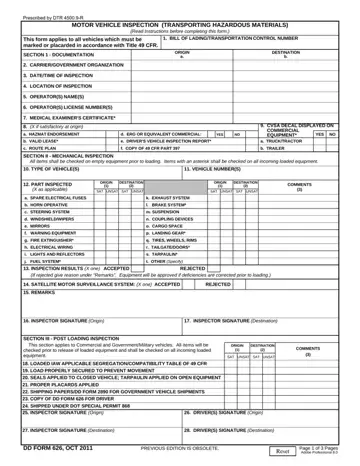
DD Form 626 at a glance
What it is: This form provides a limited inspection of the general operation of the vehicle and is not to be confused with the more thorough vehicles' periodic inspection. Read Instructions before completing this form. This form applies to all vehicles which must be marked or placarded in accordance with Title 49 CFR.
Who signs: Item 16: Ensure inspector signs name on DD Form 626 at origin prior to loading vehicle. Item 22: Ensure operator(s) sign DD Form 626, are given a copy and understand the hazards associated with the shipment. Item 24: Ensure inspector signs & prints name on DD Form 626 at origin. Item 25: Ensure driver(s)/operator(s) sign(s) & print(s) name on DD Form 626 at origin. Item 26: Ensure inspector signs & prints name on DD Form 626 at destination. Item 27: Ensure driver(s)/operator(s) sign(s) & print(s) name on DD Form 626 at destination.
A filled-in DD Form 626 example: an origin inspection of a commercial truck and trailer
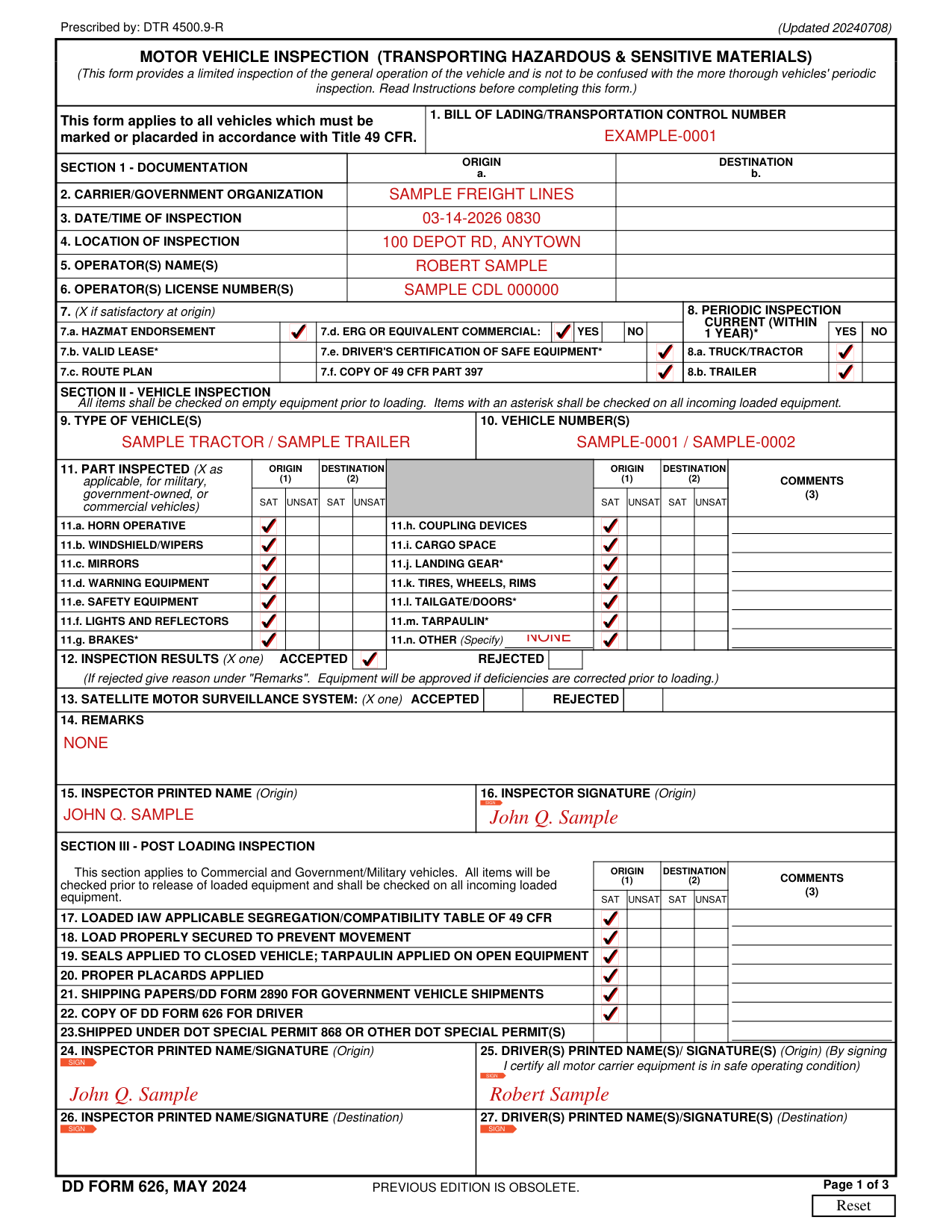
How to fill out DD Form 626, box by box
Tap a group of boxes to open it, and a picture to see it full size.
Items 1 to 8: documents, checked at origin and at destination
All items (2 through 8) will be checked at origin prior to loading.
Only Items 2 through 7 are required to be checked at destination.
In Section I, items with an asterisk (*) apply to commercial operators or equipment only.
Items 1 through 5 are self explanatory.
Item 6: Enter operator's Commercial Driver's License (CDL) number or Military OF-346 License Number.
CDL and OF-346 must have the HAZMAT and other appropriate endorsements IAW 49 CFR 383.
Box 7: (X if satisfactory at origin).
Box 7.a, Hazardous Materials Certification: In accordance with applicable service regulations, ensure operator has been certified to transport hazardous materials. Check the expiration date on driver's HAZMAT Certification.
Box 7.b, *Valid Lease: Shipper will ensure a copy of the appropriate contract or lease is carried in all leased vehicles and is available for inspection. (49 CFR 376.12 and 376.11(c)(2)).
Box 7.c, Route Plan: Prior to loading any Hazard Class/Division 1.1, 1.2, or 1.3 (Explosives) for shipment, ensure that the operator possesses a written route plan in accordance with 49 CFR Part 397.
Route Plan requirements for Hazard Class 7 (Radioactive) materials are found in 49 CFR 397.101.
Box 7.d, Emergency Response Guidebook (ERG) or Equivalent: Commercial operators must be in possession of an ERG or equivalent document.
Shipper will provide applicable ERG page(s) to military operators.
Box 7.e: *Verify the driver has completed a pre-trip inspection. The driver's signature in item 25 serves as the certification that both the motor vehicle and trailer are in safe operating condition.
Box 7.f, Copy of 49 CFR Part 397: Operators are required by regulation to have in their possession a copy of 49 CFR Part 397 (Transportation of Hazardous Materials Driving and Parking Rules).
If military operators do not possess this document, shipper will provide a copy to operator.
Item 8: * Check the last periodic inspection date for the Truck/Tractor and Trailer to ensure currency (1 year).
Acceptable documentation: (1) A copy of the inspection report or (2) A sticker or decal with the date of inspection, name and address of the motor carrier, information uniquely identifying the vehicle inspected and a certification the vehicle has passed an inspection in accordance with § 396.17.
Items 9 to 11: the vehicle and its parts
Section II, Vehicle Inspection: All items shall be checked on empty equipment prior to loading. Items with an asterisk shall be checked on all incoming loaded equipment.
Item 9, Type of Vehicle(s): For military tactical vehicles, enter Nomenclature/ Model of vehicle (and trailer, if applicable).
For GSA or commercial vehicles, enter Make & Model of vehicle (and trailer, if applicable).
Item 10, Vehicle Number(s): For military tactical vehicles, enter bumper number(s).
For GSA or commercial vehicles, enter Vehicle Identification Number (VIN) or Company-assigned number(s) for vehicle (and trailer, if applicable).
All items (11.a. through 11.n.) will be checked on all incoming military, government-owned, or commercial empty equipment prior to loading.
Common mistake: All UNSATISFACTORY conditions must be corrected prior to loading.
Box 11.a, Horn Operative: Ensure that horn is securely mounted and of sufficient volume to serve purpose. (49 CFR 393.81).
Box 11.b, Windshield/ Wipers: Inspect to ensure that windshield is free from breaks, cracks or defects that would make operation of the vehicle unsafe; that the view of the driver is not obscured and that the windshield wipers are operational and wiper blades are in serviceable condition. Defroster must be operative when conditions require. (49 CFR 393.60, 393.78 and 393.79).
Box 11.c, Mirrors: Every vehicle must be equipped with two rear vision mirrors located so as to reflect to the driver a view of the highway to the rear along both sides of the vehicle. Mirrors shall not be cracked or dirty. (49 CFR 393.80).
Common mistake: Box 11.d, Warning Equipment: Equipment must include three bidirectional emergency reflective triangles that conform to the requirements of FMVSS No. 125. FLAME PRODUCING DEVICES ARE PROHIBITED. (49 CFR 393.95).
Box 11.e, Safety Equipment: Military vehicles must be equipped with one serviceable fire extinguisher with an Underwriters Laboratories rating of 10 BC or more (Commercial motor vehicles must be equipped with one serviceable 10 BC Fire Extinguisher). Fire extinguisher must be located so that it is readily accessible for use and securely mounted on the vehicle. The fire extinguisher must be designed, constructed and maintained to permit visual determination of whether it is fully charged. A set of wheel chocks is required to prevent movement of unattended vehicles. (49 CFR 393.95 and 49 CFR 398.4(p)).
Box 11.f, Lights and Reflectors (Head, tail, turn signal, brake, clearance, marker and identification lights, Emergency Flashers): Inspect to see that all lighting devices and reflectors required are operable, of proper color and properly mounted, and are not obscured by dirt or grease or have broken lenses. High/Low beam switch must be operative. Emergency Flashers must be operative on both the front and rear of vehicle. (49 CFR 393.24, 25, and 26).
Box 11.g, Brakes (to include hand brakes, parking brakes and Low Air Warning devices): Check to ensure that brakes are operational and stop and hold the vehicle or tractor/trailer combination. Check for audible air leaks around air brake components and air lines. Check for fluid leaks and visible cracked or damaged lines. Ensure that parking brake is operational. Low air warning devices must be operative. (49 CFR 393.40, 41, 42, 43, 44, 45, 47, 48, 49, 50, 51, 52, 53, and 55).
Box 11.h, Coupling Devices (inspect without uncoupling): Fifth Wheels: Inspect for unsecured mounting to frame or any missing or damaged parts. Inspect for any visible space between upper and lower fifth wheel plates. Ensure that the locking jaws are around the shank and not the head of the kingpin. Ensure that the release lever is seated properly and safety latch is engaged. (49 CFR 393.70 and 71).
Pintle Hook, Drawbar, Towbar Eye and Tongue and Safety Devices: Inspect for unsecured mounting, cracks, missing or ineffective fasteners (welded repairs to pintle hook is prohibited). Ensure safety devices (chains, hooks, cables) are in serviceable condition and properly attached.
Box 11.i, Cargo Space: Inspect to ensure that cargo space is clean and free from exposed bolts, nuts, screws, nails or inwardly projecting parts that could damage the lading. Check floor to ensure it is tight and free from holes. Floor shall not be permeated with oil or other substances. (49 CFR 393.84).
Box 11.j, Landing Gear: Inspect to ensure that landing gear and assembly are in serviceable condition, correctly assembled, adequately lubricated, and properly mounted.
Common mistake: Box 11.k, Tires, Wheels, and Rims: Inspect to ensure that tires are properly inflated. Flat or leaking tires are unacceptable. Inspect tires for visible cuts, bruises, breaks and blisters. Tires with cuts that extend into the cord body are unacceptable. Thread depth shall not be less than: 4/32 inches for tires on a steering axle of a power unit, and 2/32 inches for all other tires. Mixing bias and radial on the steering axle is prohibited. Inspect wheels and rims for visible cracks, unseated locking rings, broken, loose, damaged or missing lug nuts or elongated stud holes. (49 CFR 393.75).
Box 11.l, Tailgate/ Doors: Inspect to see that all hinges are tight in body. Check for broken latches and safety chains. Doors must close securely. (49 CFR 177.835(h)).
Box 11.m, Tarpaulin: If shipment is made on open equipment, ensure that lading is properly covered with fire and water resistant tarpaulin. (49 CFR 177.835(h)).
Box 11.n, Other: Note any other unsatisfactory condition which would prohibit the vehicle from being loaded with hazardous or sensitive materials.
Items 12 to 16: results, satellite surveillance and the inspector at origin
Box 12, INSPECTION RESULTS (X one) ACCEPTED REJECTED: If rejected give reason under "Remarks". Equipment will be approved if deficiencies are corrected prior to loading.
Item 13: For AA&E and other shipments requiring satellite surveillance, ensure that the Satellite Motor Surveillance System is operable.
The DTTS Message Display Unit, when operative, will display the signal "DTTS ON".
The munitions carrier driver, when practical, will position the DTTS message display unit in a manner that allows the shipping inspector or other designated shipping personnel to observe the "DTTS ON" message without climbing aboard the cab of the motor vehicle.
Item 15: Ensure inspector prints name on DD Form 626 at origin prior to loading vehicle.
Item 16: Ensure inspector signs name on DD Form 626 at origin prior to loading vehicle.
Items 17 to 23: post loading inspection
Section III, Post Loading Inspection: This section applies to Commercial and Government/Military vehicles.
All placarded quantities/items will be checked prior to the release of loaded equipment.
Common mistake: Shipment will not be released until deficiencies are corrected.
All items will be checked on incoming loaded equipment.
Deficiencies will be reported in accordance with applicable service regulations.
Item 17: Check to ensure shipment is loaded in accordance with 49 CFR Part 177.848 and the applicable Segregation or Compatibility Table of 49 CFR 177.848.
Item 18: Check to ensure the load is secured from movement in accordance with applicable service outload drawings.
Item 19: Check to ensure seal(s) have been applied to closed equipment; fire and water resistant tarpaulin applied on open equipment.
Item 20: Check to ensure each transport vehicle has been properly placarded in accordance with 49 CFR 172.504.
Item 21: Check to ensure operator has been provided shipping papers that comply with 49 CFR 172.201 and 202.
For shipments transported by Government vehicle, shipping paper will be DD Form 2890.
Item 22: Ensure operator(s) sign DD Form 626, are given a copy and understand the hazards associated with the shipment.
Item 23: Applies to Commercial Shipments Only. If shipment is made under DOT Special Permit 868 or other applicable Special Permits, ensure that shipping papers are properly annotated and a copy of each Special Permit is with shipping papers.
Items 24 to 27: the inspector and the driver, at origin and at destination
Item 24: Ensure inspector signs & prints name on DD Form 626 at origin.
Item 25: Ensure driver(s)/operator(s) sign(s) & print(s) name on DD Form 626 at origin.
Box 25, DRIVER(S) PRINTED NAME(S)/ SIGNATURE(S) (Origin): By signing I certify all motor carrier equipment is in safe operating condition.
Item 26: Ensure inspector signs & prints name on DD Form 626 at destination.
Item 27: Ensure driver(s)/operator(s) sign(s) & print(s) name on DD Form 626 at destination.
Common questions about DD Form 626
What is a DD Form 626 used for?
This form provides a limited inspection of the general operation of the vehicle and is not to be confused with the more thorough vehicles' periodic inspection. Read Instructions before completing this form.
What is section 2 of DD Form 626?
All items (11.a. through 11.n.) will be checked on all incoming military, government-owned, or commercial empty equipment prior to loading.
When conducting an inbound inspection on a loaded vehicle, which items on form 626 block II require inspection?
Section II, Vehicle Inspection: All items shall be checked on empty equipment prior to loading. Items with an asterisk shall be checked on all incoming loaded equipment.
What am I certifying when I sign?
Box 25, DRIVER(S) PRINTED NAME(S)/ SIGNATURE(S) (Origin): By signing I certify all motor carrier equipment is in safe operating condition.
Sources
[1] DD Form 626 (MAY 2024), Motor Vehicle Inspection (Transporting Hazardous & Sensitive Materials), U.S. Department of Defense (the Official source link on this page).