
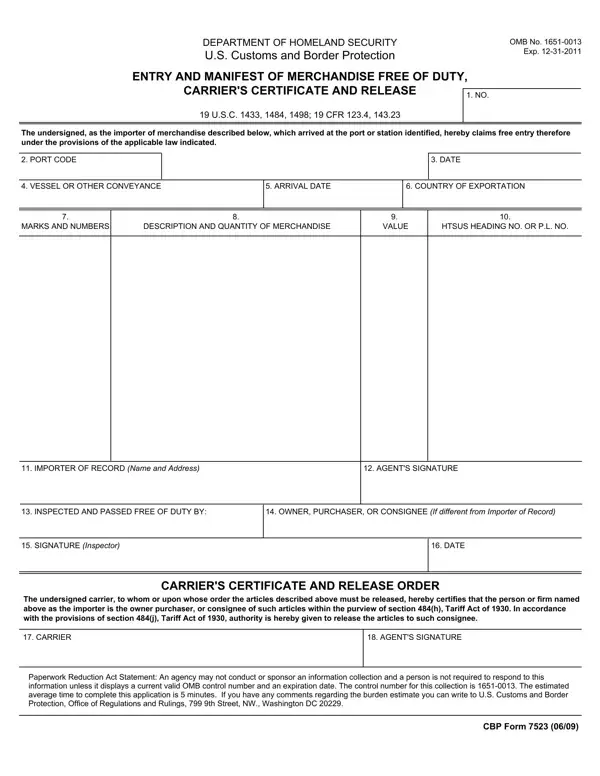
The undersigned carrier hereby certifies that the person or firm named above as the importer is the owner purchaser, or consignee of such articles.
Release: in accordance with the provisions of section 484(j), Tariff Act of 1930, authority is hereby given to release the articles to such consignee.
Owner, purchaser, or consignee: if different from Importer of Record.
Merchandise: description and quantity of merchandise, marks and numbers, value, and HTSUS heading no. or P.L. no.
Time: the estimated average time to complete this application is 5 minutes.
| Question | Answer |
|---|---|
| Form Name | CBP Form 7523 |
| Form Length | 1 page |
| Fillable? | Yes |
| Fillable fields | 26 |
| Avg. time to fill out | 5 min |
| Edition | 05/24 |
| Issuing agency | U.S. Customs and Border Protection |
| Other names | CBP Form 7523, CBP 7523, Form 7523, entry manifest, Entry and Manifest of Merchandise Free of Duty |
| Official source | CBP Form 7523 (05/24), U.S. Customs and Border Protection |
Entry Manifest Form isn’t the one you’re looking for?