
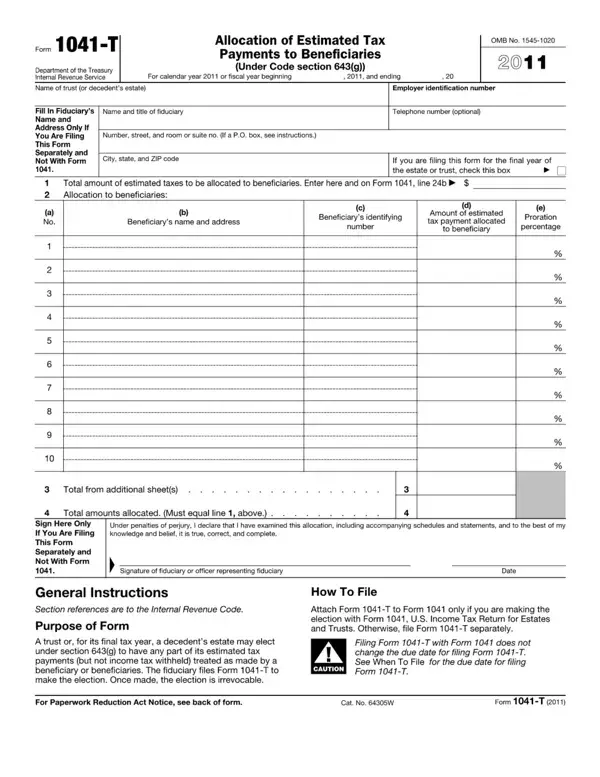

Form 1041-T at a glance
What it is: Form 1041-T is the Allocation of Estimated Tax Payments to Beneficiaries (Under Code section 643(g)).
Who signs: Signature of fiduciary or officer representing fiduciary.
A trust or, for its final tax year, a decedent's estate may elect under section 643(g) to have any part of its estimated tax payments (but not income tax withheld) treated as made by a beneficiary or beneficiaries. The fiduciary files Form 1041-T to make the election. Once made, the election is irrevocable.
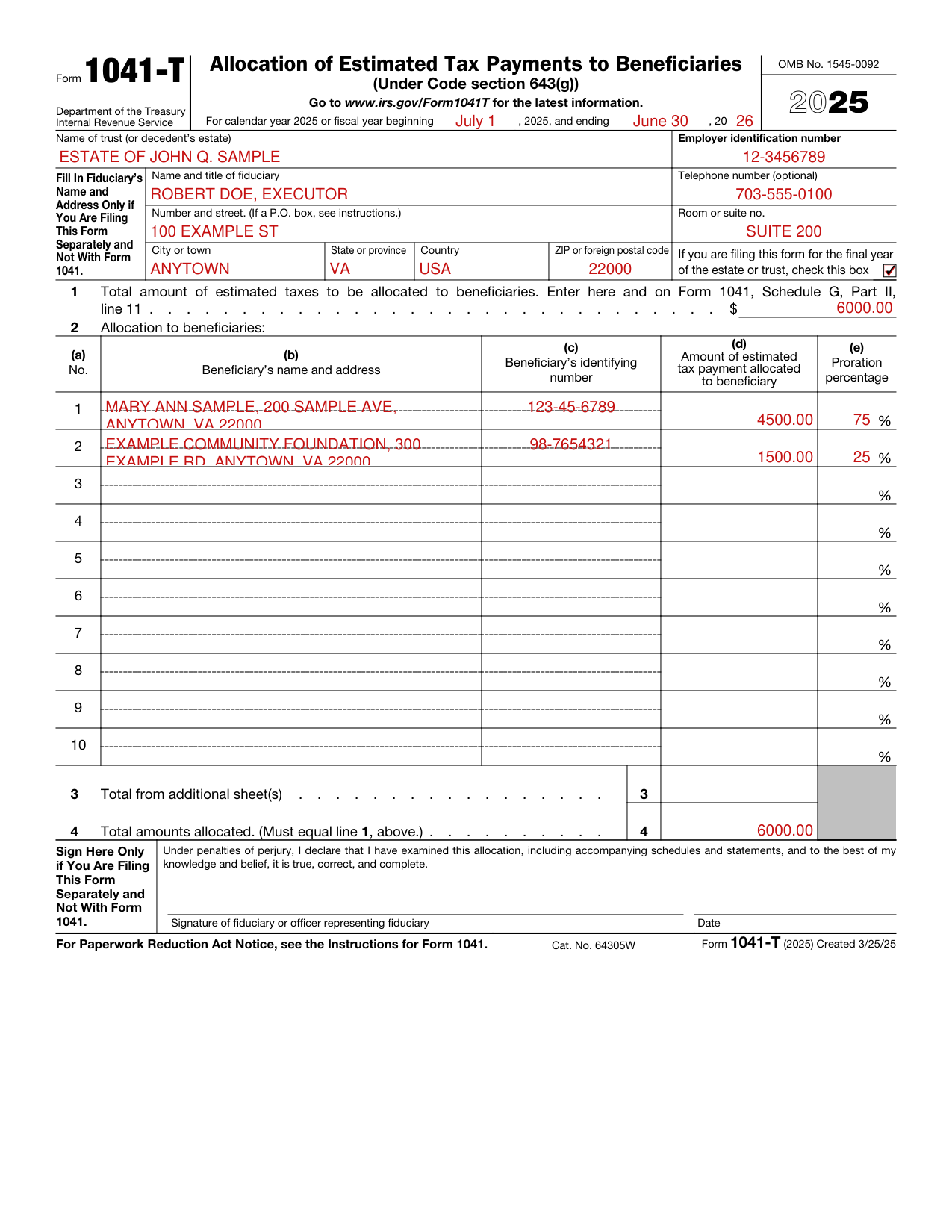
A filled-in Form 1041-T example: an estate allocates its estimated tax payments
How to fill out Form 1041-T, box by box
Tax year

For calendar year 2025 or a fiscal year, fill in the year beginning , 2025, and ending , 20.
File the 2025 form for calendar year 2025 and fiscal years beginning in 2025 and ending in 2026. If the form is for a fiscal year or a short tax year, fill in the tax year space at the top of the form.
Name of trust (or decedent's estate)

Enter the Name of trust (or decedent's estate) and the Employer identification number.
Fiduciary's Name and Address

Fill In Fiduciary's Name and Address Only if You Are Filing This Form Separately and Not With Form 1041.
Enter the Name and title of fiduciary and the Telephone number (optional).
Enter the Number and street. (If a P.O. box, see instructions.) and the Room or suite no.
If the post office doesn't deliver mail to the street address and the fiduciary has a P.O. box, show the box number instead of the street address.
Enter the City or town, State or province, Country and ZIP or foreign postal code. If you are filing this form for the final year of the estate or trust, check this box.
Line 1 Total amount of estimated taxes

Enter the Total amount of estimated taxes to be allocated to beneficiaries here and on Form 1041, Schedule G, Part II, line 11.
Enter the amount of estimated tax payments made by the trust or decedent's estate that the fiduciary elects to treat as a payment made by the beneficiaries. This amount is treated as if paid or credited to the beneficiaries on the last day of the tax year of the trust or decedent's estate. Be sure to include it on Form 1041, Schedule B, line 10.
You can't allocate to a beneficiary tax withheld from income, such as withholding from lottery or other gambling winnings, or from salary or pension payments reported on Form 1041. You must report this withholding on Form 1041, Schedule G, Part II, line 14.
Line 2 Allocation to beneficiaries
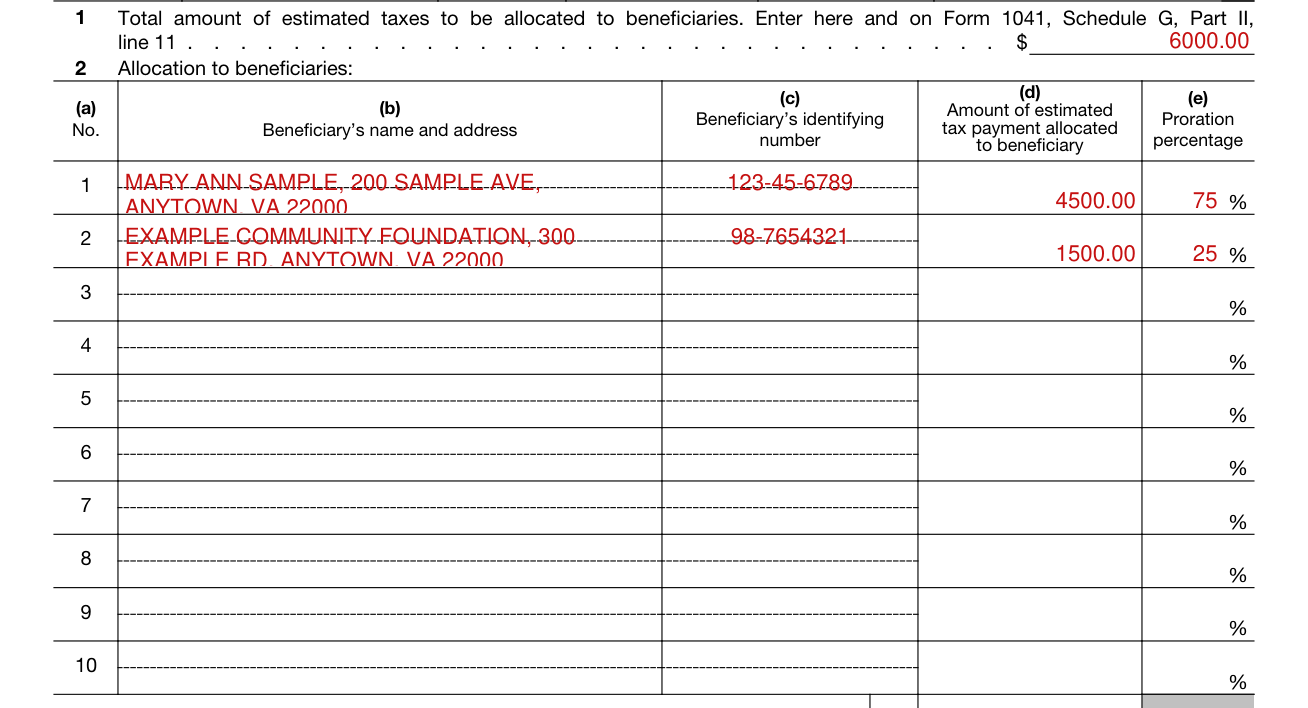
Line 2 Column (b)-Beneficiary's name and address. Group the beneficiaries to whom you are allocating estimated tax payments into two categories. First, list all the individual beneficiaries. Then, list all the other beneficiaries.
For each beneficiary, enter the appropriate taxpayer identification number (TIN). This is generally the social security number (SSN) for individuals or employer identification number (EIN) for all other entities.
Failure to enter a valid SSN or EIN may cause a delay in processing and could result in penalties being imposed on the beneficiary.
For those beneficiaries who file a joint return, you can assist the IRS in crediting the proper account by also providing the SSN, if known, of the beneficiary's spouse. However, this is an optional entry.
For each beneficiary, also report this amount in box 13 of Schedule K-1 (Form 1041), using code A.
For each listed beneficiary, divide the amount shown in column (d) by the amount shown on line 1 and enter the result as a percentage.
Lines 3 and 4 Totals

If you are allocating a payment of estimated taxes to more than 10 beneficiaries, list the additional beneficiaries on an attached sheet that follows the format of line 2. Enter on line 3 the total from the attached sheet(s).
3 Total from additional sheet(s).
Total amounts allocated. (Must equal line 1, above.)
If your situation is different
Where To File
Attach Form 1041-T to Form 1041, U.S. Income Tax Return for Estates and Trusts, only if you are making the election with Form 1041. Otherwise, file Form 1041-T separately.
If you are located in Connecticut, Delaware, District of Columbia, Georgia, Illinois, Indiana, Kentucky, Maine, Maryland, Massachusetts, Michigan, New Hampshire, New Jersey, New York, North Carolina, Ohio, Pennsylvania, Rhode Island, South Carolina, Tennessee, Vermont, Virginia, West Virginia, Wisconsin, please mail to the Department of the Treasury Internal Revenue Service Kansas City, MO 64999. If you are located in Alabama, Alaska, Arizona, Arkansas, California, Colorado, Florida, Hawaii, Idaho, Iowa, Kansas, Louisiana, Minnesota, Mississippi, Missouri, Montana, Nebraska, Nevada, New Mexico, North Dakota, Oklahoma, Oregon, South Dakota, Texas, Utah, Washington, Wyoming, or in a foreign country or a U.S. territory, please mail to the Department of the Treasury Internal Revenue Service Ogden, UT 84201.
When To File
For the election to be valid, a trust or decedent's estate must file Form 1041-T by the 65th day after the close of the tax year as shown at the top of the form. If the due date falls on a Saturday, Sunday, or legal holiday, file on the next business day. For a 2025 calendar year decedent's estate or trust, that date is March 6, 2026.
Filing Form 1041-T with Form 1041 doesn't change the due date for filing Form 1041-T.
Sign Here
Sign Here Only if You Are Filing This Form Separately and Not With Form 1041. Under penalties of perjury, I declare that I have examined this allocation, including accompanying schedules and statements, and to the best of my knowledge and belief, it is true, correct, and complete.
Sources
[1] Form 1041-T (2025), Allocation of Estimated Tax Payments to Beneficiaries, Department of the Treasury Internal Revenue Service (the Official source link on this page).