



Form 1290 PDF Details

The journey to becoming an Australian citizen encompasses a variety of crucial steps, detailed within the Application for Australian Citizenship Other Situations, Form 1290. Aimed to assist applicants through their application process, the document outlines a ten-step pathway starting with verifying eligibility criteria, meeting residence requirements, understanding the implications of citizenship, gathering and certifying necessary documents, and completing the application form. Following the submission includes lodging the application with the appropriate fee, attending a citizenship appointment and interview, awaiting the department's decision, and, finally, participating in a citizenship ceremony to make the pledge. This process emphasizes the integrity of applications, noting the consequences of providing false or misleading information. Special considerations are outlined for individuals over 60, those with certain incapacities, vision, hearing, or speech impairments, and younger demographics under specific conditions. Furthermore, the form includes details on the residence requirement, the significance of understanding Australian citizenship, the importance of original and certified documents, identity verification, and the repercussions for not meeting character or criminal standards. Form 1290 serves as an essential guide for individuals navigating through the complexities of acquiring Australian citizenship in various other situations.

QuestionAnswer
Form NameForm 1290
Form Length27 pages
Fillable?Yes
Fillable fields573
Avg. time to fill out30 min 21 sec
Other namesapplication for australian citizenship 1290, form1290, australian citizenship application form 1290, form 1290 download

Form Preview Example

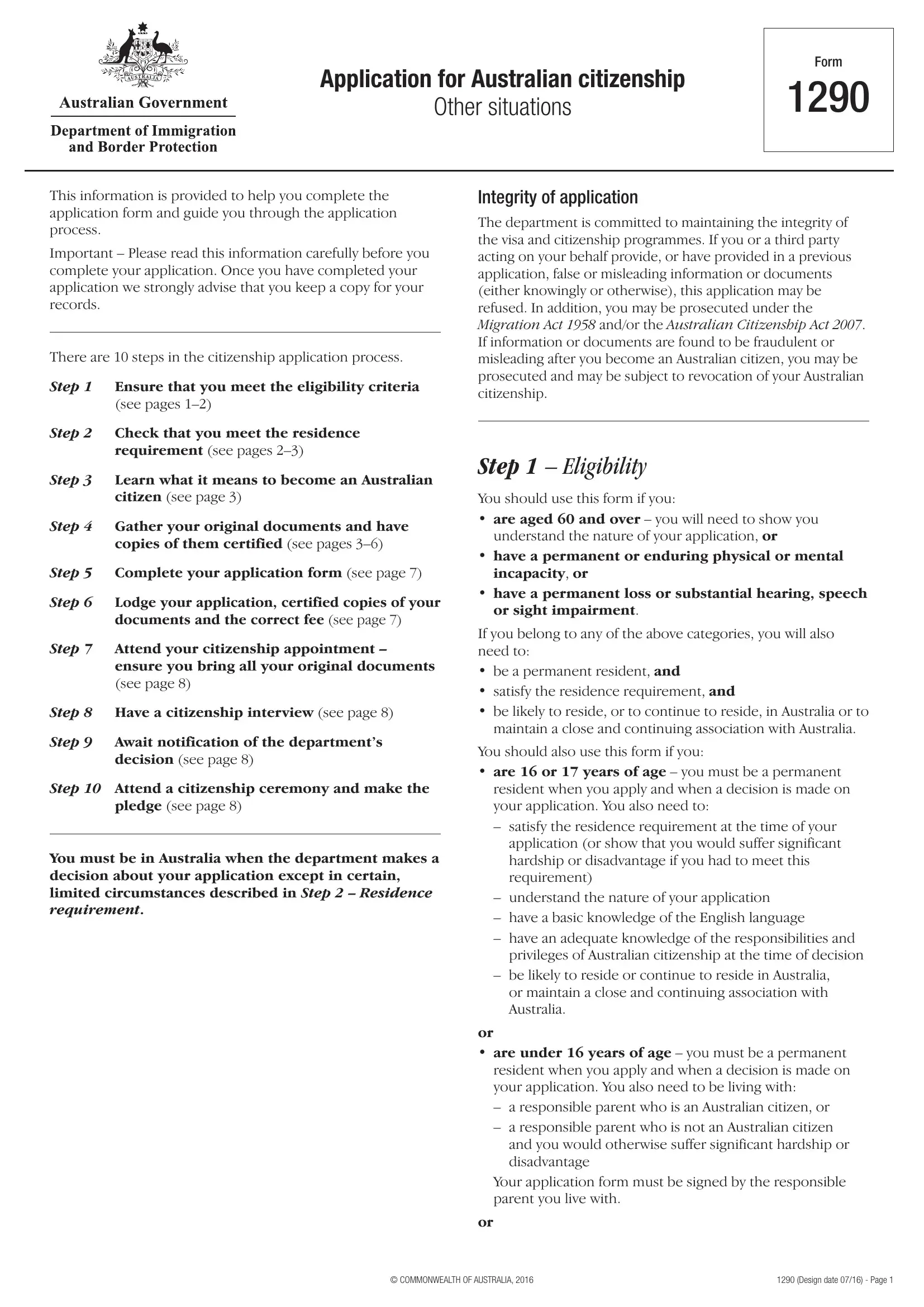
Application for Australian citizenship

Other situations

Form

1290

This information is provided to help you complete the application form and guide you through the application process.

Important – Please read this information carefully before you complete your application. Once you have completed your application we strongly advise that you keep a copy for your records.

There are 10 steps in the citizenship application process.

Step 1 Ensure that you meet the eligibility criteria

(see pages 1–2)

Step 2 Check that you meet the residence requirement (see pages 2–3)

Step 3 Learn what it means to become an Australian citizen (see page 3)

Step 4 Gather your original documents and have copies of them certified (see pages 3–6)

Step 5 Complete your application form (see page 7)

Step 6 Lodge your application, certified copies of your documents and the correct fee (see page 7)

Step 7 Attend your citizenship appointment – ensure you bring all your original documents

(see page 8)

Step 8 Have a citizenship interview (see page 8)

Step 9 Await notification of the department’s decision (see page 8)

Step 10 Attend a citizenship ceremony and make the pledge (see page 8)

You must be in Australia when the department makes a decision about your application except in certain, limited circumstances described in Step 2 – Residence requirement.

Integrity of application

The department is committed to maintaining the integrity of the visa and citizenship programmes. If you or a third party acting on your behalf provide, or have provided in a previous application, false or misleading information or documents (either knowingly or otherwise), this application may be refused. In addition, you may be prosecuted under the Migration Act 1958 and/or the Australian Citizenship Act 2007. If information or documents are found to be fraudulent or misleading after you become an Australian citizen, you may be prosecuted and may be subject to revocation of your Australian citizenship.

STEP 1 – Eligibility

You should use this form if you:

are aged 60 and over – you will need to show you understand the nature of your application, or

have a permanent or enduring physical or mental incapacity, or

have a permanent loss or substantial hearing, speech or sight impairment.

If you belong to any of the above categories, you will also need to:

be a permanent resident, and

satisfy the residence requirement, and

be likely to reside, or to continue to reside, in Australia or to maintain a close and continuing association with Australia.

You should also use this form if you:

are 16 or 17 years of age – you must be a permanent resident when you apply and when a decision is made on your application. You also need to:

satisfy the residence requirement at the time of your application (or show that you would suffer significant hardship or disadvantage if you had to meet this requirement)

understand the nature of your application

have a basic knowledge of the English language

have an adequate knowledge of the responsibilities and privileges of Australian citizenship at the time of decision

be likely to reside or continue to reside in Australia, or maintain a close and continuing association with Australia.

or

are under 16 years of age – you must be a permanent resident when you apply and when a decision is made on your application. You also need to be living with:

a responsible parent who is an Australian citizen, or

a responsible parent who is not an Australian citizen and you would otherwise suffer significant hardship or disadvantage

Your application form must be signed by the responsible parent you live with.

or

© COMMONWEALTH OF AUSTRALIA, 2016

1290 (Design date 07/16) - Page 1

are an unaccompanied humanitarian minor – if you are an unaccompanied humanitarian minor and you are a ward of the Minister, then your application requires the consent of the Minister’s delegate.

If you are an unaccompanied humanitarian minor and you are not a ward of the Minister then your application requires the consent of your responsible carer.

were born in Papua before 16 September 1975 and one of your parents was born in Australia, as it is now, and was an Australian citizen at the time of your birth, or

were born to a former Australian citizen who automatically lost Australian citizenship by acquiring the citizenship of another country as an adult.

The Citizenship Wizard on the citizenship website can help you check your eligibility.

Good character

If you are 18 years of age and over, you will need to show you are of good character.

New Zealand citizens

Special eligibility conditions apply for New Zealand citizens who arrived in Australia before 26 February 2001 (see New Zealand citizens on page 9).

Children

Children under 16 years of age can be included on a responsible parent’s application form, or can apply on their own form.

The Australian Citizenship Act 2007 defines responsible parent in relation to a child as:

a parent, unless that parent does not have parental responsibility because of orders made by the Family Court of Australia, or

any person having responsibility over the child because of an order made by the Family Court, or

any person who has guardianship or custody of the child under an Australian law or a foreign law, whether because of adoption, operation of law, an order of a court or otherwise.

STEP 2 – Residence requirement

The residence requirement is based on the time you have lived in Australia and the time you have spent outside Australia. The Residence Requirement Calculator on the citizenship website can help you calculate whether you meet this requirement.

General residence requirement

Permanent residents must:

have been living in Australia on a valid Australian visa for

4 years immediately before applying which must include the last 12 months as a permanent resident, and

not have been absent from Australia for more than one year in the past 4 years, including no more than 90 days in the year before applying.

Special residence requirements

Special residence requirements may apply to you if:

you are seeking to undertake activities that are supported by particular organisations, such as the Australian Olympic Committee, or

you have been engaged in particular kinds of work for a total of 2 in the past 4 years, that required you to travel outside Australia.

Additional documents are required to apply for either of these special residence requirements.

For more information see Special residence requirements applicants on page 9.

Note: If you have spent time in prison or a psychiatric institution by order of a court in the 4 years immediately before making your application, that time during which you were confined cannot be counted as residence in Australia.

Defence service requirement

You meet the residence requirement if you have completed relevant defence service, which is if you:

were appointed, enlisted or transferred into any of the permanent forces or reserves of the Commonwealth of Australia, and

have served 90 days in the permanent forces, or

have served a total of 90 paid service days in the navy, army or air force reserve, or

were discharged from defence service as medically unfit for service as a result of that service.

If you are a member of the family unit of a defence person you meet the residence requirement if:

the defence person was granted one of the following visas on or after 1 July 2007: Labour Agreement (Migrant) Class AU, Labour Agreement (Residence) Class BV, Employer Nomination (Permanent) Class EN, Regional Employer Nomination (Permanent) Class RN, and

you were included as an applicant in the visa application of the defence person and were granted the same type of visa at the same time, and

you still hold that same visa, and

the defence person has completed relevant defence service or dies while undertaking that service.

Ministerial discretions

There are a number of ministerial discretions which may be applied to an application to assist a person to meet the residence requirement for Australian citizenship.

1.If you were in Australia as an unlawful non-citizen during the 4 years immediately before making your application and it was as the result of an administrative error, then that period of time may be treated as a period of lawful residence in Australia.

2.If you were in Australia as a lawful non-citizen but not as a permanent resident as the result of an administrative error, then that period of time may be treated as a period of permanent residence.

3.If you were in Australia as a lawful non-citizen, but not as a permanent resident during the 12 months immediately before application, then that period of time may be treated as a period of permanent residence if you would otherwise suffer significant hardship or disadvantage.

1290 (Design date 07/16) - Page 2

© COMMONWEALTH OF AUSTRALIA, 2016

4.Time spent in prison or a psychiatric institution by order of a court in the 4 years immediately before making your application may be counted as time in Australia if your conviction has been quashed.

5.If you are the spouse or de facto partner of an Australian citizen, or surviving spouse or partner of an Australian citizen at the time you make your application, and you spent time outside Australia as a permanent resident in the 4 years immediately before making your application, you may treat those periods of absence as time in Australia if, during each period of absence:

you were the spouse or de facto partner of that Australian citizen, and

they were an Australian citizen, and

you maintained a close and continuing association with Australia.

6.If you spent time outside Australia as a permanent resident in the 12 months immediately before making your application, as the holder of an interdependent visa and your interdependent partner was an Australian citizen during your periods of absence, you may treat those periods of absence as time in Australia if you had a close and continuing association with Australia during those periods of absence.

You will need to provide documents to support your claims at the time you lodge your application.

STEP 3 – Learn what it means to become an Australian citizen

It is important that you understand what becoming an Australian citizen involves. The citizenship resource book or DVD, Australian Citizenship: Our Common Bond provides useful information. To download the book or watch the DVD, visit the department’s website www.border.gov.au/trav/citi/ lear/citizenship-test/Australian-citizenship-test-resource

Translations and certified copies

If your documents are not in English, you must provide official translations. In Australia, you must use translators accredited by the National Accreditation Authority of Translators and Interpreters. For more information,

see www.naati.com.au

Unless specified that original documents are required, certified copies of original documents must be attached to your application. These copies must be certified by a person with the appropriate authority. See Identity declarations – list of professions on pages 9–10 for people who can certify documents.

If you are outside Australia when applying, contact the Australian diplomatic mission in the country that issued the documents for advice on acceptable translators, and who can certify your original documents.

If you need to provide overseas penal clearance certificates with your application, you must provide original certificates.

Identity documents

Applicants 16 years of age or over

You must provide identity documents for yourself and all children included in your application.

For yourself, you must provide the following documents.

1.Three original documents that collectively show your:

photograph

signature

current residential address

birth name, date of birth and gender.

2.Proof of change of name, if applicable.

3.Part F – Identity declaration completed by a person with the appropriate authority.

If you do not provide these documents, your application will not be accepted and will be returned to you.

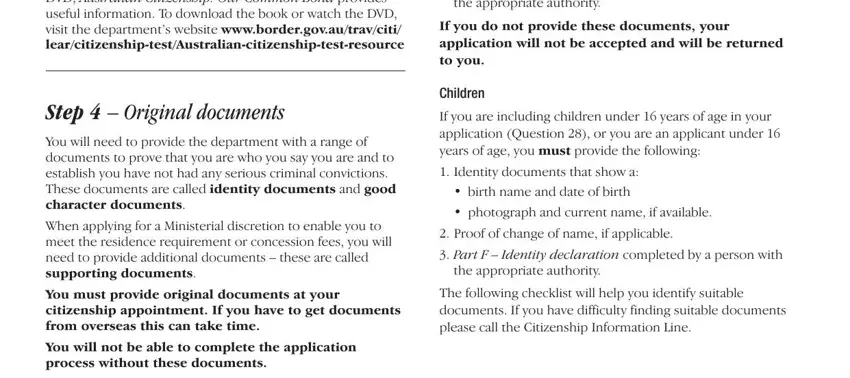
STEP 4 – Original documents

You will need to provide the department with a range of documents to prove that you are who you say you are and to establish you have not had any serious criminal convictions. These documents are called identity documents and good character documents.

When applying for a Ministerial discretion to enable you to meet the residence requirement or concession fees, you will need to provide additional documents – these are called supporting documents.

You must provide original documents at your citizenship appointment. If you have to get documents from overseas this can take time.

You will not be able to complete the application process without these documents.

Children

If you are including children under 16 years of age in your application (Question 28), or you are an applicant under 16 years of age, you must provide the following:

1.Identity documents that show a:

birth name and date of birth

photograph and current name, if available.

2.Proof of change of name, if applicable.

3.Part F – Identity declaration completed by a person with the appropriate authority.

The following checklist will help you identify suitable documents. If you have difficulty finding suitable documents please call the Citizenship Information Line.

© COMMONWEALTH OF AUSTRALIA, 2016

1290 (Design date 07/16) - Page 3

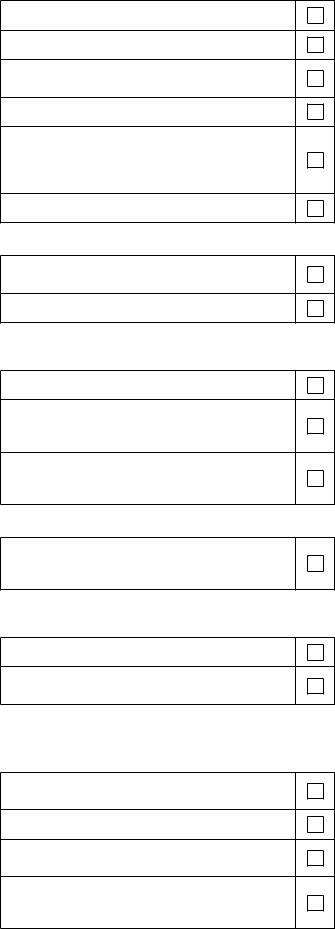
Identity document checklist

Attach certified copies of relevant documents to your application. Bring original documents to your appointment.

Applicants 16 years of age or over

A current document with your photograph and/or signature

An Australian driver’s licence, or

A passport, or

A United Nations High Commissioner for Refugees (UNHCR) document, or

A national identity card, or

Another document containing a signature and photograph, eg. an air crew identity document, seafarer identity document, military identity document or student card

Document for travel to Australia (DFTTA)

Evidence of your current residential address

A utilities notice eg. electricity, gas or water bill, bank notice, or

Rental contracts or rates notice

Evidence of your date of birth, birth name and any changes of name

A full birth certificate

Evidence of links between present and previous names, for example a marriage or divorce certificate, if applicable

A certificate issued by an Australian Registry of Births, Deaths and Marriages as evidence of other changes of name, if applicable

Evidence of your identity in the community

One passport-sized photograph and identity declaration signed by an Australian citizen with the appropriate authority

Evidence of when you first arrived in Australia and your present country of citizenship

Current and previous passport, or

Travel document with visa such as a Document for Travel to Australia, PLO56 (M56), Titre de Voyage

Children

The following documents are required for all children under 16 years of age

A full birth certificate or family register containing parent’s details

Passport or travel document

Evidence of links between birth name and current name, if applicable

One passport-sized photograph and identity declaration signed by an Australian citizen with the appropriate authority

Identity declaration

Applicants 16 years of age or over

As well as your identity documents, you will need to provide an identity declaration and an endorsed passport-sized photograph of yourself.

The identity declaration must be completed and signed by an Australian citizen who:

has known you for at least one year and belongs to a profession on the list on pages 9–10, and

is not related to you by birth, marriage or de facto relationship, and

is easy to contact by telephone during normal working hours.

Note: If you are outside Australia when applying you can have the identity declaration completed by a citizen of your country of residence who has known you for at least one year and belongs to a profession on the list on pages 9–10.

Photograph requirements

The person who signs the declaration must also write on the back of your photograph the words: This is a true photograph of (your full name) and sign the back of the photograph using the same signature as on the declaration.

The photograph should be carefully attached to the front of the application form without obscuring the image, or you can place the photograph in a plastic sleeve or envelope and staple it to the form.

The photograph must be:

no more than 6 months old

a full-face view of your head and shoulders (untinted prescription glasses can be worn – a photograph that shows facial features only is acceptable if you wear a head covering for religious reasons)

of good quality, in colour, against a plain, light coloured background (laser copies are not acceptable).

Children

An identity declaration and endorsed photograph are required if you are an applicant under 16 years of age, or for each child under 16 years of age you are including in your application at Question 28.

If you are including more children than the space on the application form allows, please use form 1195 Identity declaration for each additional child.

The declaration and photograph should be signed by an Australian citizen who has known your child for at least one year and belongs to a profession on the list on pages 9–10.

In the case of children under 6 years of age, if no Australian citizen has known them for one year, the declaration can be signed by a person who has known them for less than one year and belongs to a profession on the list on pages 9–10.

The photograph of each child should be individually attached to the front of the application form without obscuring the image, or you can place the photographs in a plastic sleeve or envelope and staple it to the form.

1290 (Design date 07/16) - Page 4

© COMMONWEALTH OF AUSTRALIA, 2016

Circumstances when an application cannot be approved

If any of the following circumstances apply to you your application for Australian citizenship cannot be approved:

your identity cannot be verified.

you are not in Australia at the time of decision on your application and have applied for citizenship under the provisions for incapacity, a hearing, speech or sight impairment or are aged 60 or over. (If you have an Australian citizen spouse or partner the decision maker may use a discretion to approve your application while you are outside Australia.)

it is less than 12 months since you last ceased to be an Australian citizen.

there is an adverse or qualified security assessment in place in relation to you, or you have been convicted of a national security offence.

Criminal offences

If you are 16 years of age or over, the department will request a National Police check from the National Police Checking Service (NPCS).

If any of the following circumstances apply to you, your application for Australian citizenship cannot be approved:

when proceedings for an offence against an Australian law (including proceedings by way of appeal or review) are pending.

when it is less than 2 years since you were released from prison after serving a prison sentence of 12 months or more, or 10 years if you are a repeat offender.

you are subject to certain conditions set by an Australian court (such as being released on parole, good behaviour or bail) where action may be taken against you for breach of those conditions.

you are in prison or a psychiatric institution by order of the court at the time of decision.

Good character

If you are 18 years of age or over, you will also need to be assessed under the good character requirement.

Convictions

You must tell the department about any convictions you may have had in Australia or overseas.

A conviction is a criminal charge leading to a guilty verdict in a court of law resulting in imprisonment or a fine or good behaviour bond. A traffic infringement, such as an on-the-spot speeding or parking fine is not considered a conviction.

If any of the above apply to you at the time you lodge your application please call the Citizenship Information Line.

Spent convictions

You must declare spent convictions in your application.

The spent convictions law allows people with minor convictions to disregard those convictions after a certain period of time. A conviction may be considered spent if:

it is 10 years since the date of the conviction (or 5 years for juvenile offenders), and

the person was not sentenced to imprisonment for more than 30 months, and

the person has not re-offended during the 10 years (or 5 years for juveniles) period, and

a statutory or prescribed exclusion does not apply.

The department is allowed to ask you for this information for the purpose of assessing your application.

Please refer to and read the information regarding spent convictions at www.border.gov.au/citizenship

Overseas penal clearance certificates

Overseas penal clearance certificates, or police checks as they are known in some countries, show whether a person has a criminal record.

You may need to provide an overseas penal clearance certificate as part of your documentation if you are 18 years of age or over.

When to provide overseas penal clearance certificates

Penal clearance certificates from overseas countries are required if:

you lived or travelled outside Australia since the age of 18 years or over, and

you held a permanent Australian visa at that time, and

the total time spent outside Australia added up to 12 months or more, and

the time spent in any one country was more than 90 days, or

requested by the department.

You will need to provide original overseas penal clearance certificates from each country where you spent more than 90 days.

In addition, New Zealand citizens who do not hold a permanent visa, must provide a penal clearance certificate from New Zealand if they have left Australia since the age of 18, irrespective of destination or the amount of time spent overseas. For more information contact the Citizenship Information Line.

Information about where to obtain an overseas penal clearance certificate by country can be obtained from the citizenship website or contact the Citizenship Information Line.

Supporting documents

Documents supporting your application are required for a variety of reasons, such as:

to request a Ministerial discretion to enable you to meet the residence requirement

to provide evidence that your spouse or partner is an Australian citizen

to claim fee concessions (form 1298i Citizenship fees provides a list of fees and concessions)

to provide evidence you are a responsible parent of children included in your application

to confirm your identity if you are completing the application form on behalf of an applicant under 16 years of age.

The following checklist provides a list of supporting documents commonly required. Attach certified copies of relevant documents to your application. Bring original documents to your appointment.

You may be required to provide additional documents to those listed.

If you are overseas when you are applying, you should check the website of the nearest overseas Australian immigration office for more information before posting your application to Australia.

© COMMONWEALTH OF AUSTRALIA, 2016

1290 (Design date 07/16) - Page 5

How to Edit Form 1290 Online for Free

With the help of the online editor for PDFs by FormsPal, you may fill out or modify application 1290 form here and now. Our editor is consistently evolving to give the best user experience possible, and that is thanks to our commitment to constant development and listening closely to customer opinions. This is what you will have to do to begin:

Step 1: Access the PDF form in our tool by clicking the "Get Form Button" in the top area of this page.

Step 2: When you open the online editor, you will get the document prepared to be completed. In addition to filling out different blank fields, you can also perform many other things with the PDF, namely writing any words, changing the original text, adding illustrations or photos, affixing your signature to the document, and much more.

This form will need particular details to be entered, therefore be sure you take the time to type in precisely what is expected:

1. The application 1290 form necessitates specific information to be entered. Ensure the next blank fields are complete:
Simple tips to complete 1290 application portion 1

2. Just after filling in the last section, head on to the next part and complete the essential particulars in these blanks - The identity declaration must be, profession on the list on pages, is not related to you by birth, relationship and, is easy to contact by telephone, Note If you are outside Australia, Photograph requirements, The person who signs the, The photograph should be carefully, The photograph must be no more, prescription glasses can be worn, A current document with your, An Australian drivers licence or, A passport or, and A United Nations High Commissioner.
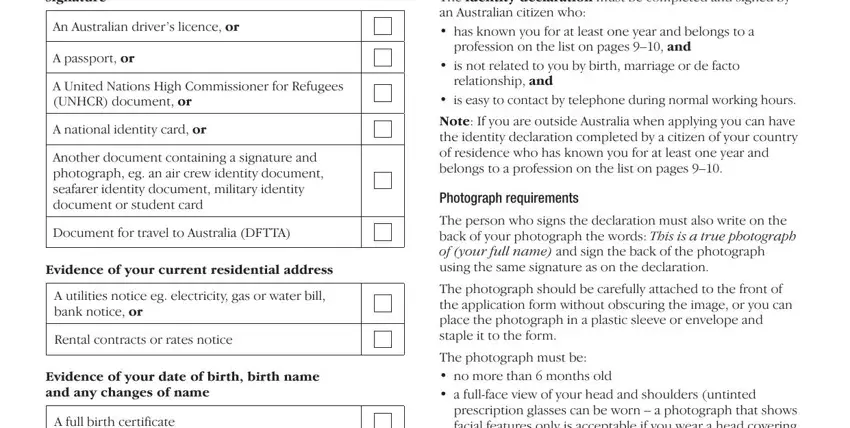
How you can prepare 1290 application stage 2

3. The next step should also be pretty easy, prescription glasses can be worn, of good quality in colour against, background laser copies are not, Children, An identity declaration and, If you are including more children, The declaration and photograph, In the case of children under, The photograph of each child, Evidence of links between present, A certificate issued by an, Evidence of your identity in the, One passportsized photograph and, Evidence of when you first arrived, and Current and previous passport or - all of these form fields is required to be filled in here.
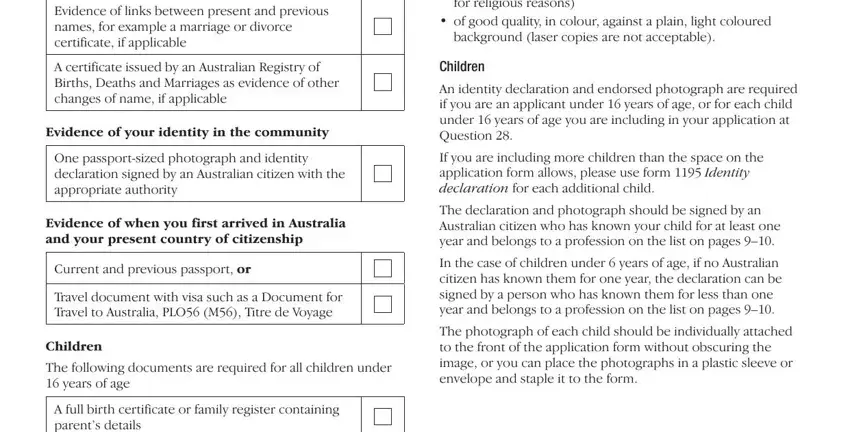
How one can prepare 1290 application part 3

4. This specific section arrives with these particular blank fields to fill out: A full birth certificate or family, Passport or travel document, Evidence of links between birth, One passportsized photograph and, Design date Page, and COMMONWEALTH OF AUSTRALIA.
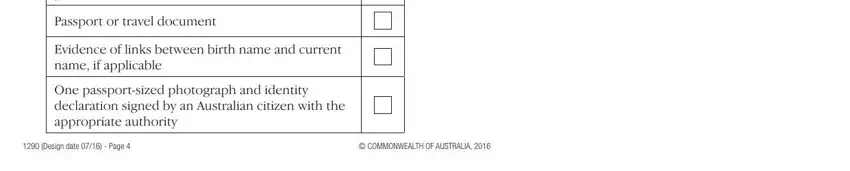
Writing segment 4 of 1290 application

Be really attentive while completing Passport or travel document and COMMONWEALTH OF AUSTRALIA, since this is where many people make errors.

5. The form should be wrapped up within this section. Further you can see a detailed list of blanks that require accurate information in order for your form usage to be faultless: Medical evidence of a permanent or, Medical evidence of permanent loss, Evidence of your birth in Papua, Evidence of the need for a fee, A letter from the Child Migrants, Evidence of your birth to a former, Evidence of residence New Zealand, Evidence of relevant defence, A letter or discharge papers from, Evidence for Ministerial, Discretions and, Evidence of a departmental, Discretion, A statement and appropriate, and Discretion.
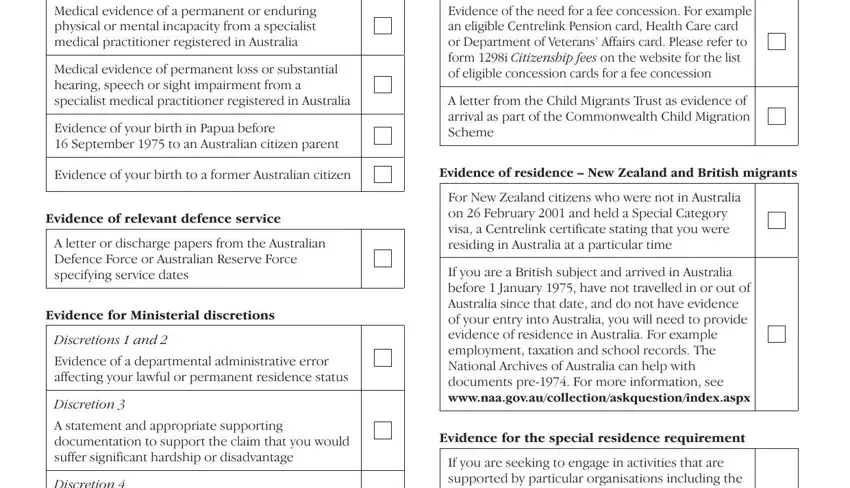
Stage number 5 of completing 1290 application

Step 3: Spell-check everything you have typed into the blanks and then click on the "Done" button. After setting up a7-day free trial account here, you will be able to download application 1290 form or email it without delay. The PDF form will also be readily available via your personal account menu with your each and every change. When you use FormsPal, you're able to fill out forms without stressing about information leaks or data entries being distributed. Our protected system helps to ensure that your private details are maintained safely.