
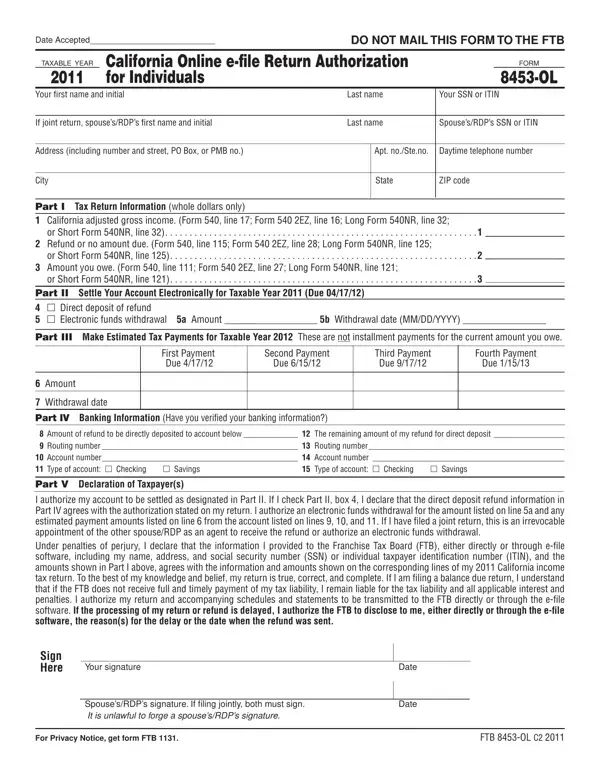
Form 8453-OL at a glance
What it is: 2025 Instructions, Page 1: Form FTB 8453-OL, California Online e-file Return Authorization for Individuals, is the signature document for self-prepared individual e-file returns.[2]
Where and when to file: Do not mail this form to the FTB.
Who signs: Spouse's/RDP's signature. If filing jointly, both must sign. It is unlawful to forge a spouse's/RDP's signature.
A filled-in Form 8453-OL example: a refund deposited in one checking account
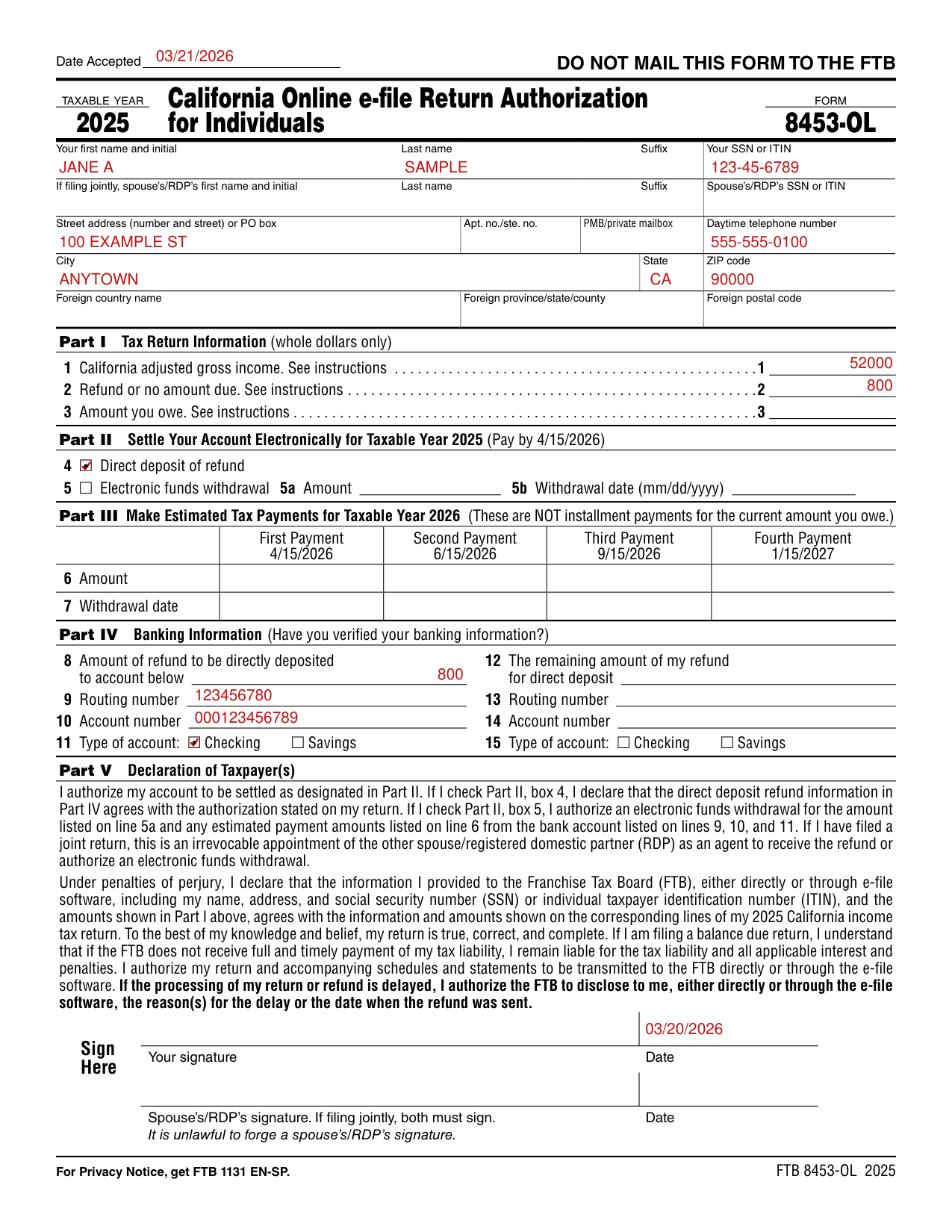
How to fill out Form 8453-OL, box by box
Date Accepted

Enter the date the FTB accepts the return in the space at the top of form FTB 8453-OL.[2]
Your name, SSN, address and telephone
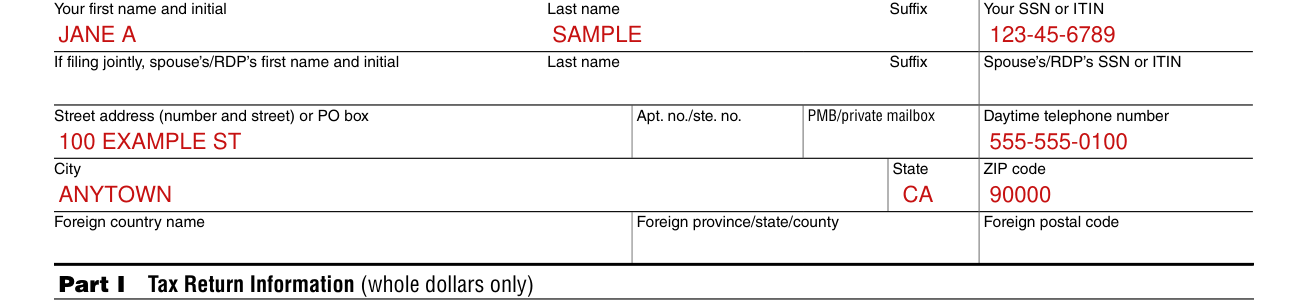
Enter your first name and initial, Last name, Suffix and your SSN or ITIN.
If filing jointly, enter spouse's/RDP's first name and initial, Last name, Suffix and Spouse's/RDP's SSN or ITIN.
Enter Street address (number and street) or PO box, Apt. no./ste. no., PMB/private mailbox and Daytime telephone number, then City, State and ZIP code.
Enter Foreign country name, Foreign province/state/county and Foreign postal code.
Part I Tax Return Information (whole dollars only)

On line 1, California adjusted gross income, enter the same amount you entered on your original or amended return: Form 540, line 17; Form 540 2EZ, line 16; Form 540NR, line 32. On line 2, Refund or no amount due, enter the same amount you entered on your original return: Form 540, line 115; Form 540 2EZ, line 36; Form 540NR, line 125. If you are amending your return, enter on line 2 the same amount you entered on your California Schedule X, California Explanation of Amended Return Changes, line 11. On line 3, Amount you owe, enter the same amount you entered on your original return: Form 540, line 111; Form 540 2EZ, line 35; Form 540NR, line 121. If you are amending your return, enter on line 3 the same amount you entered on your California Schedule X, line 7.[2]
Part II Settle Your Account Electronically

For Taxable Year 2025, using direct deposit or electronic funds withdrawal is voluntary and applies only to the return you are filing at this time. If you want your refund directly deposited into one or more accounts or your payment withdrawn electronically from your account, you must complete the applicable Parts II and IV before transmitting the return. The FTB will not honor requests completed after transmission of the return.
Pay by electronic funds withdrawal (EFW): You can have all or part of your balance due withdrawn electronically from your bank account on the date you choose.
To cancel an electronic funds withdrawal, you must call FTB e-Programs Customer Service at 916.845.0353 at least two working days before the date of the withdrawal.[2]
Part III Make Estimated Tax Payments

When you e-file, you may opt to schedule the electronic payment of estimated tax payments for taxable year 2026. The amounts you designate on line 6 will be withdrawn from the account listed on lines 9, 10, and 11 on the date you select. Be sure to select a date on or before the due date of the estimated tax payment to avoid penalties and interest charges.
Enter the line 6 Amount and the line 7 Withdrawal date for the First Payment 4/15/2026, the Second Payment 6/15/2026, the Third Payment 9/15/2026 and the Fourth Payment 1/15/2027.
FTB 8453-OL Instructions 2025, Page 2: To cancel a scheduled estimated tax payment, you must call FTB e-Programs Customer Service at 916.845.0353 at least two working days before the date of the withdrawal.[2]
Part IV Banking Information

Individual taxpayers may request that their refund be electronically deposited into more than one checking or savings account. It's fast, safe, and convenient to have your refund directly deposited into your bank account.
Enter 8 Amount of refund to be directly deposited, then 9 Routing number, 10 Account number and 11 Type of account: Checking or Savings.
Enter 12 The remaining amount of my refund for direct deposit, then 13 Routing number, 14 Account number and 15 Type of account: Checking or Savings.
Lines 8 and 12 are the refund amounts you designated for direct deposit. Lines 9 and 13: The routing number must be nine digits. The first two digits must be between 01 and 12 or 21 and 32.
Lines 10 and 14: The account number can be up to 17 characters and can include numbers and letters. Include hyphens but omit spaces and special symbols.[2]
Part V Declaration of Taxpayer(s) and Sign Here
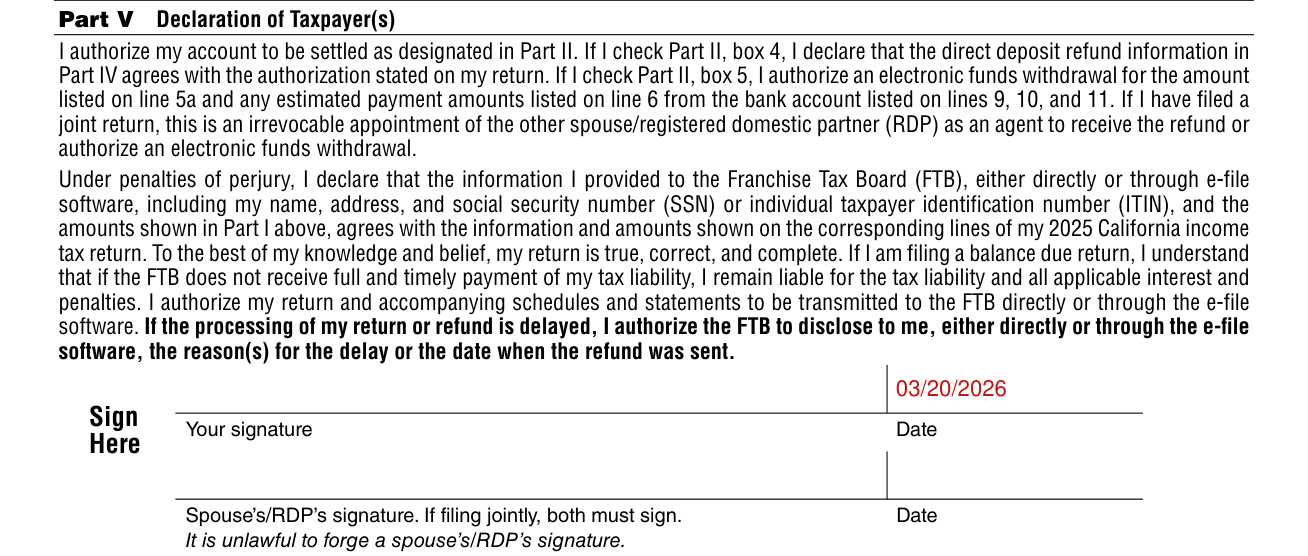
An e-filed tax return is not considered complete or filed unless you sign form FTB 8453-OL before you transmit the return.
If you check Part II, box 4, you declare that the direct deposit refund information in Part IV agrees with the authorization stated on your return. If you check Part II, box 5, you authorize an electronic funds withdrawal for the amount listed on line 5a and any estimated payment amounts listed on line 6 from the bank account listed on lines 9, 10, and 11. If you have filed a joint return, this is an irrevocable appointment of the other spouse/registered domestic partner (RDP) as an agent to receive the refund or authorize an electronic funds withdrawal. Under penalties of perjury, you declare that the amounts shown in Part I above agree with the information and amounts shown on the corresponding lines of your 2025 California income tax return. If you are filing a balance due return, you understand that if the FTB does not receive full and timely payment of your tax liability, you remain liable for the tax liability and all applicable interest and penalties. If the processing of your return or refund is delayed, you authorize the FTB to disclose to you, either directly or through the e-file software, the reason(s) for the delay or the date when the refund was sent.
Spouse's/RDP's signature. If filing jointly, both must sign. It is unlawful to forge a spouse's/RDP's signature.[2]
More rules for Form 8453-OL
By signing this form, you declare that the return is true, correct, and complete. Additionally, you authorize the electronic transmission of the return to the Franchise Tax Board (FTB) and the execution of any designated electronic account settlement.[2]
A deceased taxpayer
Deceased taxpayer(s)
Deceased taxpayer(s): The legal representative (e.g., beneficiary, administrator, or executor) of the deceased taxpayer's estate must sign form FTB 8453-OL before the return is transmitted. If you are the surviving spouse/registered domestic partner (RDP) and no administrator or executor has been appointed, you may still file a joint return for the year of death. Write next to your signature that you are the surviving spouse/RDP. Also, write "Deceased" and the date of death next to the name of the deceased taxpayer. If you file a return and claim a refund due to a deceased taxpayer, you are certifying under penalty of perjury either that you are the legal representative of the deceased taxpayer's estate (in this case, you must attach certified copies of the letters of administration or letters testamentary to form FTB 8453-OL) or that you are entitled to the refund as the deceased's surviving relative or sole beneficiary under the provisions of the California Probate Code. You must also attach a copy of federal Form 1310, Statement of Person Claiming Refund Due a Deceased Taxpayer, and a copy of the death certificate to form FTB 8453-OL.[2]
Before you go
Before you e-file your return, you must verify all information on the form FTB 8453-OL, including social security number(s) (SSN), individual taxpayer identification number(s) (ITIN), and banking information. Reconfirm your routing and account numbers. Inspect a copy of the return and ensure the information is correct. Sign form FTB 8453-OL after you prepare the return, but before you transmit it.
Common questions about Form 8453-OL
Is there a deadline?
If you owe tax, you must pay it by April 15, 2026, to avoid penalties and interest. (When the due date falls on a weekend or holiday, the deadline to file and pay without penalty is extended to the next business day.)[2]
Where do I file it?
Do not mail this form to the FTB. After you e-file your return, you should retain the following documents for the California statute of limitations period: Form FTB 8453-OL. Original federal Form(s) W-2, Wage and Tax Statement; W-2G, Certain Gambling Winnings; and 1099-R, Distributions From Pensions, Annuities, Retirement or Profit-Sharing Plans, IRAs, Insurance Contracts, etc. A paper copy of Form 540, California Resident Income Tax Return; Form 540 2EZ, California Resident Income Tax Return; or Form 540NR, California Nonresident or Part-Year Resident Income Tax Return. A paper copy of your federal tax return. A paper copy of your other state income tax return if you claimed the Other State Tax Credit.[2]
Are there fees?
Pay by credit card: You can use your Discover, MasterCard, Visa, or American Express card to pay your tax. ACI Payments, Inc. (formerly Official Payments) charges a convenience fee for using this service.[2]
Is there a penalty?
If you owe tax and do not pay it by April 15, 2026, penalties and interest apply. If the bank or financial institution rejects the electronic funds withdrawal due to an error in the routing number or account number, the FTB will send you a notice that may include penalties and interest.[2]
Sources
[1] Form FTB 8453-OL (2025), California Online e-file Return Authorization for Individuals, Franchise Tax Board (the Official source link on this page).
[2] 2025 Instructions for Form FTB 8453-OL, Franchise Tax Board.