
Form C100 at a glance
What it is: Form C100 is the application under section 8 of the Children Act 1989 for a child arrangements, prohibited steps or specific issue order.
Who signs: Sign as the Applicant or as the Applicant's legal representative (as defined by FPR 2.3(1)), then enter the Date as Day Month Year.
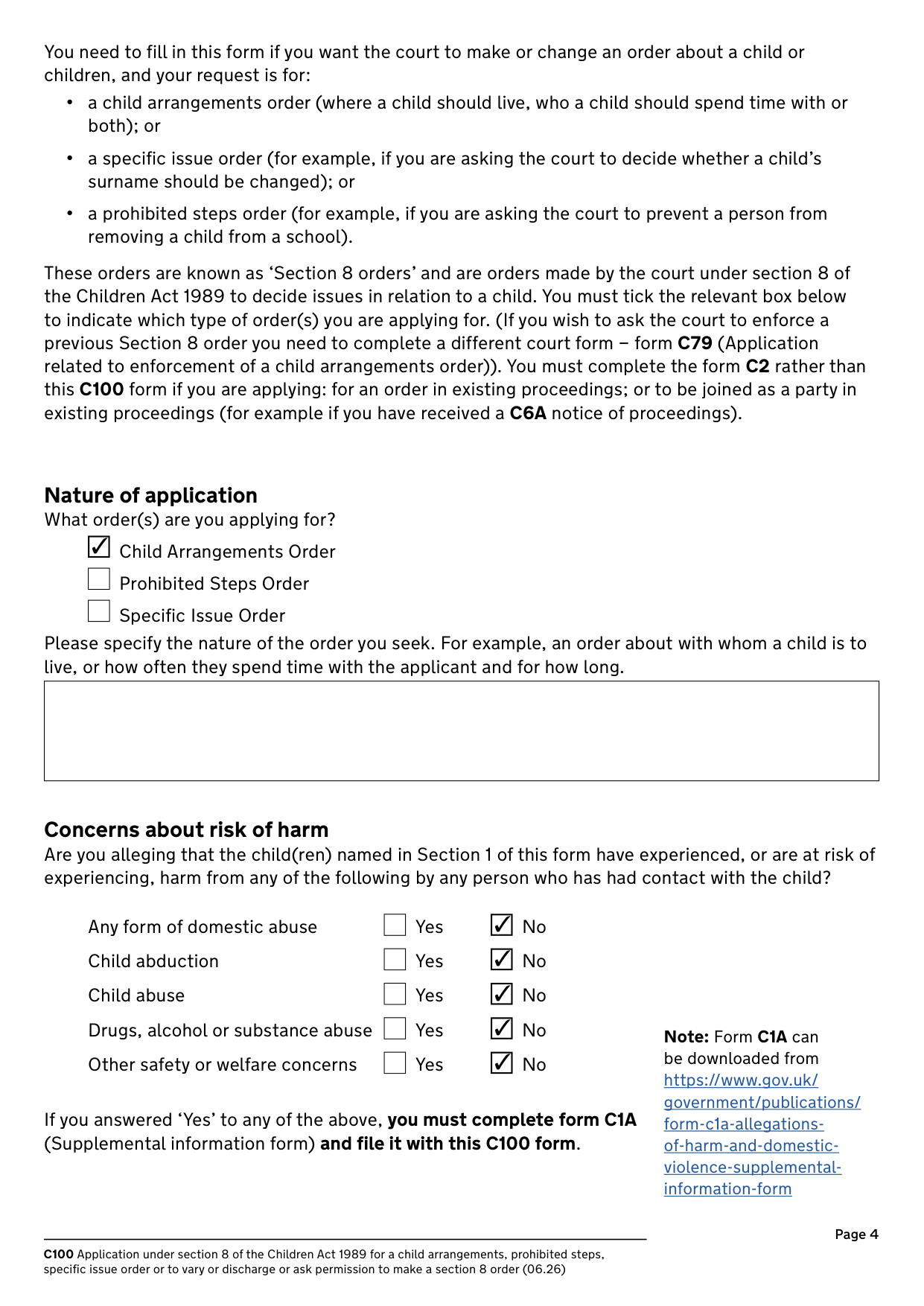
You need to fill in this form if you want the court to make or change an order about a child or children, and your request is for: a child arrangements order (where a child should live, who a child should spend time with or both); or a specific issue order (for example, if you are asking the court to decide whether a child's surname should be changed); or a prohibited steps order (for example, if you are asking the court to prevent a person from removing a child from a school).
What to bring and attach to Form C100
If you are sending the court a physical copy of this form, you must send at least three copies. This is because one copy will be kept by the court, one will be sent to you and one will be sent to the respondent.
A filled-in Form C100 example: a parent asks for a child arrangements order
How to fill out Form C100, box by box
Nature of application
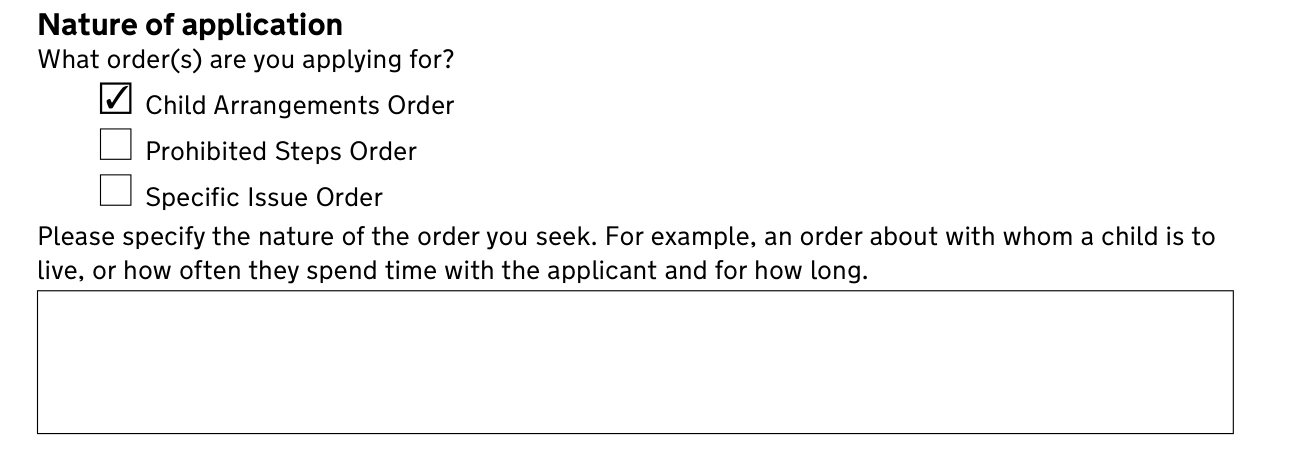
You must tick the relevant box to indicate which type of order(s) you are applying for. Nature of application: What order(s) are you applying for?
You must complete the form C2 rather than this C100 form if you are applying: for an order in existing proceedings; or to be joined as a party in existing proceedings (for example if you have received a C6A notice of proceedings).
If you wish to ask the court to enforce a previous Section 8 order you need to complete a different court form, form C79 (Application related to enforcement of a child arrangements order).
Concerns about risk of harm
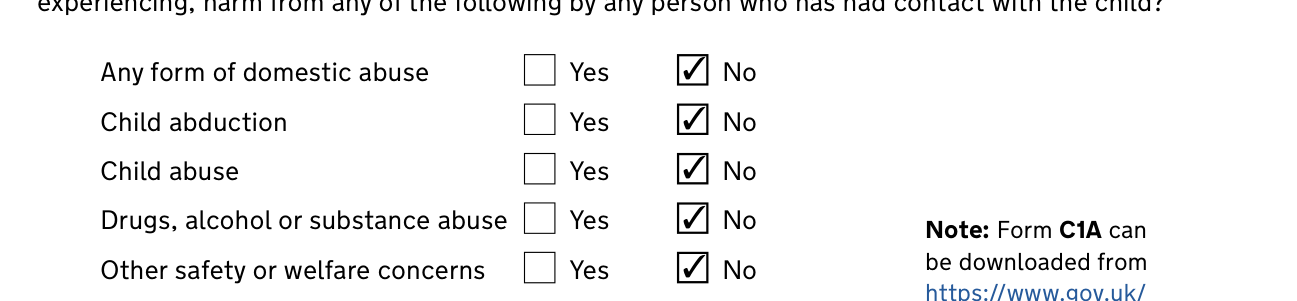
Are you alleging that the child(ren) named in Section 1 of this form have experienced, or are at risk of experiencing, harm from any of the following by any person who has had contact with the child?
Any form of domestic abuse, child abduction, child abuse, drugs, alcohol or substance abuse, other safety or welfare concerns: Yes No.
If you answered Yes to any of these, you must complete form C1A (Supplemental information form) and file it with this C100 form.
Other sections, MIAM exemptions, urgent hearings and confidential contact details
Additional information required
Additional information required. Note A1 and A2: Permission may be required depending on your relationship to the child(ren).
A1. Are you asking for permission to make this application, where that is required? Yes. Complete Section 5.
A2. Is there an order under section 91(14) Children Act 1989, a limited civil restraint order, a general civil restraint order or an extended civil restraint order in force which means you need permission to make this application? Yes. Attach a copy of the order to this form. Complete Section 5.
A3. Is an urgent hearing or without notice hearing required? Yes. Complete Section 6.
A4. Are there previous or ongoing proceedings for the child(ren)? Yes. Complete Section 7.
A5. Are you applying for an order to formalise an agreement (consent order)? Yes. Attach the draft order to this form, signed by both parties.
A6. Is this a case with a Scotland or Northern Ireland element. Yes. Complete Section 8.
A7. Is this a case with an international element or factors affecting litigation capacity? Yes. Complete Section 8 or 9.
A8. Will the child or any of the people involved want to use spoken or written Welsh during the course of the proceedings? Yes. Complete Section 10.
Requirement to attend a Mediation Information and Assessment Meeting (MIAM)
Before making an application for a child arrangements order, prohibited steps order or specific issue order (a section 8 order) you must first attend a Mediation Information and Assessment Meeting (MIAM).
You must have attended a MIAM before making this application unless the requirement to attend a MIAM does not apply because: the section 8 order you are applying for is a consent order; or the section 8 order you are applying for concerns a child who is the subject of separate ongoing emergency proceedings, care proceedings or supervision proceedings (or is already the subject of an emergency, care or supervision order); or you are exempt from the requirement to attend a MIAM.
Where evidence is required to support a MIAM exemption claim, you must submit this evidence alongside your application.
2.1 If you ticked Yes to the question A4 about current or previous court cases, are/were any of those cases about an emergency protection, care or supervision order? Yes. Complete Section 7 to provide additional details. Do not complete Sections 3 and 4. No. Go to question 2.2.
2.2 Have you attended a MIAM? Yes. You must ensure that the family mediator signs Section 4. No. Go to question 2.3.
2.3 Are you claiming exemption from the requirement to attend a MIAM? Yes. Complete Section 3. No. You cannot make this application to court.
What you do next
You should normally make your application to the Designated Family Centre for your area (What you do next, page 48, C100 Application under section 8 of the Children Act 1989 (06.26)).
Statement of truth
I understand that proceedings for contempt of court may be brought against anyone who makes, or causes to be made, a false statement in a document verified by a statement of truth without an honest belief in its truth.
The applicant believes that the facts stated in this application are true.
You have attended a MIAM
If you have attended a MIAM you must ask the family mediator who conducted it to complete section 4 of the form and sign where shown.
You are claiming a MIAM exemption
The applicant has not attended a MIAM because the following MIAM exemption(s) applies: Domestic abuse, you must complete Section 3a; Child protection concerns, you must complete Section 3b; Urgency, you must complete Section 3c; Previous attendance at a MIAM or non-court dispute resolution, you must complete Section 3d; Other, you must complete Section 3e.
Evidence is required when claiming a MIAM exemption due to domestic abuse or due to prior attendance at a non-court dispute resolution process.
If you are unable to provide the required evidence with your application, please use the text box in Section 3g to explain the reason(s) why.
An urgent hearing is necessary
Examples of where an urgent hearing is necessary include where there may be an immediate risk of harm to you or the child. Otherwise, in many cases the first hearing will take place within 2 months. The court will determine whether your case requires an urgent hearing.
You do not wish your contact details to be known to the other person or people in the case
If you do not wish your contact details to be known to the other person or people in the case, leave the contact details blank and complete the confidential contact details form C8. You can get a copy of the form C8 from hmctsformfinder.justice.gov.uk or from any family court office. Make sure that any documents submitted with this form or at a later date, do not disclose those confidential contact details.
Common questions about Form C100
Are there fees?
You may need to pay a fee with your application. You should read the online guidance EX50 Civil and family court fees to find out what fee, if any, you need to pay. Court fee - Are you paying the court fee by credit or debit card? Yes. The court will contact you, using the details given in your application, within three working days to take payment.
Sources
[1] Form C100 (06.26), Application under section 8 of the Children Act 1989, HM Courts & Tribunals Service (the Official source link on this page).