

Form FL-150 at a glance
What it is: Form FL-150 is the Income and Expense Declaration, adopted for mandatory use by the Judicial Council of California. Because the form covers your finances, our guide to the cost of a divorce in California can help you plan.
Who signs: Enter the Date, type or print your name and sign as the declarant.
What to bring and attach to Form FL-150
Attach copies of your pay stubs for the last two months and proof of any other income. Take a copy of your latest federal tax return to the court hearing. Black out your Social Security number on the pay stub and tax return.
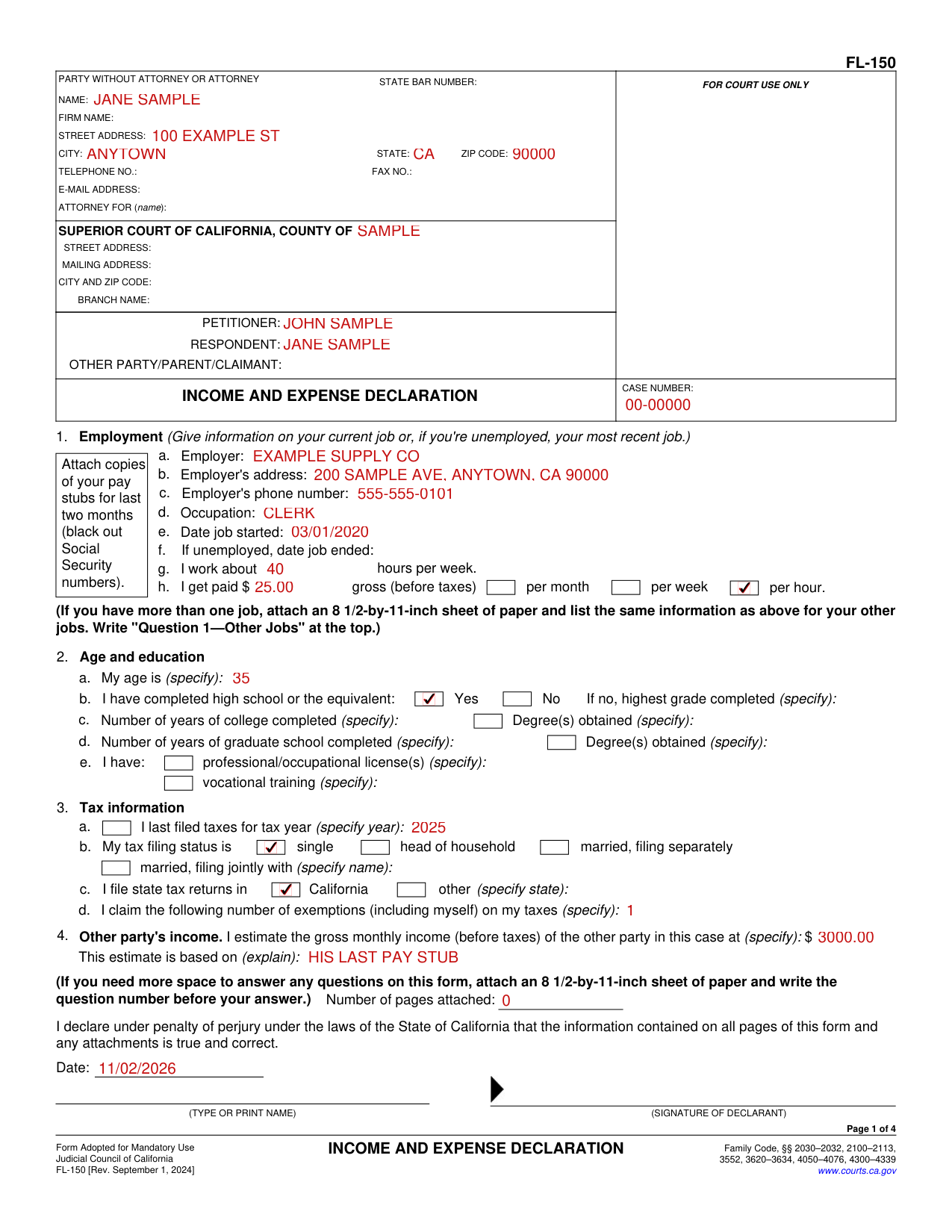
A filled-in Form FL-150 example: a self-represented respondent lists her income
How to fill out Form FL-150, box by box
Your name, the court and the case
Under Party without attorney or attorney, enter the State bar number, name, firm name, street address, city, state, zip code, telephone no., fax no., e-mail address and Attorney for (name).
Under Superior Court of California, County of, enter the county, then the street address, mailing address, city and zip code and branch name.
Enter the Petitioner, the Respondent, the Other party/parent/claimant and the Case number.
1. Employment
Give information on your current job or, if you're unemployed, your most recent job. Enter the employer and the employer's address.
Enter the employer's phone number, the occupation, the date job started and, if unemployed, the date job ended. Enter the hours per week that you work, about. Enter what you get paid, gross (before taxes), and mark per month, per week or per hour.
2. Age and education
Enter your age. Mark Yes or No: I have completed high school or the equivalent. If no, enter the highest grade completed.
3. Tax information
Enter the tax year for which you last filed taxes. Mark your tax filing status: single, head of household, married, filing separately, or married, filing jointly with (specify name).
Mark California or other (specify state) for the state tax returns you file. Enter the number of exemptions (including myself) that you claim on your taxes.
4. Other party's income
Enter the gross monthly income (before taxes) of the other party in this case that you estimate. Explain what this estimate is based on.
5. Income
For average monthly, add up all the income you received in each category in the last 12 months and divide the total by 12.
Enter salary or wages (gross, before taxes), overtime (gross, before taxes) and commissions or bonuses.
Enter spousal support from this marriage or from a different marriage. Check the federally taxable box if the spousal support order or judgment was executed by the parties and the court before January 1, 2019, or if a court-ordered change maintains the spousal support payments as taxable income to the recipient and tax deductible to the payor.
6. Investment income
Investment income: attach a schedule showing gross receipts less cash expenses for each piece of property. Enter dividends/interest, rental property income, trust income and other (specify).
7. Income from self-employment
Enter income from self-employment, after business expenses for all businesses. Mark owner/sole proprietor, business partner or other (specify), and enter the number of years in this business, the name of business and the type of business. Attach a profit and loss statement for the last two years or a Schedule C from your last federal tax return. Black out your Social Security number.
8. Additional income and 9. Change in income
Additional income: specify the source and amount of one-time money (lottery winnings, inheritance, etc.) you received in the last 12 months.
Change in income: specify why your financial situation has changed significantly over the last 12 months.
10. Deductions
Under Deductions, enter the Last month amount of required union dues; required retirement payments (not Social Security, FICA, 401(k), or IRA); and medical, hospital, dental, and other health insurance premiums (total monthly amount).
Attach an explanation labeled "Question 10g" for necessary job-related expenses not reimbursed by my employer.
11. Assets
Under Assets, enter the Total of cash and checking accounts, savings, credit union, money market, and other deposit accounts; stocks, bonds, and other assets I could easily sell; and all other property, real and personal (estimate fair market value minus the debts you owe).
12. The people who live with you
For the people who live with you, enter the Name, Age, how the person is related to me (ex: son), that person's gross monthly income and Yes or No for pays some of the household expenses.
13. Average monthly expenses
For average monthly expenses, mark Estimated expenses, Actual expenses or Proposed needs.
Under Home, enter rent or mortgage, real property taxes, homeowner's or renter's insurance (if not included in Home), and maintenance and repair. If mortgage, enter the average principal and the average interest.
Itemize monthly payments listed in item 14 below in 14 and insert the total here. Specify other.
Enter TOTAL EXPENSES (a-q) but do not add in the amounts in a(1)(a) and (b). Enter the amount of expenses paid by others.
14. Installment payments and debts not listed above
Installment payments and debts not listed: enter who it was Paid to, For, the Amount, the Balance and the Date of last payment.
15. Attorney fees
Attorney fees: this information is required if either party is requesting attorney fees.
Specify the amount you have paid your attorney to date for fees and costs, the source of this money, the total fees and costs you still owe your attorney and your attorney's hourly rate. To estimate the total for your own case, try our divorce cost calculator.
Child support information (page 4)
Fill out the child support information only if your case involves child support.
Specify the number of children under the age of 18 that you have with the other parent in this case.
Enter the percent of their time the children spend with you and the percent of their time with the other parent. If you're not sure about percentage or it has not been agreed on, describe your parenting schedule here.
Specify other information I want the court to know concerning support in my case.
Signing the declaration
If you need more space to answer any questions on this form, attach an 8 1/2-by-11-inch sheet of paper and write the question number before your answer. Enter the number of pages attached.
You declare under penalty of perjury under the laws of the State of California that the information contained on all pages of this form and any attachments is true and correct.
Enter the Date, type or print your name and sign as the declarant.
Other situations
You have more than one job
If you have more than one job, attach an 8 1/2-by-11-inch sheet of paper and list the same information as in this question for your other jobs. Write "Question 1-Other Jobs" at the top.
Sources
[1] Form FL-150 (Rev. September 1, 2024), Judicial Council of California (the Official source link on this page).
