

Form LIC 610D at a glance
What it is: California Department of Social Services form LIC 610D is the Emergency and Disaster Plan for Adult Community Care Facilities and Residential Care Facilities for the Chronically Ill (Public).
Who signs: The plan shall be reviewed annually, updated as necessary, and maintained on file at the facility. A licensee or administrator shall sign and date the plan to show that it has been reviewed and updated as necessary. A licensee is encouraged, but not required, to have the plan reviewed by local emergency authorities.
An applicant seeking a license for a new Adult Day Program (ADP), Adult Residential Facility (ARF), Adult Residential Facility for Persons with Special Health Care Needs (ARFPSHN), Community Crisis Home (CCH), Enhanced Behavioral Supports Home (EBSH), Residential Care Facility for the Chronically Ill (RCFCI), and Social Rehabilitation Facility (SRF) must submit an emergency and disaster plan with their initial license application.
A licensee is required to have an emergency disaster plan pursuant to Health and Safety Code Section 1565, Section 1565.5, Section 1568.044 and California Code of Regulations, Title 22, Section 80023, Section 81023, Section 82023, and Section 87823 Disaster and Mass Casualty Plan. The plan must be in writing and made available upon request to residents/clients onsite, any responsible party for a resident/client, local long-term care ombudsman, and local emergency responders. All resident/client and employee information on this form must be kept confidential.
A filled-in Form LIC 610D example: an administrator fills in page 3
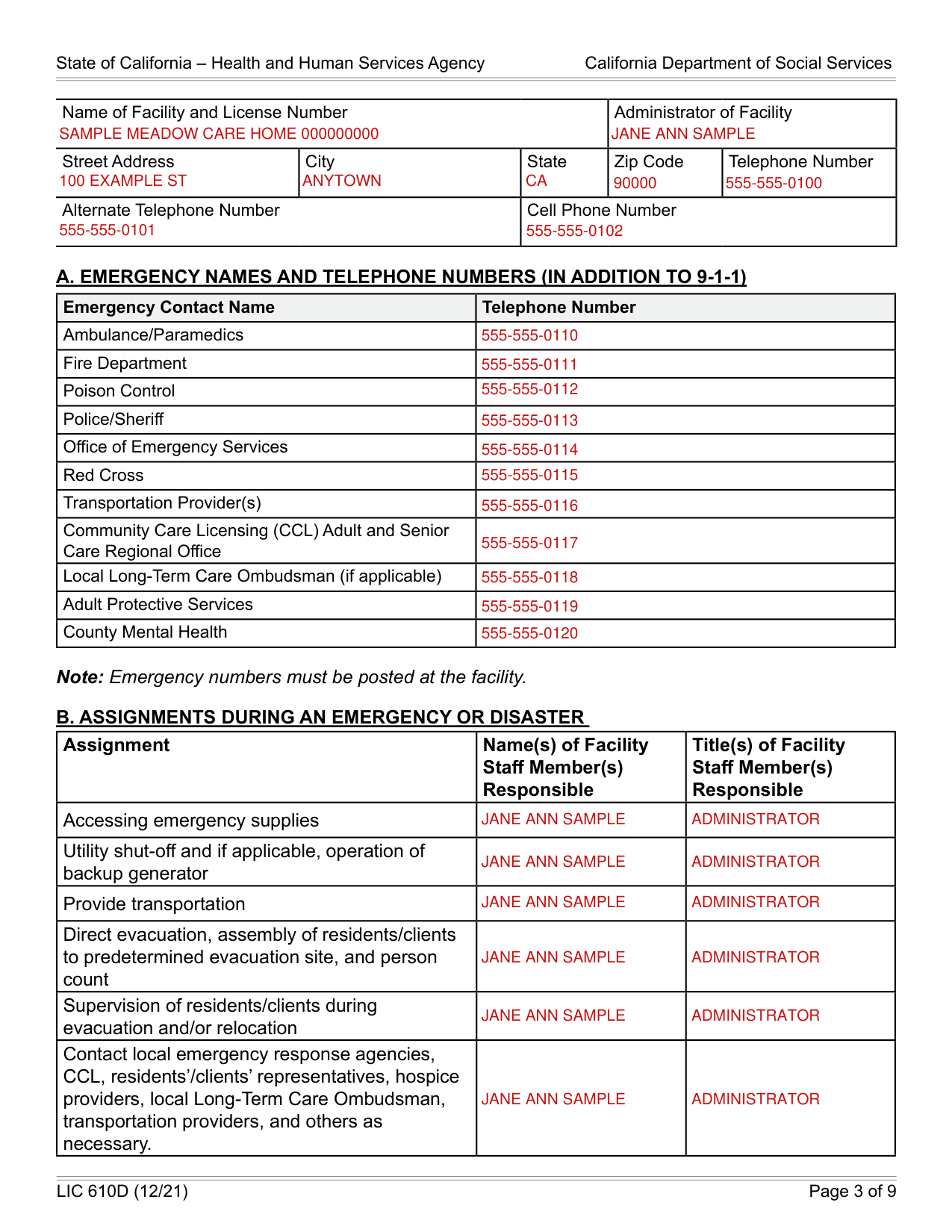
How to fill out Form LIC 610D, box by box
Name of Facility and License Number

Enter the Name of Facility and License Number, the Administrator of Facility, the Street Address, City, State, Zip Code, Telephone Number, Alternate Telephone Number and Cell Phone Number.
A. Emergency Names and Telephone Numbers (in addition to 9-1-1)
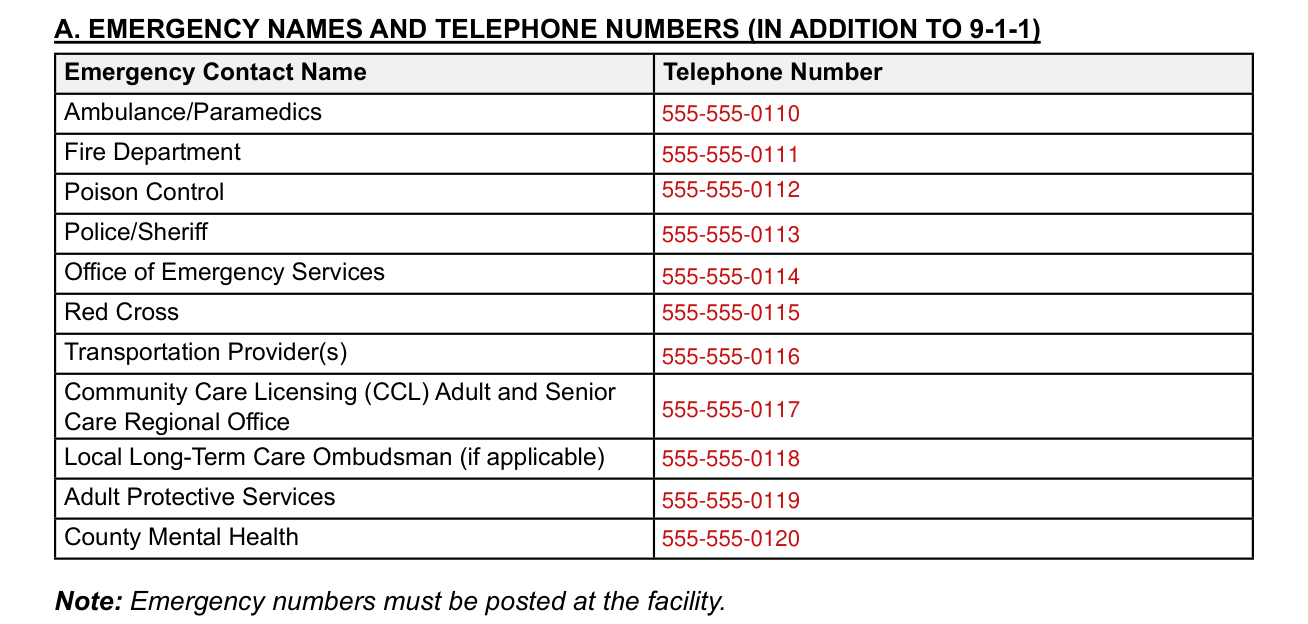
Under A. Emergency Names and Telephone Numbers (in addition to 9-1-1), enter the Emergency Contact Name and Telephone Number for Ambulance/Paramedics, Fire Department, Poison Control, Police/Sheriff, Office of Emergency Services, Red Cross, Transportation Provider(s), Community Care Licensing (CCL) Adult and Senior Care Regional Office, Local Long-Term Care Ombudsman (if applicable), Adult Protective Services and County Mental Health.
Emergency numbers must be posted at the facility.
B. Assignments During an Emergency or Disaster
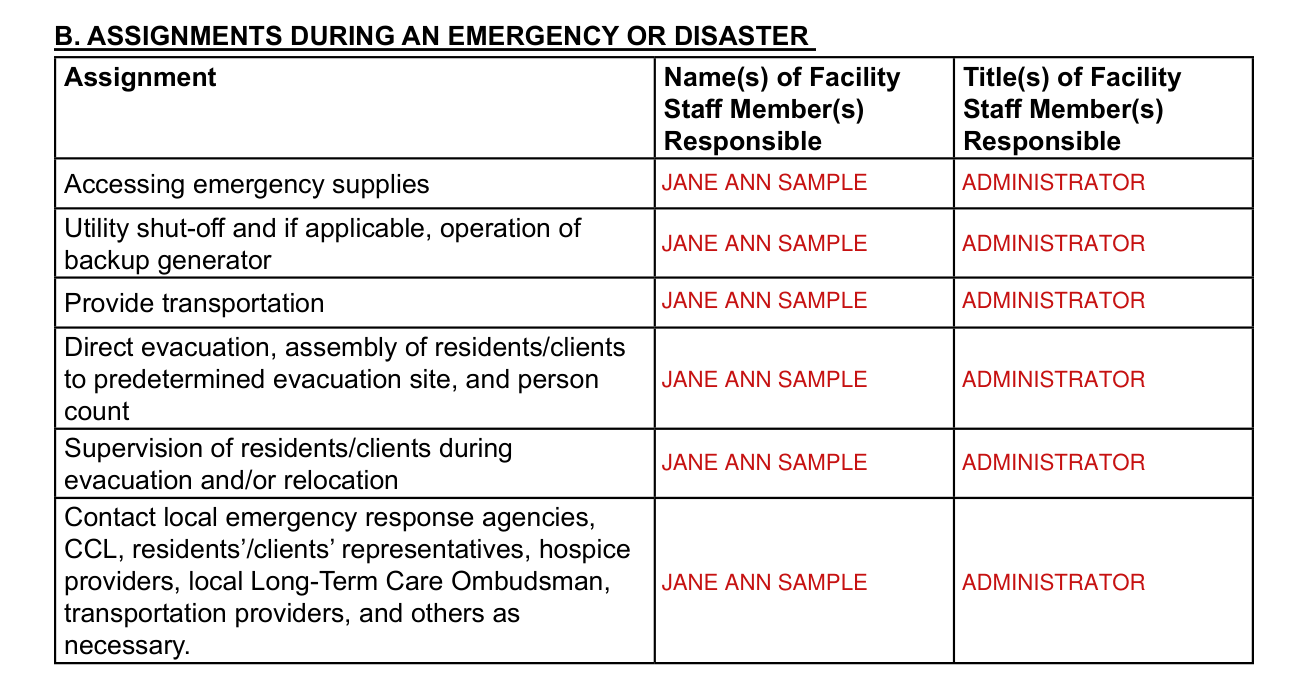
Under B. Assignments During an Emergency or Disaster, enter the Name(s) of Facility Staff Member(s) Responsible and the Title(s) of Facility Staff Member(s) Responsible for each Assignment: Accessing emergency supplies. Utility shut-off and if applicable, operation of backup generator. Provide transportation. Direct evacuation, assembly of residents/clients to predetermined evacuation site, and person count. Supervision of residents/clients during evacuation and/or relocation. Contact local emergency response agencies, CCL, residents'/clients' representatives, hospice providers, local Long-Term Care Ombudsman, transportation providers, and others as necessary.
C. Resident/Client Information
Under C. Resident/Client Information (to be readily available to facility staff during an emergency), enter the Location of the roster of residents/clients with date of birth for each resident/client, the appraisal of resident/client needs and services for each resident/client, the medication list for residents/clients with centrally stored medications, and the contact information for the responsible party and physician for each resident/client.
This information must be located in the facility to ensure all information and records obtained from or regarding resident/clients is kept confidential as required by California Code of Regulations, Title 22, Section 80070 and Section 81070, Client Records.
D. Utility Shut Off
Under D. Utility Shut Off, enter the Utility Shut-Off Location and the Instructions for Shut-Off for Electricity, Gas, Sewer and Water.
D.1. Generator (voluntary, not required)
D.1. Generator is voluntary, not required. Enter the Location and the Instructions to Turn-On.
E. Facility Exit Doors
Under E. Facility Exit Doors, enter each Exit Door Location.
F. Resident Assembly Points
Under F. Resident Assembly Points, enter each Assembly Point Location. A licensee must show the location of all resident assembly points on the facility sketch.
G. Temporary Shelter Locations
Under G. Temporary Shelter Locations, enter the Name, Address and Telephone Number of each shelter.
A licensee must list at least two appropriate shelter locations that can house facility residents during an evacuation and are equipped to provide safe temporary accommodations. One of the locations must be outside the immediate area where the facility is located.
H. Sheltering in Place Procedures
Under H. Sheltering in Place Procedures, 1: if the facility plans to shelter-in-place, indicate the planned sheltering-in-place procedures. In case one or more utilities, including water, sewer, gas, or electricity, is not available, specify the plan and supplies available to provide alternative resources during an outage. 2: specify plan for the facility to be self-reliant for a period of not less than 72 hours immediately following any emergency or disaster, including, but not limited to, a short-term or long-term power failure.
I. Evacuation Procedures
Under I. Evacuation Procedures, 1: indicate the planned evacuation procedures. 2: identify transportation needs.
If the transportation plan includes use of vehicle(s) owned or operated by the facility, the keys to the vehicle shall be available to staff on all shifts.
In I. Evacuation Procedures, 3: procedures to ensure communication with emergency response personnel and access to information needed to check emergency routes to be used for evacuation and relocation during an emergency or disaster.
J. Emergency and Disaster Procedures 1
Under J. Emergency and Disaster Procedures, list procedures that address: 1, provisions for emergency power (could include identifying suppliers of, and obtaining backup generators).
J. Emergency and Disaster Procedures 2 to 6
J. Emergency and Disaster Procedures: 2, responding to individual residents' needs if emergency call buttons are inoperable. 3, operating assistive medical devices that need electric power for operation, including, but not limited to, oxygen equipment and wheelchairs. 4, communicating with residents/clients, families, hospice providers, and others as appropriate (may include landline telephones, cellular telephones, or walkie-talkies), establish backup communication, and inform residents/clients and their responsible parties of the process for communicating during an emergency or disaster. 5, assisting residents with self-administration of medication and administering medication to residents. 6, storage and preservation of medications, including storing medications that require refrigeration.
J. Emergency and Disaster Procedures 7 and 8
J. Emergency and Disaster Procedures: 7, identifying residents with special needs, such as hospice services, and a plan for meeting those needs; 8, confirming the location of each resident during an emergency or disaster.
K. Administrator Statement and L. Review History
In K. Administrator Statement, as licensee or administrator of this facility, I assume responsibility for and have reviewed this plan for providing emergency services, and as necessary, have updated it to reflect any changes in the facility that affect this plan, as indicated in part L. I shall instruct all residents/ clients, age and abilities permitting, any staff and/or household members as needed on their duties and responsibilities under this plan.
Under L. Review History, check the appropriate box, Reviewed or Updated, and enter the Date, the Name and Title and the Signature.
If your situation is different
The facility is a residential facility other than an ARFPSHN
Residential facilities (except ARFPSHNs) serving adults will complete the form in its entirety.
A licensee of all residential facilities except ARFPSHNs must provide training on the plan to all staff upon hire and annually thereafter. The training must include staff responsibilities during an emergency or disaster. Drills must be conducted by a licensee at least quarterly for each shift. The type of emergency covered in the drills must vary from quarter to quarter as specified in Health and Safety Code Section 1565 and Section 1568.044. An actual evacuation of residents is not required during a drill.
The licensee shall instruct all clients, age and abilities permitting, and/or volunteers in their duties and responsibilities under the plan. While a licensee may provide an opportunity for residents to participate in a drill, they may not require resident participation. Documentation of drills must include the date, the type of emergency covered by the drill, and the names of facility staff participating in the drill.
Sources
[1] Form LIC 610D (12/21), Emergency and Disaster Plan for Adult Community Care Facilities and Residential Care Facilities for the Chronically Ill (Public), California Department of Social Services (the Official source link on this page).
