
Assisted Living Manager's Assessment at a glance
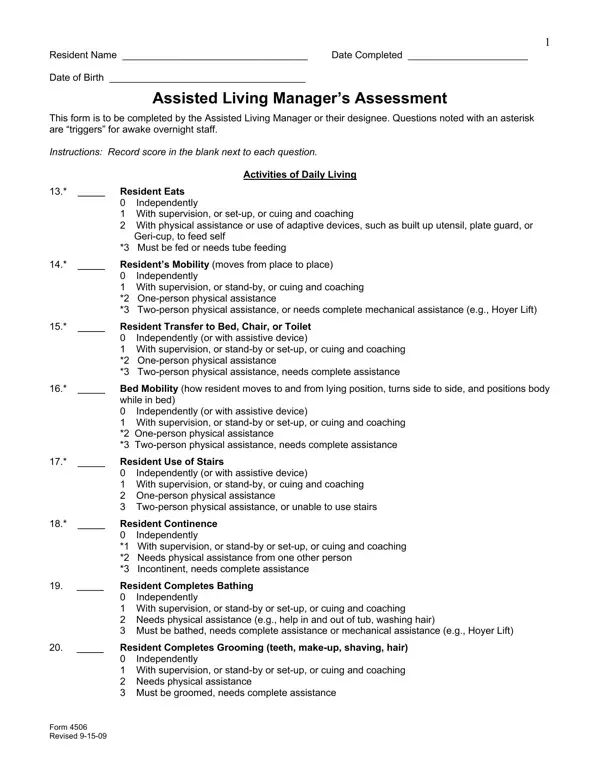
What it is: Assisted Living Manager's Assessment for a Resident, with the Date Completed and Date of Birth.
The Assisted Living Manager or their designee completes this form.
The blank Assisted Living Manager's Assessment: print it and complete it by hand
How to fill out Assisted Living Manager's Assessment, box by box
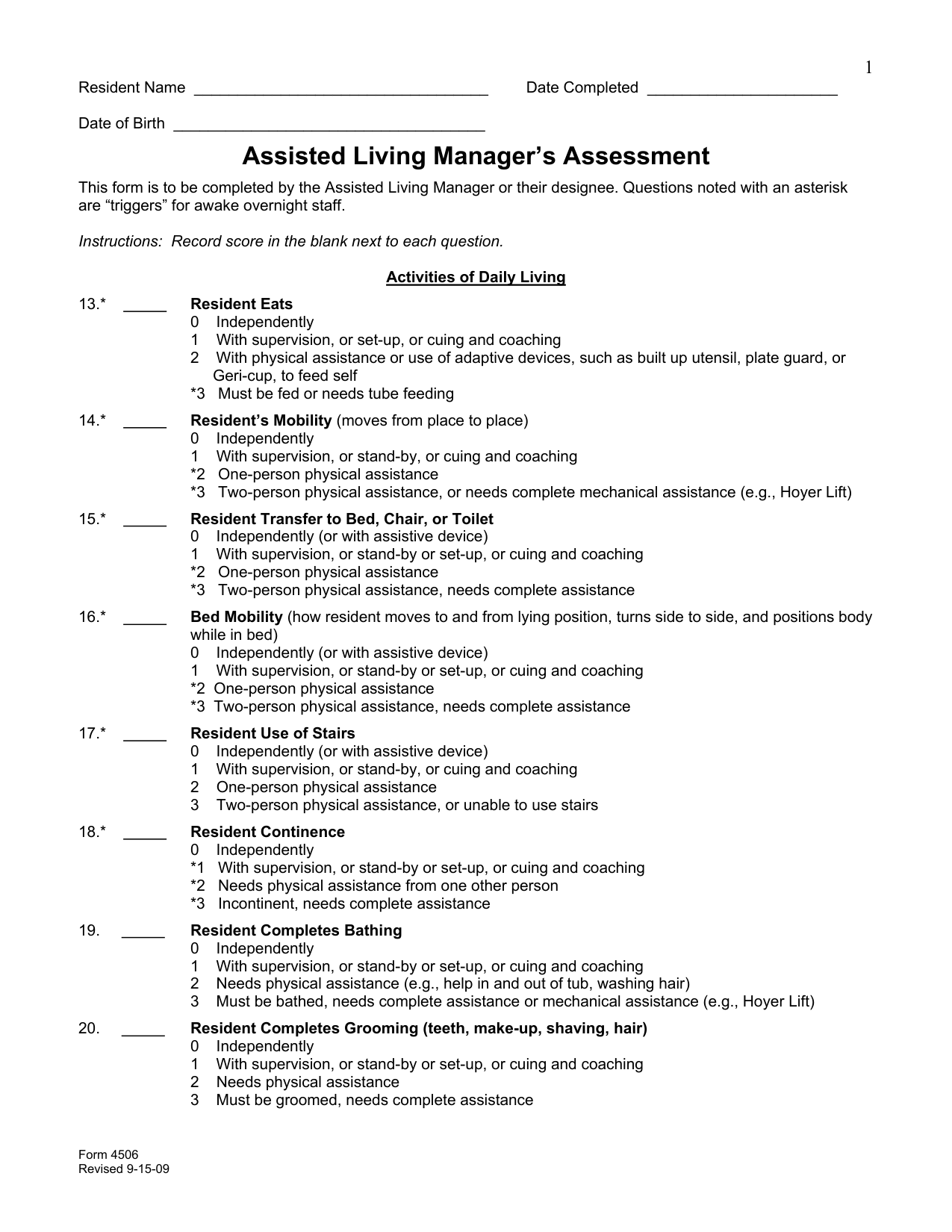
Activities of Daily Living
Write the score in the blank next to each question.
Questions noted with an asterisk are triggers for awake overnight staff.
Resident Eats (13): write 0 for independently, 1 with supervision, or set-up, or cuing and coaching, 2 with physical assistance or use of adaptive devices, such as built up utensil, plate guard, or Geri-cup, to feed self, or 3 if the resident must be fed or needs tube feeding.
Resident's Mobility (moves from place to place) (14): write 0 for independently, 1 with supervision, or stand-by, or cuing and coaching, 2 for one-person physical assistance, or 3 for two-person physical assistance, or needs complete mechanical assistance (e.g., Hoyer Lift).
Resident Transfer to Bed, Chair, or Toilet (15): write 0 for independently (or with assistive device), 1 with supervision, or stand-by or set-up, or cuing and coaching, 2 for one-person physical assistance, or 3 for two-person physical assistance, needs complete assistance.
Bed Mobility (how resident moves to and from lying position, turns side to side, and positions body while in bed) (16): write 0 for independently (or with assistive device), 1 with supervision, or stand-by or set-up, or cuing and coaching, 2 for one-person physical assistance, or 3 for two-person physical assistance, needs complete assistance.
Resident Use of Stairs (17): write 0 for independently (or with assistive device), 1 with supervision, or stand-by, or cuing and coaching, 2 for one-person physical assistance, or 3 for two-person physical assistance, or unable to use stairs.
Resident Continence (18): write 0 for independently, 1 with supervision, or stand-by or set-up, or cuing and coaching, 2 if the resident needs physical assistance from one other person, or 3 if incontinent, needs complete assistance.
Resident Completes Bathing (19): write 0 for independently, 1 with supervision, or stand-by or set-up, or cuing and coaching, 2 if the resident needs physical assistance (e.g., help in and out of tub, washing hair), or 3 if the resident must be bathed, needs complete assistance or mechanical assistance (e.g., Hoyer Lift).
Resident Completes Grooming (teeth, make-up, shaving, hair) (20): write 0 for independently, 1 with supervision, or stand-by or set-up, or cuing and coaching, 2 if the resident needs physical assistance, or 3 if the resident must be groomed, needs complete assistance.
Resident Gets Dressed/Changes Clothes (21): write 0 for independently, 1 with supervision, or stand-by or set-up, or cuing and coaching, 2 with physical assistance, or 3 if the resident must be dressed, needs complete assistance. 21(a): add scores for Items 13 - 21 and write the total in the blank space at left.
Instrumental Activities of Daily Living
Check the letter that most closely reflects the resident's capabilities. Incapacities identified in this section do not imply services will be provided.
Resident Can Prepare Light Meal (22): A for independent, plans and prepares adequate meals, B with supervision, set-up, or cuing and coaching, C for one-person physical assistance, D for unable to prepare meals.
Resident Can Do Light Chores (23): A for independent, B with supervision, set-up, or cuing and coaching, C for one-person physical assistance, D for unable to do light chores.
Resident Can Do Shopping (24): A for independent, B with supervision or cuing and coaching (e.g., choosing items), C with one-person physical assistance/someone to go with them, D for unable to do shopping.
Ability to Manage Finances (25): A if family or resident manages all financial matters independently, writes checks, pays bills/rent, goes to bank, B with supervision, writes checks, pays bills/rent, goes to bank, C if the resident manages day-to-day purchases, but needs help with purchases and banking, D for unable to manage finances or handle money.
Transportation (26): A travels by self, all modes of transportation, B needs some assistance/escort, C needs complete assistance/needs specialized vehicle. Number 27 is next on the form.
Behaviors/Communication
Check the appropriate box to indicate frequency of each behavior. For scoring purposes use the highest frequency noted. See the User's Guide for definitions of frequency.
Withdrawn (28): check Never, Occasional, Regular or Continuous for refuses to leave room and for refuses to socialize with others, then write on the Explain line.
Wanders (29): check Never, Occasional, Regular or Continuous for persistent moving/walking about without purpose, looks for non-existent place (former house/apartment/bus), actively tries to leave facility, wanders during day, and wanders in evening and/or at night, then write on the Explain line.
Sleep disturbance (30): check Never, Occasional, Regular or Continuous for unable to sleep or agitated at night and for frequently falls asleep during day, then write on the Explain line.
Verbally inappropriate (31): check Never, Occasional, Regular or Continuous for uses foul language and for sounds angry and threatens others, then write on the Explain line.
Disruptive behaviors (32): check Never, Occasional, Regular or Continuous for yells, demands attention without regard to others, takes other's possessions, socially inappropriate behaviors (e.g., disrobes, urinates, or defecates in public), and sexually inappropriate behaviors (e.g., unwanted touching, public masturbation), then write on the Explain line.
Combative behaviors (33): check Never, Occasional, Regular or Continuous for throws objects indiscriminately, strikes out, kicks, or punches at others, and pinches, bites, spits at others, scratches, or pulls hair, then write on the Explain line.
Check Never, Occasional, Regular or Continuous for refuses to wash, refuses to eat, refuses to drink, refuses to care for self, refuses to allow others to assist, refuses medications, and refuses to comply with safety advice, then write on the Explain line.
Communication (check and/or explain appropriate response) (35): for communicates needs, ideas, & wishes check Unable, Sometimes Able, Usually or Always, and for unwilling to communicate needs/wishes check Never, Occasional, Regular or Continuous, then write on the Explain line.
Eating patterns and food preferences
Eating patterns and food preferences (check all that apply) (36): eats full meals, eats only two meals, eats small portions, finger foods, eats only what they want, but maintains weight, eats only when they want, supplements (type ordered), prefers fruit, vegetables, meats, snacks or snack foods, then write on the Explain line.
Sources
[1] Assisted Living Manager's Assessment, Form 4506 Revised 9-15-09, as served on this page (the Official source link on this page).