
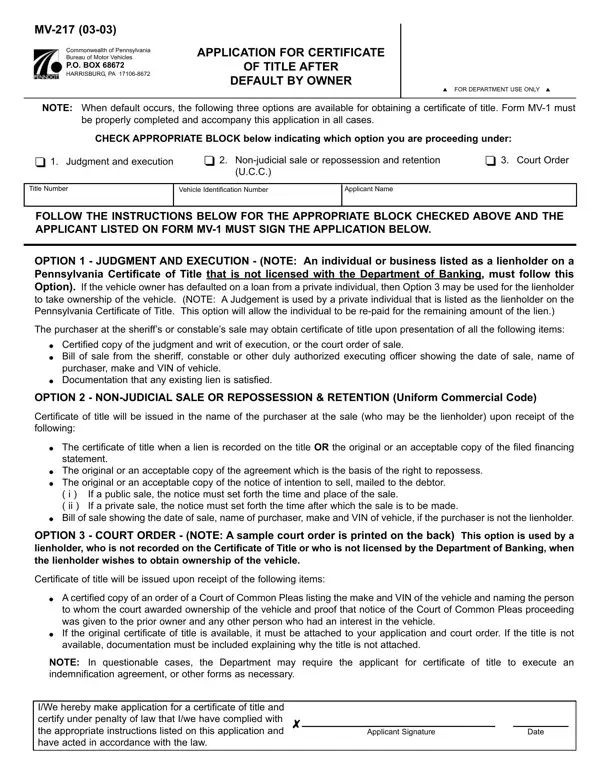
Understanding the procedural nuances of the MV-217 form, issued by the Commonwealth of Pennsylvania's Bureau of Motor Vehicles, is crucial for individuals or entities involved in the acquisition of a vehicle title under certain default conditions. This form serves as an application for a Certificate of Title after a vehicle’s owner defaults on obligations, providing a structured pathway for lienholders or purchasers to claim ownership. The form outlines three distinct options for proceeding: Judgment and Execution, Non-Judicial Sale or Repossession and Retention under the Uniform Commercial Code, and Court Order. Each option requires the completion of the MV-1 form and comes with a unique set of requirements, including but not limited to, submitting a certified copy of the judgment or court order, providing bills of sale, satisfying any existing liens, and presenting documentation related to the repossession process or the court's decision. The specifics of these options offer a legal framework to ensure that the transition of vehicle ownership happens in a lawful manner, emphasizing the importance of documentation and adherence to the guidelines set by the Department of Motor Vehicles. This process underscores the importance of legal and procedural accuracy in the handling of assets subject to liens or judgements, providing a recourse for lienholders to recover debts or assert ownership in cases of default.
| Question | Answer |
|---|---|
| Form Name | Form Mv 217 |
| Form Length | 2 pages |
| Fillable? | No |
| Fillable fields | 0 |
| Avg. time to fill out | 30 sec |
| Other names | indemnification, mv 217, MV-1, MV-217 |