
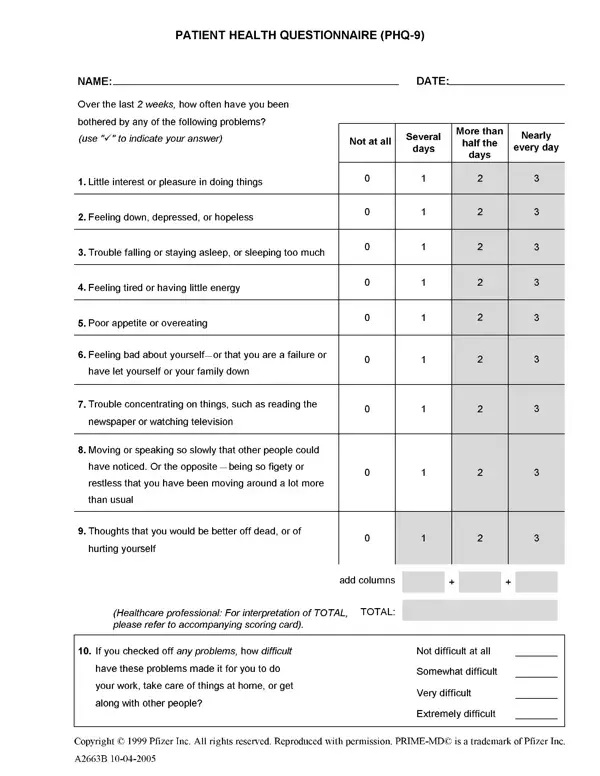
Form Phq 9 PDF Details

Navigating the complexities of diagnosing and monitoring depression has been markedly improved with the implementation of tools like the PHQ-9 Patient Depression Questionnaire. This pivotal form serves a dual purpose: initially aiding in the diagnosis of depressive disorders and subsequently monitoring the severity of a patient's depression over time. By answering a series of questions that gauge the frequency of depressive symptoms, patients play an active role in their mental health assessment. The questionnaire’s simplicity belies the rigor of its diagnostic criteria, requiring a specific number of responses in certain categories to consider diagnoses of Major Depressive Disorder or Other Depressive Disorder. This nuanced approach ensures that a diagnosis is not only based on the questionnaire's results but also on a clinician's comprehensive evaluation of the patient’s understanding, social and occupational functioning, and the exclusion of other medical conditions. Moreover, the periodic reassessment capability of the PHQ-9 makes it an invaluable tool for tracking the progression of depression and the effectiveness of treatment strategies over time. By quantitatively scoring the severity of depression, the PHQ-9 facilitates a tailored treatment approach, ensuring that patients receive the appropriate level and type of care they need to manage their condition. With its backed validation and ease of use, the PHQ-9 questionnaire significantly contributes to the nuanced landscape of mental health care, championing a more patient-centered and dynamic approach to treating one of the most common yet complex mental health disorders.

QuestionAnswer
Form NameForm Phq 9
Form Length2 pages
Fillable?No
Fillable fields0
Avg. time to fill out30 sec
Other namesphq9 fillable, phq 9 patient questionnaire, phq 9 printable, phq 9

How to Fill Out Form PHQ-9

Form PHQ-9 at a glance

What it is: The PATIENT HEALTH QUESTIONNAIRE (PHQ-9). Patient completes PHQ-9 Quick Depression Assessment.

Patient completes PHQ-9 Quick Depression Assessment.

Patients may complete questionnaires at baseline and at regular intervals (eg, every 2 weeks) at home and bring them in at their next appointment for scoring or they may complete the questionnaire during each scheduled appointment.

A filled-in Form PHQ-9 example: a patient completes the PHQ-9
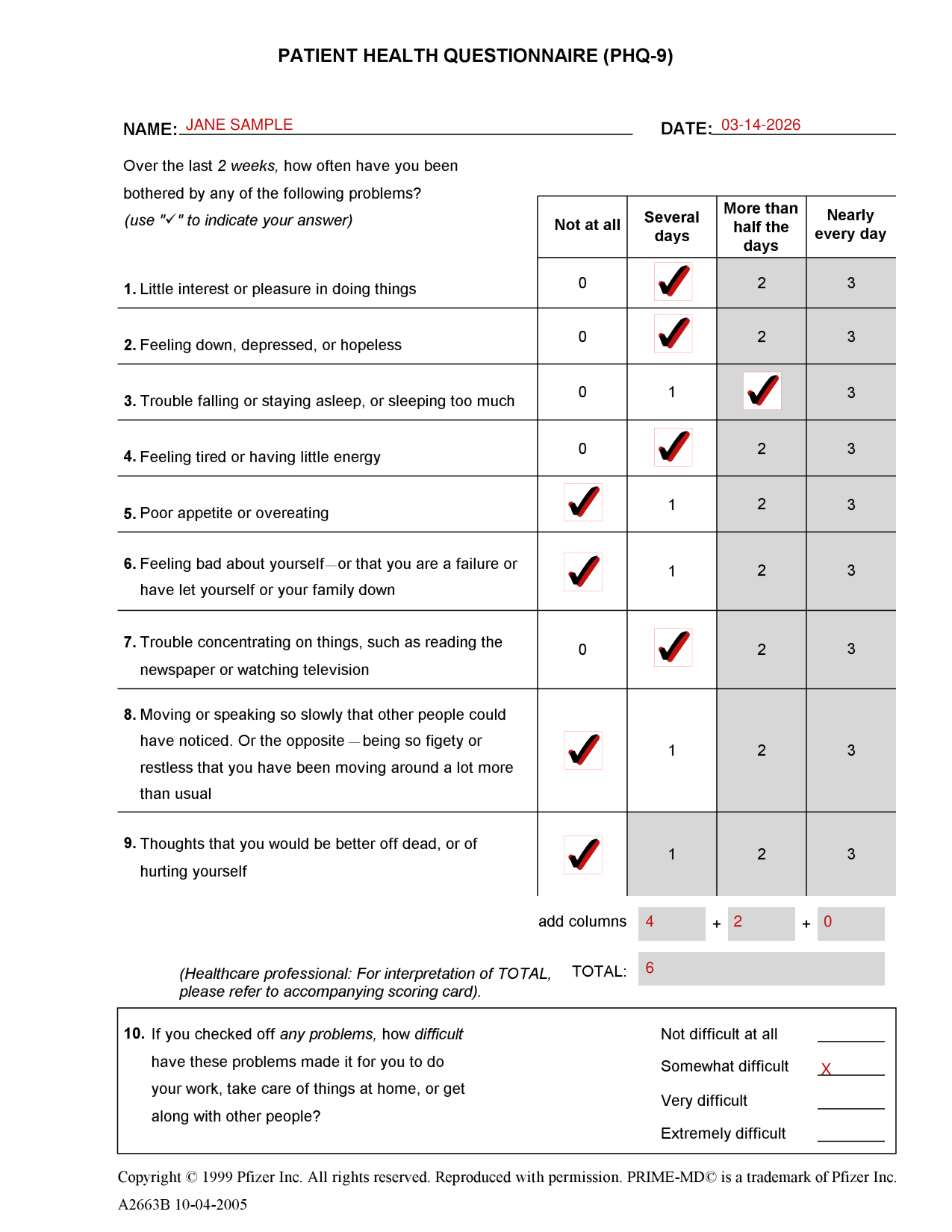
Form PHQ-9 example filled out, example: a patient completes the PHQ-9
A patient completes the PHQ-9 questionnaire at a clinic visit. In the last 2 weeks, four problems bothered the patient on several days, one on more than half. The picture shows page 1 and none of its entries is real. The other four problems bother the patient not at all, so each of those rows has its Not at all box ticked. In Not at all, Several days, More than half the days or Nearly every day, each problem gets one answer, so the other boxes in its row stay empty. The column scores are 4, 2 and 0, so the TOTAL is 6. Question 10 is answered Somewhat difficult, so the other three fields in How difficult these problems have made it stay empty.

How to fill out Form PHQ-9, box by box

Date and name

Form PHQ-9 example filled out, date and name

Enter the DATE and the NAME.

Not at all, Several days, More than half the days or Nearly every day
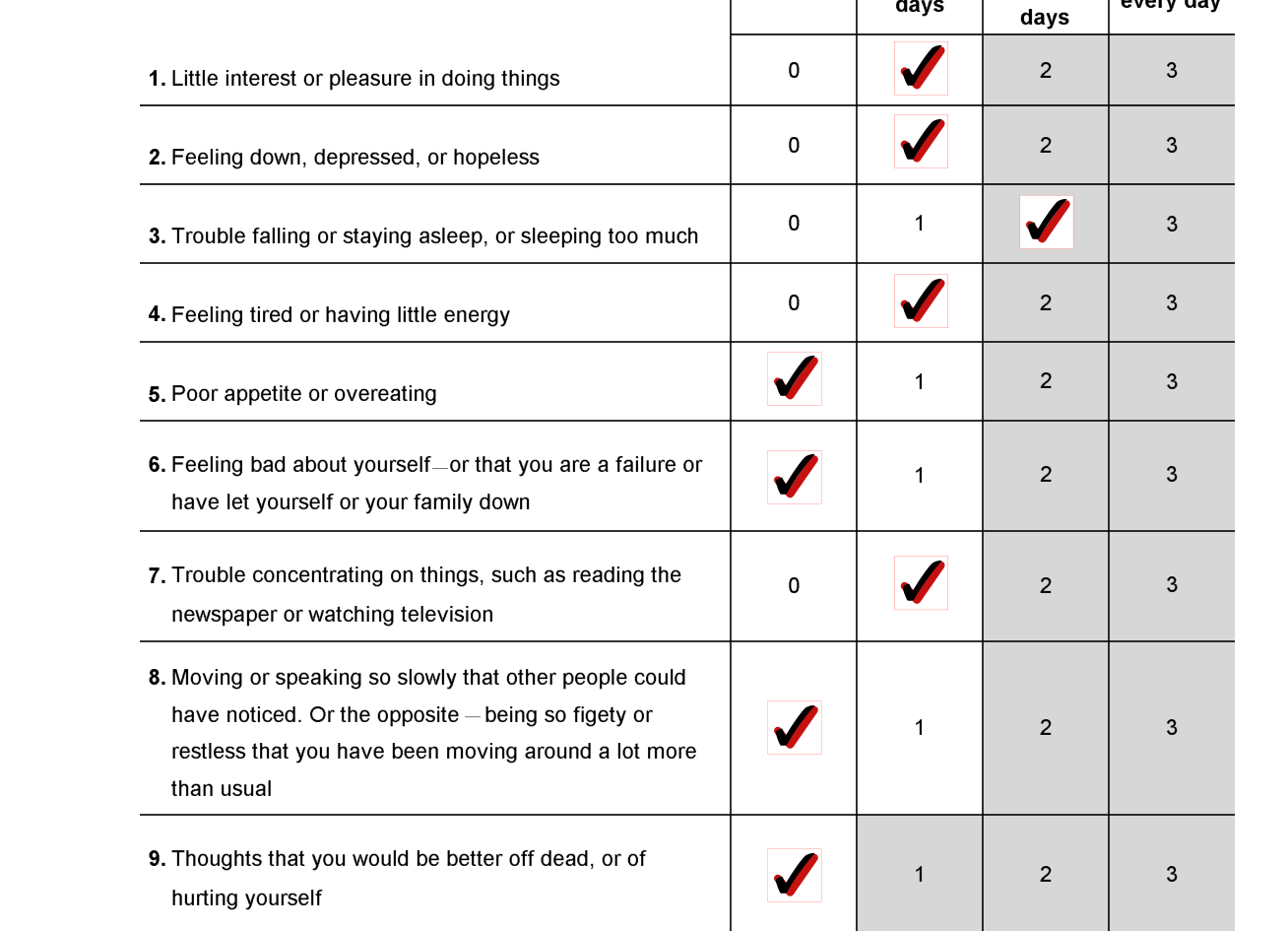
Form PHQ-9 example filled out, not at all, Several days, More than half the days or Nearly every day

Over the last 2 weeks, how often have you been bothered by any of the following problems?

Not at all, Several days, More than half the days or Nearly every day: indicate your answer.

Little interest or pleasure in doing things 1. Feeling down, depressed, or hopeless 2. Trouble falling or staying asleep, or sleeping too much 3. Feeling tired or having little energy 4. Poor appetite or overeating 5.

Feeling bad about yourself or that you are a failure or have let yourself or your family down. Trouble concentrating on things, such as reading the newspaper or watching television. Moving or speaking so slowly that other people could have noticed. Or the opposite being so figety or restless that you have been moving around a lot more than usual. Thoughts that you would be better off dead, or of hurting yourself.

Add columns and the TOTAL

Form PHQ-9 example filled out, add columns and the TOTAL

Add columns.

Add up all checked boxes by column: Several days = 1, More than half the days = 2, Nearly every day = 3.

Add together column scores to get a TOTAL score.

TOTAL: (Healthcare professional: For interpretation of TOTAL, please refer to accompanying scoring card).

Scoring: add up all checked boxes on PHQ-9. Not at all = 0; Several days = 1; More than half the days = 2; Nearly every day = 3 Interpretation of Total Score Total Score Depression Severity 1-4 Minimal depression 5-9 Mild depression 10-14 Moderate depression 15-19 Moderately severe depression 20-27 Severe depression.

How difficult these problems have made it

Form PHQ-9 example filled out, how difficult these problems have made it

If you checked off any problems, how difficult have these problems made it for you to do your work, take care of things at home, or get along with other people? Not difficult at all, Somewhat difficult, Very difficult or Extremely difficult.

Diagnoses of Major Depressive Disorder or Other Depressive Disorder also require impairment of social, occupational, or other important areas of functioning (Question #10) and ruling out normal bereavement, a history of a Manic Episode (Bipolar Disorder), and a physical disorder, medication, or other drug as the biological cause of the depressive symptoms.

Sources

[1] PATIENT HEALTH QUESTIONNAIRE (PHQ-9), A2663B 10-04-2005 (the Official source link on this page).