
Form S-3C at a glance
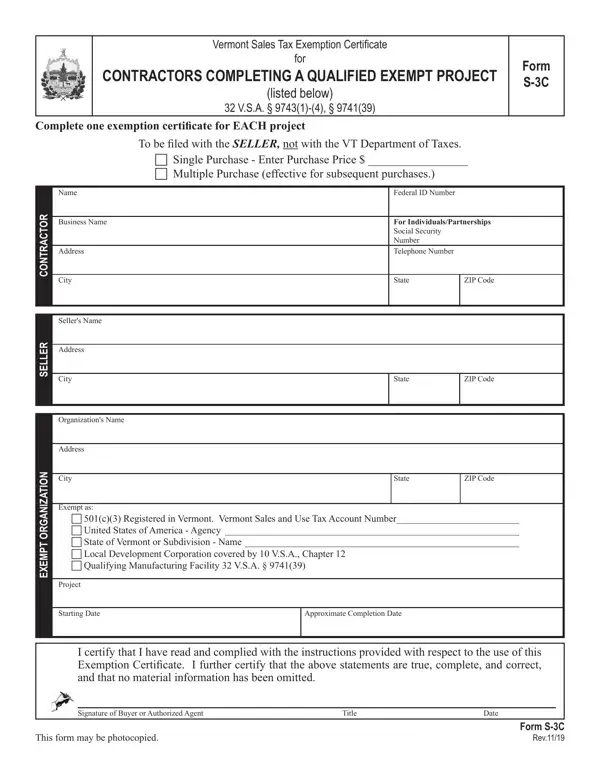
What it is: Form S-3C is the Vermont Sales Tax Exemption Certificate for contractors completing a qualified exempt project.
Where and when to file: To be filed with the seller, not with the Vermont Department of Taxes.
The blank Form S-3C: print it and complete it by hand
How to fill out Form S-3C, box by box
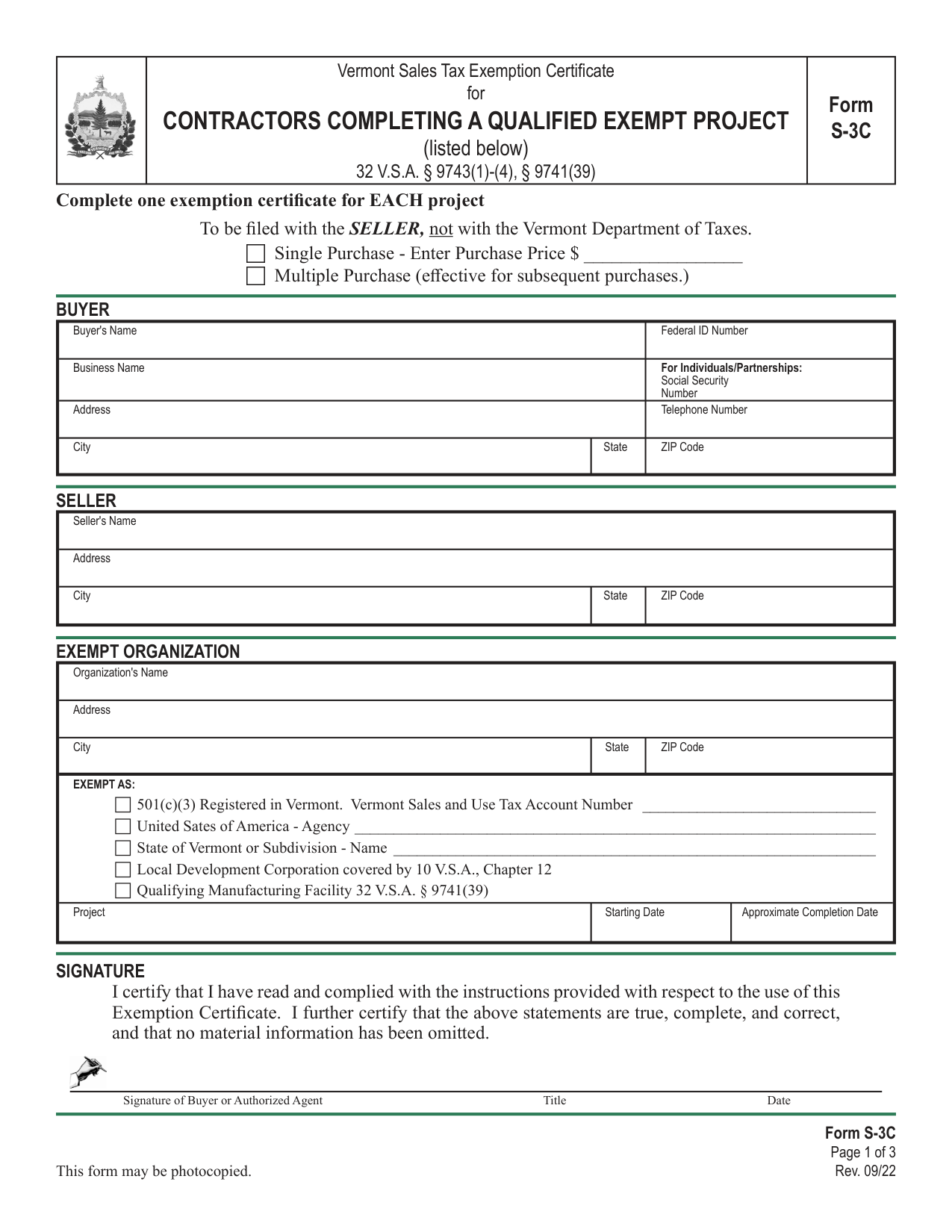
Single Purchase or Multiple Purchase
Complete one exemption certificate for each project.
Mark Single Purchase and enter the Purchase Price, or mark Multiple Purchase, which is effective for subsequent purchases.
BUYER
Under BUYER, enter the Buyer's Name, Federal ID Number, Business Name, Address, Telephone Number, City, State and ZIP Code. For Individuals/Partnerships, enter the Social Security Number.
SELLER
Under SELLER, enter the Seller's Name, Address, City, State and ZIP Code.
EXEMPT ORGANIZATION
Under EXEMPT ORGANIZATION, enter the Organization's Name, Address, City, State and ZIP Code.
EXEMPT AS
Under EXEMPT AS, mark the box that applies: 501(c)(3) Registered in Vermont, with the Vermont Sales and Use Tax Account Number; United States of America - Agency, with the Agency; State of Vermont or Subdivision, with the Name; Local Development Corporation covered by 10 V.S.A., Chapter 12; or Qualifying Manufacturing Facility 32 V.S.A. § 9741(39).
Project dates
Enter the Project Starting Date and the Approximate Completion Date.
SIGNATURE
You certify that you have read and complied with the instructions provided with respect to the use of this Exemption Certificate, and that the statements in the Exemption Certificate are true, complete, and correct, and that no material information has been omitted.
Sign as Buyer or Authorized Agent, and enter the Title and the Date.
If your situation is different
General Information
Please print in BLUE or BLACK ink only.
All tangible personal property purchased by a contractor is taxable as the contractor is considered to be the end-user with the finished product normally being real property, which is not subject to Vermont Sales and Use Tax.
There are certain exemptions allowed for contractors purchasing materials: when the contractor is working with a qualifying exempt organization, and when the contractor is working on a specific qualifying exempt project. Tangible personal property exempted from tax must be incorporated into the real estate, or the supplies must be used or consumed on the job.
If the contractor buys materials or supplies exempt from tax but uses them later in a taxable project, the contractor must pay use tax on those materials and supplies.
Purchases of equipment and tools used by the contractor are subject to tax.
Qualifying Organizations & Projects
A qualifying organization contracts to construct, reconstruct, alter, remodel, or repair any building structure or public works project owned by the Federal government, State of Vermont (and its agencies and subdivisions), or a 501(c)(3) as designated by the Internal Revenue Service and registered with the Vermont Department of Taxes.
Many nonprofit organizations, such as civic, social, and fraternal organizations, are not 501(c)(3) entities and not all 501(c)(3) projects qualify for exemption.
To qualify, the project must be used exclusively for public purposes, and the project contract must be granted by an exempt organization.
Turnkey projects are not exempt, even if the ultimate owner may be an exempt organization.
Qualifying Manufacturing Facility
Under 32 V.S.A. § 9741(39), Qualifying Manufacturing Facility: Sales of building materials within any three consecutive years in excess of $1,000,000.00 in purchase value used in the construction, renovation, or expansion of facilities which are used exclusively, except for isolated or occasional uses, for the manufacture of tangible personal property for sale (checked November 12, 2026).
Accepting an Exemption Certificate in "Good Faith"
The buyer must present to the seller an accurate and properly executed exemption certificate for the exempted sale.
The responsibility is on the seller to determine if the buyer is submitting the exemption certificate in "good faith."
This requires the seller to be familiar with Vermont Sales and Use Tax law and regulations, including exemptions, that apply to the seller's business.
If the buyer provides a certificate that is not valid, i.e., the item purchased does not qualify for the exemption, this is not in good faith and the seller should not accept the certificate.
When the seller accepts the certificate in good faith, the seller is not liable for collecting and remitting Vermont Sales Tax.
An exemption certificate is received at the time of sale in good faith when all of the following conditions are met.
The certificate contains no statement or entry which the seller knows, or has reason to know, is false or misleading.
The certification is on an exemption form issued by the Vermont Department of Taxes or a form with substantially identical language.
The certificate is signed, dated and complete (all applicable sections and fields completed).
The property purchased is of a type ordinarily used for the stated purpose, or the exempt use is explained.
Burden of Proof
The burden of proof is on the seller to demonstrate the certificate was taken in good faith.
If the seller cannot provide an exemption certificate showing that the sale was exempt, the Department will seek to collect tax from the seller.
If, however, the seller can prove the buyer's claim for the exemption was false, the Department will seek to collect the tax from the buyer.
Obtaining and Retaining the Exemption Certificate
The seller must obtain an exemption certificate from the buyer either prior to or at the time of the sale.
If the certificate is not available at the time of sale, the seller has 90 days after the sale to obtain a fully executed certificate, accepted in good faith.
Sellers must retain exemption certificates for at least three years from the date of the last sale covered by the certificate to document why the tax was not collected from the buyer.
Multiple Purchase Exemption Certificates
If the buyer presents a "Multiple Purchase" exemption certificate to the seller, it may be used only when purchasing tangible personal property for use as indicated on this exemption certificate.
For each purchase covered by the exemption certificate, the sales slip or invoice must show the buyer's name and address sufficient to link the purchase to the exemption certificate on file.
Common questions about Form S-3C
Where do I file it?
To be filed with the seller, not with the Vermont Department of Taxes.
Where to get help with Form S-3C
For questions regarding how these exemption certificates may be properly applied, please contact the Vermont Department of Taxes at (802) 828-2551.
Sources
[1] Form S-3C (Rev. 09/22), Vermont Sales Tax Exemption Certificate for Contractors Completing a Qualified Exempt Project, Vermont Department of Taxes (the Official source link on this page).