
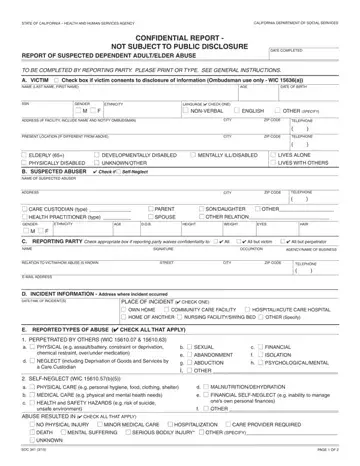
Form SOC 341 at a glance
What it is: This form documents the information given by the reporting party on the suspected incident of abuse or neglect of an elder or dependent adult.[1]
Who signs: Box D, Reporting Party: Name, Signature, Occupation, Agency/Name of Business. Please note that mandated reporters are required to disclose their names, however, non-mandated reporters may report anonymously.[1]
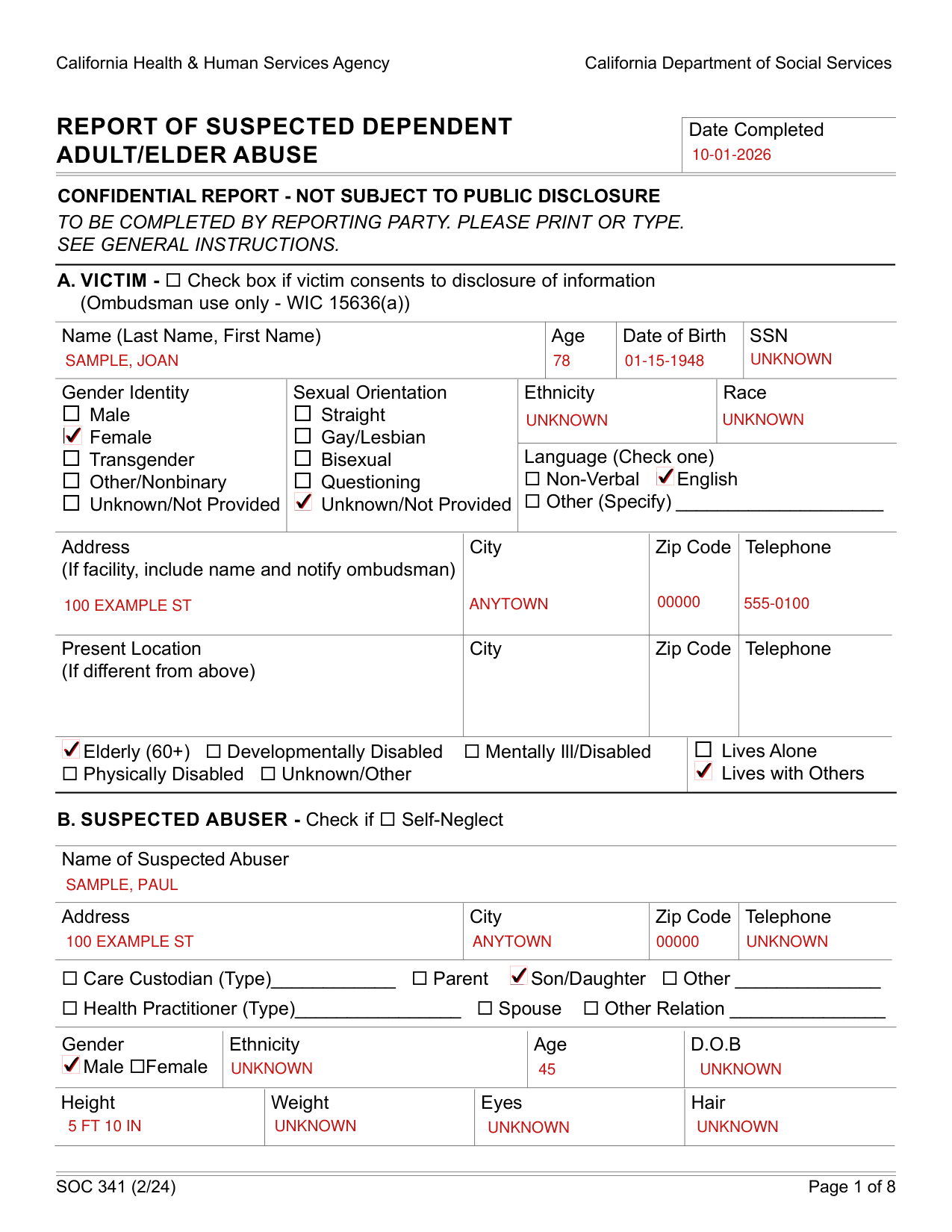
A filled-in Form SOC 341 example: a home health aide reports suspected neglect
How to fill out Form SOC 341, box by box
Tap a group of boxes to open it, and a picture to see it full size.
Box A: the victim
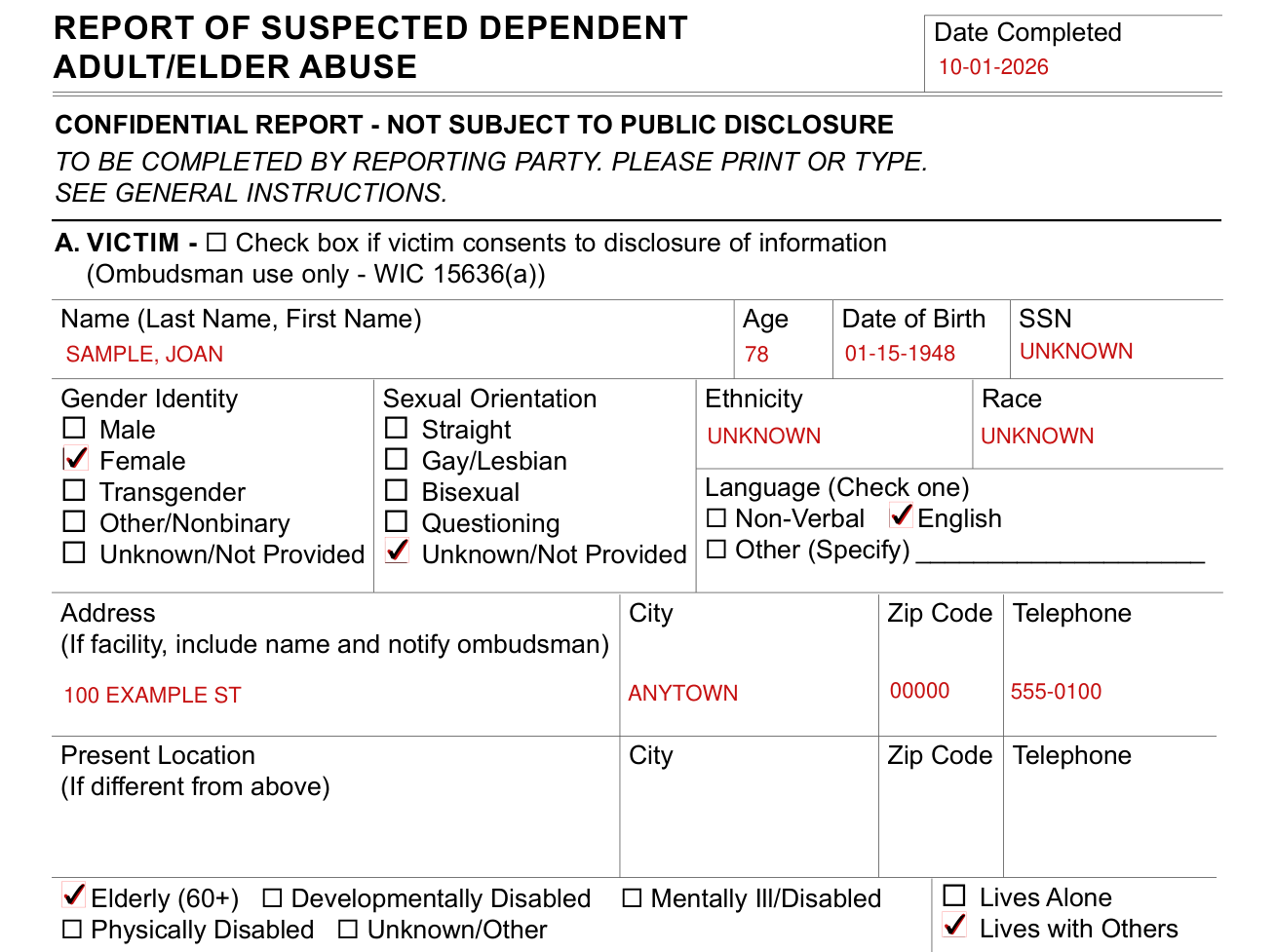
Box A, Victim: Check box if victim consents to disclosure of information (Ombudsman use only - WIC 15636(a)). Item A: Check box to indicate if the victim waives confidentiality.
Box A: Name (Last Name, First Name), Age, Date of Birth and SSN.
Box A, Gender Identity: Male, Female, Transgender, Other/Nonbinary or Unknown/Not Provided.
Box A, Sexual Orientation: Straight, Gay/Lesbian, Bisexual, Questioning or Unknown/Not Provided.
Box A: Ethnicity and Race.
Box A, Language (Check one): Non-Verbal, English or Other (Specify).
Box A: Address (If facility, include name and notify ombudsman), City, Zip Code and Telephone.
Box A: Present Location (If different from the address in Box A), City, Zip Code and Telephone.
Box A: Check Elderly (60+), Developmentally Disabled, Mentally Ill/Disabled, Physically Disabled or Unknown/Other.
Box A: Check Lives Alone or Lives with Others.[1]
Box B: the suspected abuser
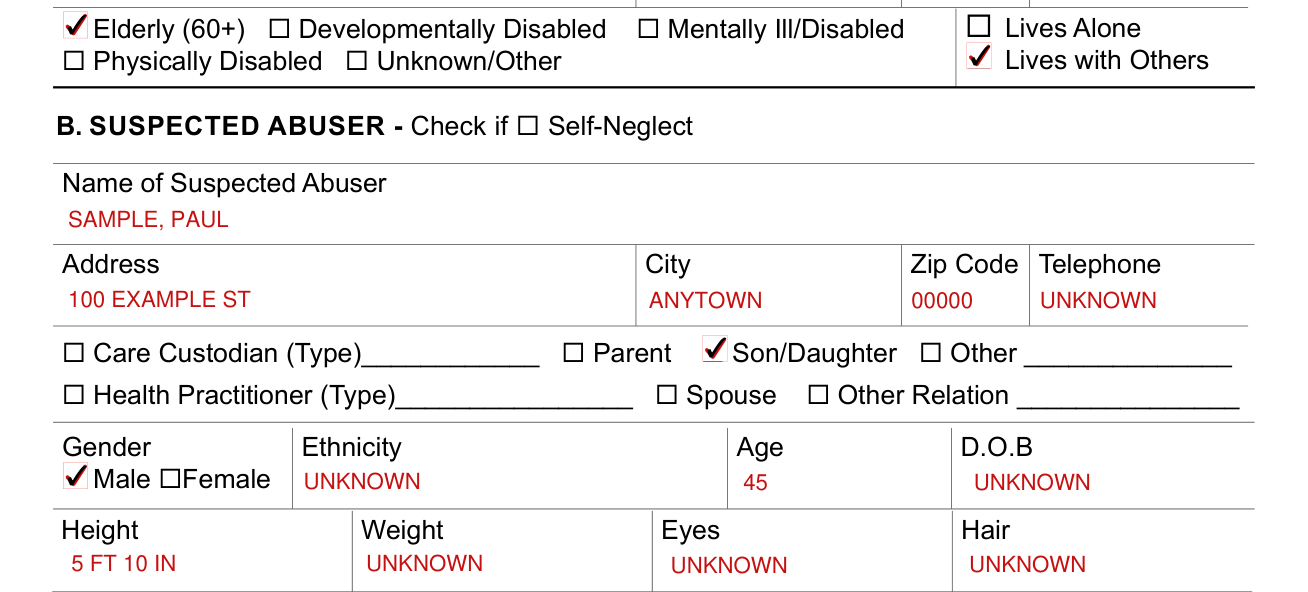
Box B, Suspected Abuser: Check if Self-Neglect.
Box B, Suspected Abuser: Name of Suspected Abuser.
Box B, Suspected Abuser: Address, City, Zip Code and Telephone.
Box B, Suspected Abuser: Care Custodian (Type), Parent, Son/Daughter, Other; Health Practitioner (Type), Spouse, Other Relation.
Box B, Suspected Abuser: Gender, Male or Female.
Box B, Suspected Abuser: Ethnicity, Age, D.O.B, Height, Weight, Eyes and Hair.[1]
Page 2: access, serious bodily injury, time frame and danger
Does the alleged perpetrator still have access to the victim?
Does the allegation involve a serious bodily injury (see definition in section "Reporting Responsibilities and Time Frames" within the General Instructions)?
Provide any known time frame (2 days, 1 week, ongoing, etc.).
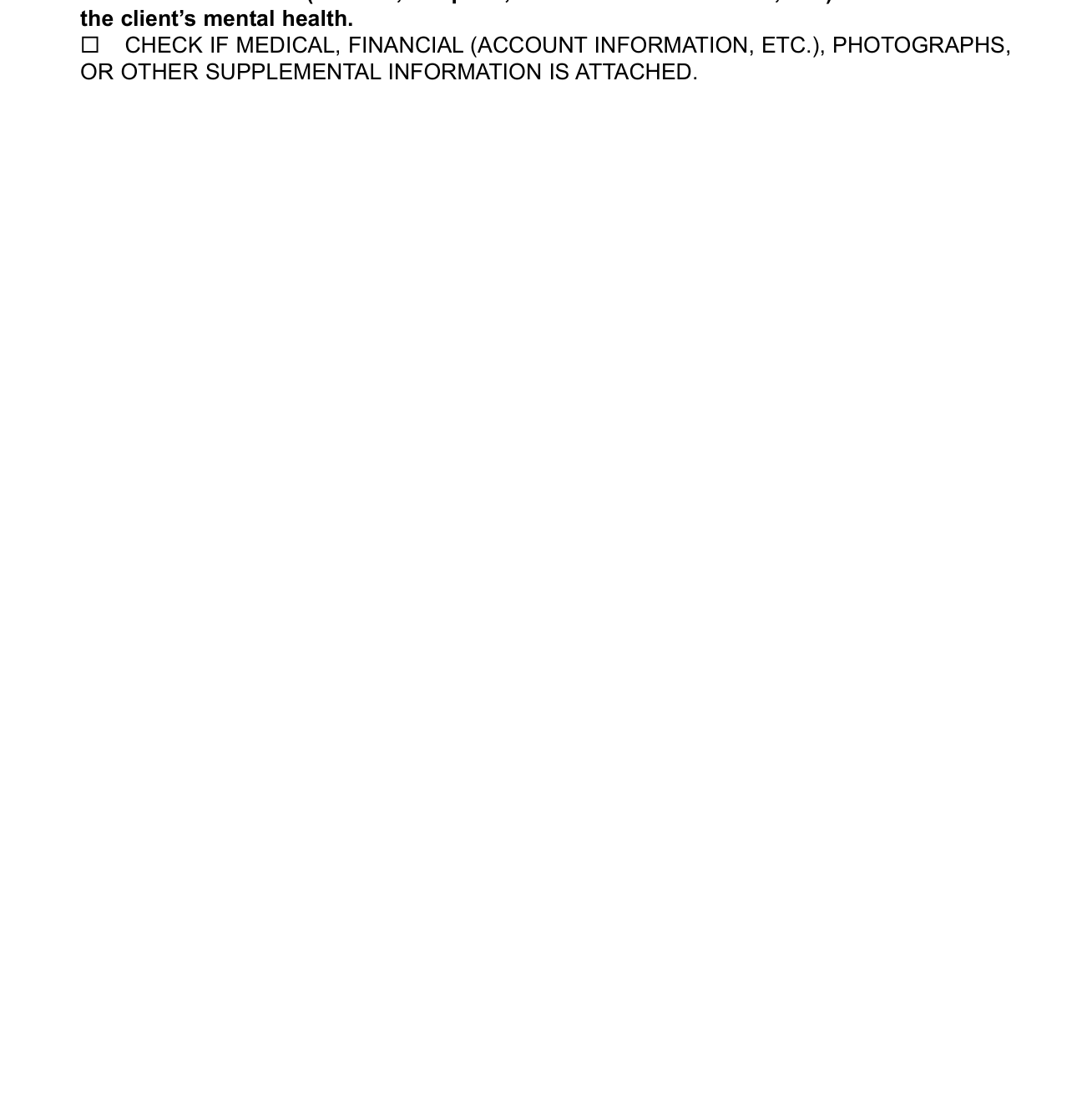
List any potential danger for investigator (animals, weapons, communicable diseases, etc.) or concerns about the client's mental health. Check if medical, financial (account information, etc.), photographs, or other supplemental information is attached.[1]
Box D: the reporting party, signature and confidentiality
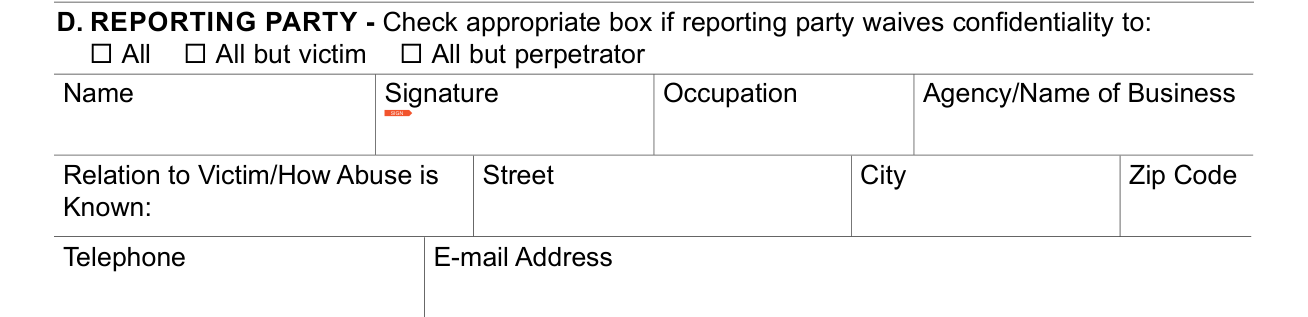
Box D, Reporting Party: Name, Signature, Occupation, Agency/Name of Business.
Box D, Reporting Party: Check appropriate box if reporting party waives confidentiality to: All, All but victim, All but perpetrator. Item D: Check box if the reporting party waives confidentiality.
Please note that mandated reporters are required to disclose their names, however, non-mandated reporters may report anonymously.
Box D, Reporting Party: Relation to Victim/How Abuse is Known.
Box D, Reporting Party: Street, City, Zip Code, Telephone and E-mail Address.[1]
Box E: the incident

Box E, Incident Information: Address where incident occurred, and Date/Time of Incident(s).
Box E, Incident Information, Place of Incident (Check One): Own Home, Community Care Facility, Hospital/Acute Care Hospital, Home of Another, Nursing Facility/Swing Bed or Other (Specify).[1]
Box F: the types of abuse and what it resulted in
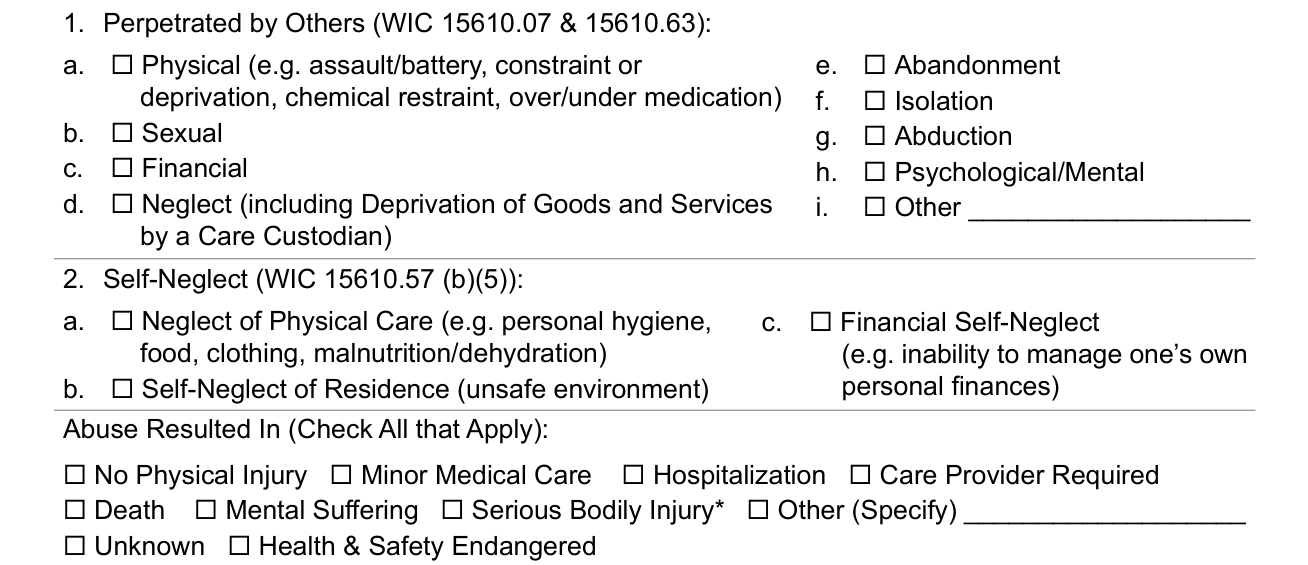
Box F, Reported Types of Abuse (Check All that Apply), 1. Perpetrated by Others (WIC 15610.07 & 15610.63): a. Physical (e.g. assault/battery, constraint or deprivation, chemical restraint, over/under medication), b. Sexual, c. Financial, d. Neglect (including Deprivation of Goods and Services by a Care Custodian), e. Abandonment, f. Isolation, g. Abduction, h. Psychological/Mental, i. Other.
Box F, Reported Types of Abuse (Check All that Apply), 2. Self-Neglect (WIC 15610.57 (b)(5)): a. Neglect of Physical Care (e.g. personal hygiene, food, clothing, malnutrition/dehydration), b. Self-Neglect of Residence (unsafe environment), c. Financial Self-Neglect (e.g. inability to manage one's own personal finances).
Box F, Abuse Resulted In (Check All that Apply): No Physical Injury, Minor Medical Care, Hospitalization, Care Provider Required, Death, Mental Suffering, Serious Bodily Injury*, Other (Specify), Unknown or Health & Safety Endangered.[1]
Box G: other persons who know of the abuse
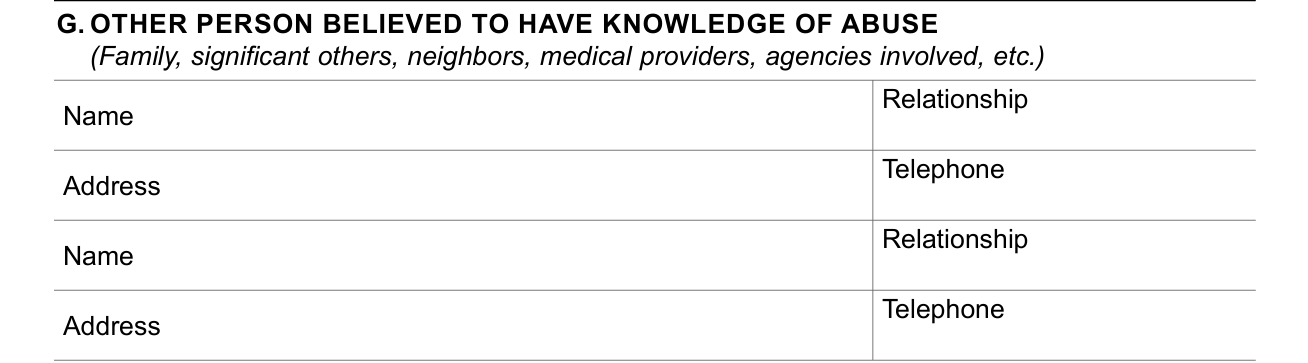
Box G, Other Person Believed to Have Knowledge of Abuse (Family, significant others, neighbors, medical providers, agencies involved, etc.): Name, Relationship, Address and Telephone.[1]
Box H: the person responsible for the victim's care

Box H, Family Member or Other Person Responsible for Victim's Care (If known, list contact person): If Contact person check the box; Name, Relationship, Address, City, Zip Code and Telephone.[1]
Box I: the telephone report

Box I, Telephone Report Made To: APS, Law Enforcement, Local Ombudsman, Calif. Dept. of State Hospitals or Calif. Dept. of Developmental Services; then Name of Official Contacted by Phone, Telephone and Date/Time.[1]
Box J: the written report
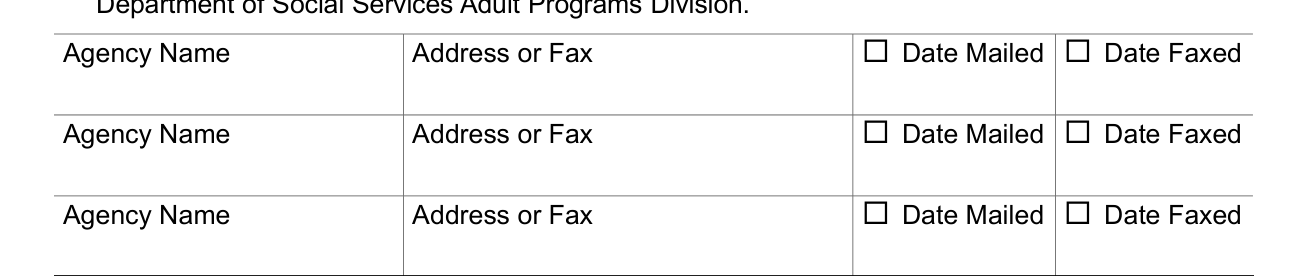
Box J, Written Report - Enter information about the agencies receiving this report: Agency Name, Address or Fax, Date Mailed and Date Faxed.
If the abuse occurred in a LTC facility and resulted in Serious Bodily Injury*, please refer to "Reporting Responsibilities and Time Frames" in the General Instructions.
Common mistake: Do not submit report to California Department of Social Services Adult Programs Division.[1]
More rules for Form SOC 341
CONFIDENTIAL REPORT - NOT SUBJECT TO PUBLIC DISCLOSURE.[1]
To be completed by reporting party. Please print or type. See General Instructions.[1]
If any item of information is unknown, enter “unknown.”[1]
Box K, Receiving Agency Use Only.[1]
When and where to report, and other situations
Any mandated reporter
REPORTING RESPONSIBILITIES AND TIME FRAMES: Any mandated reporter, who in his or her professional capacity, or within the scope of his or her employment, has observed or has knowledge of an incident that reasonably appears to be abuse or neglect, or is told by an elder or dependent adult that he or she has experienced behavior constituting abuse or neglect, or reasonably suspects that abuse or neglect has occurred, shall complete this form for each report of known or suspected instance of abuse (physical abuse, sexual abuse, financial abuse, abduction, neglect (self-neglect), isolation, and abandonment) involving an elder or dependent adult immediately or as soon as practicably possible. *Serious bodily injury means an injury involving extreme physical pain, substantial risk of death, or protracted loss or impairment of function of a bodily member, organ or of mental faculty, or requiring medical intervention, including, but not limited to, hospitalization, surgery, or physical rehabilitation (WIC Section 15610.67).[1]
The abuse occurred in a long-term care (LTC) facility
If the abuse occurred in a LTC facility, was physical abuse, did not result in serious bodily injury, and was perpetrated by a resident with a physician's diagnosis of dementia, the reporter shall submit a written report to both the LTCOP and the local law enforcement agency within 24 hours of observing, obtaining knowledge of, or suspecting physical abuse.
In all other instances of abuse that occurred in a Long-Term Care (LTC) facility (as defined in WIC Section 15610.47) a verbal report shall be made by telephone to the local law enforcement agency immediately and no later than two (2) hours after observing, obtaining knowledge of, or suspecting physical abuse.
Send the written report to the local law enforcement agency, the local Long-Term Care Ombudsman Program (LTCOP), and the appropriate licensing agency (for long-term health care facilities, the California Department of Public Health; for community care facilities, the California Department of Social Services) within twenty-four (24) hours of observing, obtaining knowledge of, or suspecting physical abuse.[1]
The abuse or neglect occurred in a state mental hospital or a state developmental center
If the abuse or neglect occurred in a state mental hospital or a state developmental center, mandated reporters shall report immediately, but no later than two (2) hours after observing, obtaining knowledge of, or suspecting physical abuse to the responsible agency.
If the abuse occurred in a State Mental Hospital, report to the local law enforcement agency and the California Department of State Hospitals.
If the abuse occurred in a State Developmental Center, report to the local law enforcement agency and to the California Department of Developmental Services.[1]
All other abuse (not in a Long-Term Care (LTC) facility, a state mental hospital or a state developmental center)
For all other abuse, mandated reporters shall report by telephone or through a confidential Internet reporting tool to the adult protective services agency or the local law enforcement agency immediately or as soon as practicably possible.
If reported by telephone, a written or confidential Internet report shall be sent to adult protective services or law enforcement within two working days.[1]
Two or more mandated reporters know of the same abuse
MULTIPLE REPORTERS When two or more mandated reporters are jointly knowledgeable of a suspected instance of abuse of a dependent adult or elder, and when there is agreement among them, the telephone report may be made by one member of the group.
Also, a single written report may be completed by that member of the group.
Any person of that group, who believes the report was not submitted, shall submit the report.[1]
After the telephone report: sending the written report
Mandated reporter: After making the telephone report to the appropriate agency or agencies, the reporter shall send the written report to the designated agencies (as defined under “Reporting Responsibilities and Time Frames”); and keep one copy for the reporter's file.[1]
Who is a mandated reporter
Mandated Reporter (WIC Section 15630 (a)): Any person who has assumed full or intermittent responsibility for care or custody of an elder or dependent adult, whether or not that person receives compensation, including administrators, supervisors, and any licensed staff of a public or private facility that provides care or services for elder or dependent adults, or any elder or dependent adult care custodian, health practitioner, clergy member, or employee of a county adult protective services agency or a local law enforcement agency, is a mandated reporter.[1]
Confidentiality of the identity of the reporter
The identity of all persons who report under WIC Chapter 11 shall be confidential and disclosed only among APS agencies, local law enforcement agencies, LTCOPs, California State Attorney General Bureau of Medi-Cal Fraud and Elder Abuse, licensing agencies or their counsel, Department of Consumer Affairs Investigators (who investigate elder and dependent adult abuse), the county District Attorney, the Probate Court, and the Public Guardian.
Confidentiality may be waived by the reporter or by court order.[1]
Anyone who attempts to impede or inhibit a mandated reporter from reporting
No one, including a supervisor, employer, or lawyer, can excuse a mandated reporter from his or her personal legal duty to report known or suspected abuse.
Anyone who attempts to impede or inhibit a mandated reporter from reporting may be prosecuted for a misdemeanor punishable by a fine, imprisonment, or both.
Mandated reporters are therefore expected to report any such efforts to law enforcement, as well as any other responsible agency (see Welfare and Institutions Code Section 15630(f) and (h)).[1]
Failure to report suspected abuse
Failure to report by mandated reporters (as defined under “Reporting Party Definitions”) any suspected incidents of physical abuse (including sexual abuse), abandonment, isolation, financial abuse, abduction, or neglect (including self-neglect) of an elder (age 65 or older) or a dependent adult is a misdemeanor, punishable by not more than six months in the county jail, or by a fine of not more than $1,000, or by both imprisonment and fine.
Any mandated reporter who willfully fails to report abuse of an elder (age 65 or older) or a dependent adult, where the abuse results in death or great bodily injury, may be punished by up to one year in the county jail, or by a fine of up to $5,000, or by both imprisonment and fine (WIC Section 15630(h)).
Officers or employees of financial institutions are mandated reporters of financial abuse (effective January 1, 2007).
These mandated reporters who fail to report financial abuse of an elder or dependent adult are subject to a civil penalty not exceeding $1,000.
Individuals who willfully fail to report financial abuse of an elder or dependent adult are subject to a civil penalty not exceeding $5,000.
These civil penalties shall be paid by the financial institution, which is the employer of the mandated reporter, to the party bringing the action.[1]
What the form means by abuse, neglect, elder, dependent adult and Adult Protective Services eligibility
Abuse means any treatment with resulting physical harm, pain, or mental suffering or the deprivation by a care custodian of goods or services that are necessary to avoid physical harm or mental suffering.
Neglect means the negligent failure of an elder or dependent adult or of any person having the care or custody of an elder or a dependent adult to exercise that degree of self-care or care that a reasonable person in a like position would exercise.
For purposes of mandatory reporting, elder means any person residing in this state who is 60 years of age or older (WIC Section 15610.27).
For purposes of eligibility to receive services under the APS program, an elder is defined as anyone residing in this state 60 years of age or older (WIC Section 15750(b)(2)).
As of January 1, 2022, APS agencies can receive referrals and investigate allegations of abuse and provide intervention and case management to any elder 60 years of age or older, and to dependent adults between the ages of 18-59 (WIC Section 15750(b)(1)(A)).
Statutes governing mandated reporting have not been affected; accordingly, mandatory reporting still only applies to elders age 65 years and older.
Dependent Adult means any person residing in this state, between the ages of 18 and 59, who has physical or mental limitations that restrict his or her ability to carry out normal activities or to protect his or her rights including, but not limited to, persons who have physical or developmental disabilities or whose physical or mental abilities have diminished because of age (WIC Section 15610.23).
Dependent adult includes any person between the ages of 18 and 59 who is admitted as an inpatient to a 24-hour health facility (defined in the Health and Safety Code Sections 1250, 1250.2, and 1250.3).
Adults age 60+, however, are eligible for Adult Protective Services (APS).
APS can investigate allegations of abuse against them, and if confirmed, offer appropriate services.[1]
Common questions about Form SOC 341
What is a SOC 341 form?
This form documents the information given by the reporting party on the suspected incident of abuse or neglect of an elder or dependent adult.[1]
Does it need a notary?
No notary is named anywhere on Form SOC 341.
Are there fees?
The form does not say.
What am I certifying when I sign?
The form does not say.
When is this form not the right one?
Any officer and/or employee of a financial institution is a mandated reporter of suspected financial abuse and shall report suspected financial abuse of an elder or dependent adult on form SOC 342, “Report of Suspected Dependent Adult/Elder Financial Abuse”.[1]
Sources
[1] Form SOC 341 (2/24), Report of Suspected Dependent Adult/Elder Abuse, California Department of Social Services (the Official source link on this page).