

Form ST-5C at a glance
What it is: Form ST-5C Contractor's Sales Tax Exempt Purchase Certificate, Massachusetts Department of Revenue.
Who signs: Part A. Governmental body, agency or 501(c)(3) certified exempt organization: sign the Authorizing signature line and enter the Date. Purchasing contractor or subcontractor claiming exemption: sign under the penalties of perjury on the Signature line and enter your Title.
In general, this form is intended for use by contractors and subcontractors purchasing building materials and supplies, as well as other types of tangible personal property for use in various tax-exempt projects.
Contractors and subcontractors must complete all appropriate sections of this form when making purchases for which they are claiming exemption.
A filled-in Form ST-5C example: a roofing contractor buys building materials
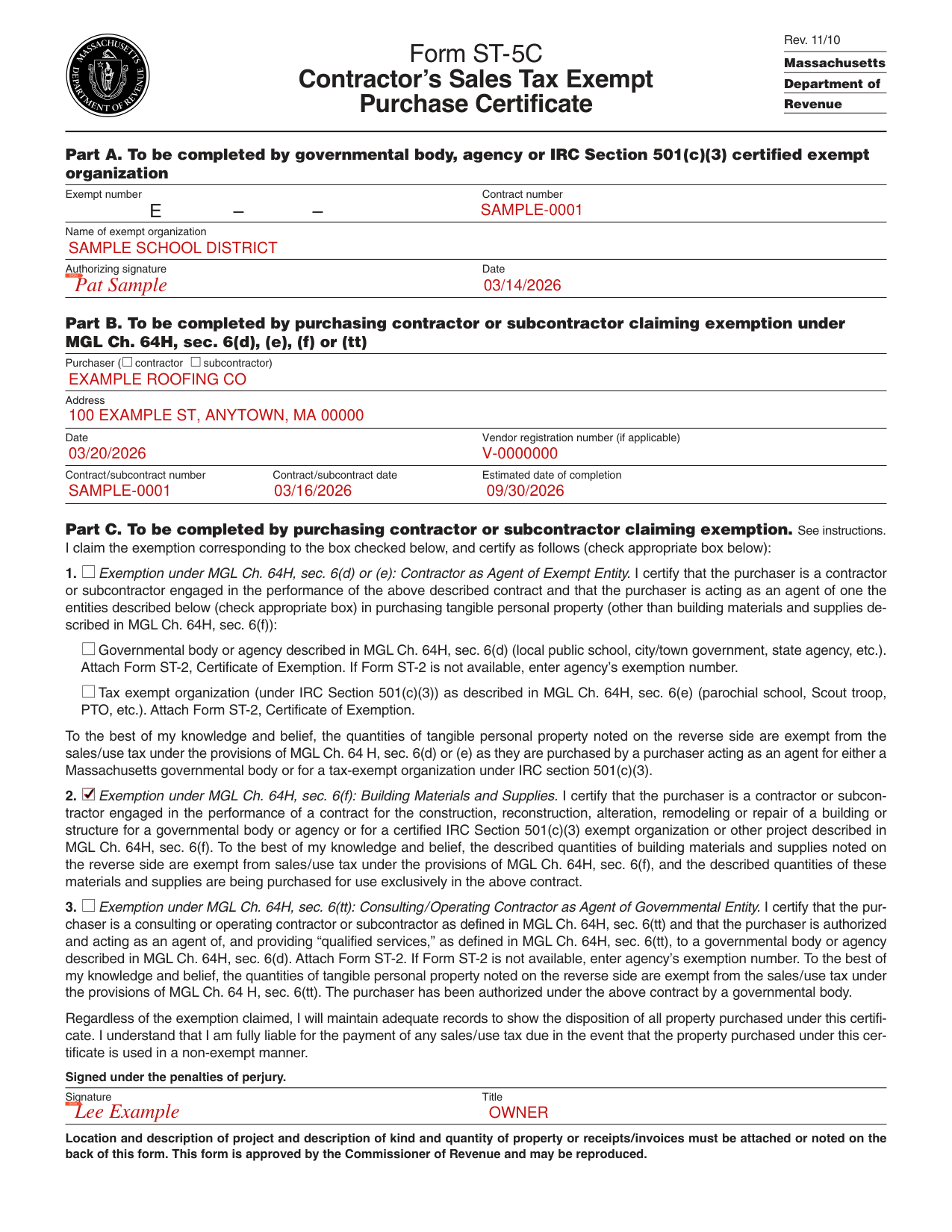
How to fill out Form ST-5C, box by box
Part A: the governmental body or exempt organization

Part A. Governmental body, agency or 501(c)(3) certified exempt organization: sign the Authorizing signature line and enter the Date.
Enter the Exempt number, Contract number and Name of exempt organization.
Part B: the purchasing contractor or subcontractor

Part B. To be completed by purchasing contractor or subcontractor claiming exemption under MGL Ch. 64H, sec. 6(d), (e), (f) or (tt).
Enter the Purchaser (contractor or subcontractor), Address, Date, Vendor registration number (if applicable), Contract/subcontract number, Contract/subcontract date and Estimated date of completion.
Part C, Box 1: contractor as agent of an exempt entity
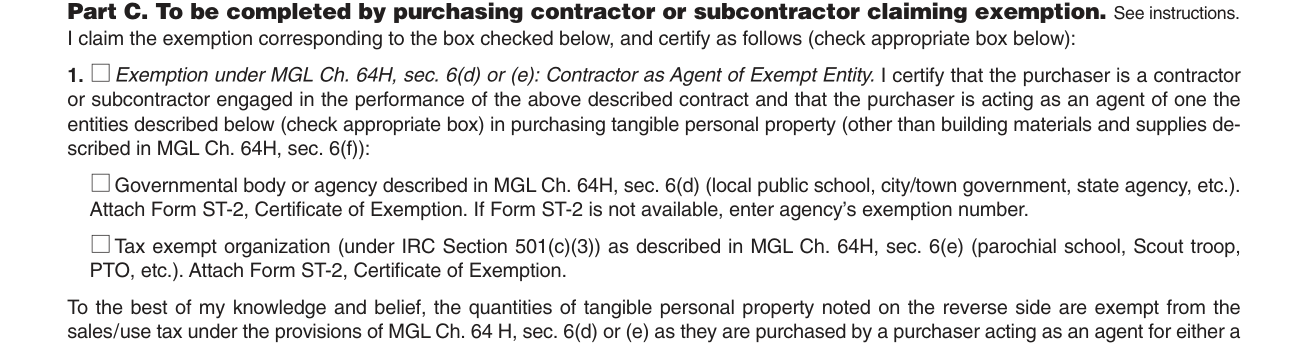
Box 1. Exemption under MGL Ch. 64H, sec. 6(d) or (e): Contractor as Agent of Exempt Entity.
In general, contractors or subcontractors purchasing tangible personal property as duly authorized agents acting on behalf of governmental bodies or agencies or Internal Revenue Service certified tax exempt 501(c)(3) organizations must check Box 1 under Part C of Form ST-5C. Box 1 is for tangible personal property other than building materials and supplies for use in projects described in MGL Ch. 64H, sec. 6(f), which are discussed in section 2, below.
Governmental body or agency described in MGL Ch. 64H, sec. 6(d) (local public school, city/town government, state agency, etc.). Attach Form ST-2, Certificate of Exemption. If Form ST-2 is not available, enter agency's exemption number.
Tax exempt organization (under IRC Section 501(c)(3)) as described in MGL Ch. 64H, sec. 6(e) (parochial school, Scout troop, PTO, etc.). Attach Form ST-2, Certificate of Exemption.
Overhead items purchased in connection with such contracts, for example, office furniture and equipment, consumable supplies for the contractor's own use and not for the use of the governmental agency or 501(c)(3) organization, are not eligible for this exemption. A contractor, as the consumer of such items, must pay sales/use tax on these purchases.
Agents of exempt governmental entities or 501(c)(3) organizations who are not contractors or subcontractors purchasing property other than building materials and supplies described in MGL Ch. 64H, sec. 6(f) should not use this form.
Part C, Box 2: building materials and supplies

Contractors or subcontractors purchasing building materials or supplies for use in an exempt project described in MGL Ch. 64H, sec. 6(f) must check Box 2 under Part C of Form ST-5C.
Exempt purchases of building materials and supplies are limited to those materials and supplies used, consumed, employed or expended in the construction, reconstruction, alteration, remodeling or repair of any building, structure, public highway, bridge or other such public work as well as such materials and supplies physically incorporated therein.
Items that do not constitute “building materials and supplies” within the meaning of MGL Ch. 64H, sec. 6(f) include office supplies, furniture and equipment and other overhead items purchased for use by the contractor or its employees in performing its contracts. Contractors and subcontractors, as the consumers of such items, must pay sales/use tax on these purchases.
Part C, Box 3: consulting or operating contractor

“Consulting or operating contractors or subcontractors,” as defined in MGL Ch. 64H, sec. 6(tt) purchasing tangible personal property on behalf of, and acting as agents of, and providing “qualified services” (as defined in MGL c. 64H, sec. 6(tt)) to a governmental body or agency described in MGL Ch. 64H, sec. 6(d) must check Box 3 under Part C of Form ST-5C.
Such contractors or subcontractors must attach a copy of the exempt governmental entity's Form ST-2 provided by the entity on whose behalf it is making the purchases. If the exempt governmental entity does not present its contractors or subcontractors with Form ST-2, the contractor/subcontractor must present other documentation evidencing its principal's exempt governmental status.
Overhead items purchased by contractors for their own use in performing contracts for exempt governmental entities are not eligible for this exemption. Rather, a consulting or operating contractor or subcontractor, as the consumer of such items, must pay sales/use tax on these purchases.
Signing under the penalties of perjury

By signing you certify that, regardless of the exemption claimed, you will maintain adequate records to show the disposition of all property purchased under this certificate, and that you understand you are fully liable for the payment of any sales/use tax due in the event that the property purchased under this certificate is used in a non-exempt manner.
Purchasing contractor or subcontractor claiming exemption: sign under the penalties of perjury on the Signature line and enter your Title.
Parts D and E: project and property purchased
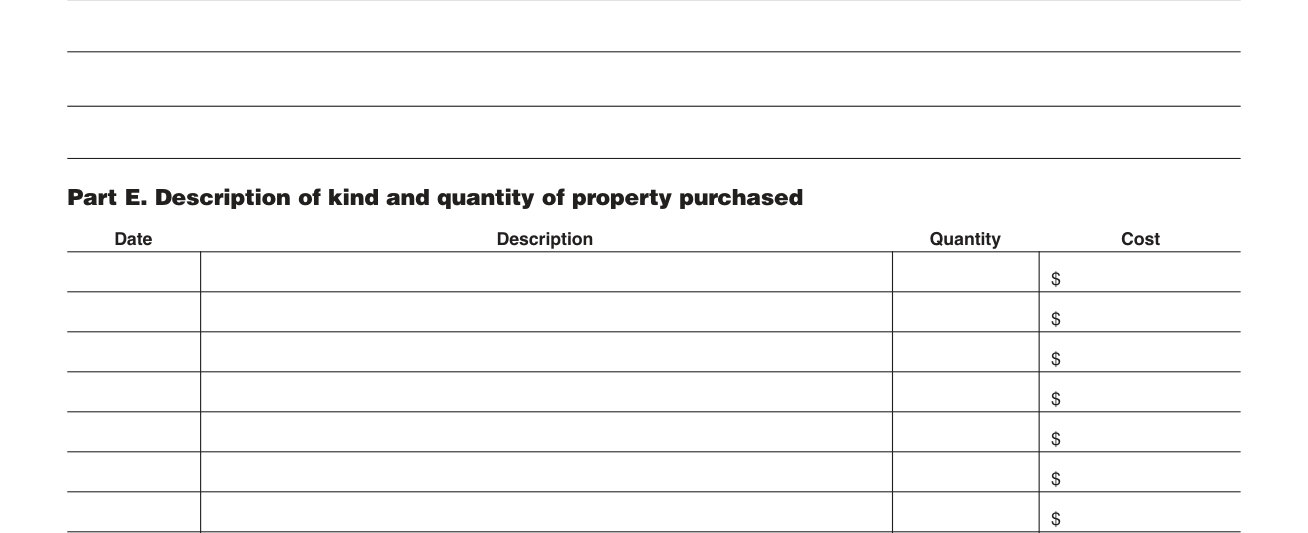
Location and description of project and description of kind and quantity of property or receipts/invoices must be attached or noted on the back of this form.
Part D. Location and description of project. Part E. Description of kind and quantity of property purchased.
Enter the Date, Description, Quantity and Cost.
More rules for Form ST-5C
Form ST-5C applies only to the contract specified therein.
Any abuse or misuse of this certificate by any tax-exempt organization, or any unauthorized use of this certificate by any individual, constitutes a serious violation and will lead to revocation.
Common questions about Form ST-5C
Is there a penalty?
Willful misuse of this Certificate of Exemption is subject to criminal sanctions of up to one year in prison and $10,000 ($50,000 for corporations) in fines (checked November 1, 2026).
Sources
[1] Form ST-5C (Rev. 11/10), Contractor's Sales Tax Exempt Purchase Certificate, Massachusetts Department of Revenue (the Official source link on this page).
