
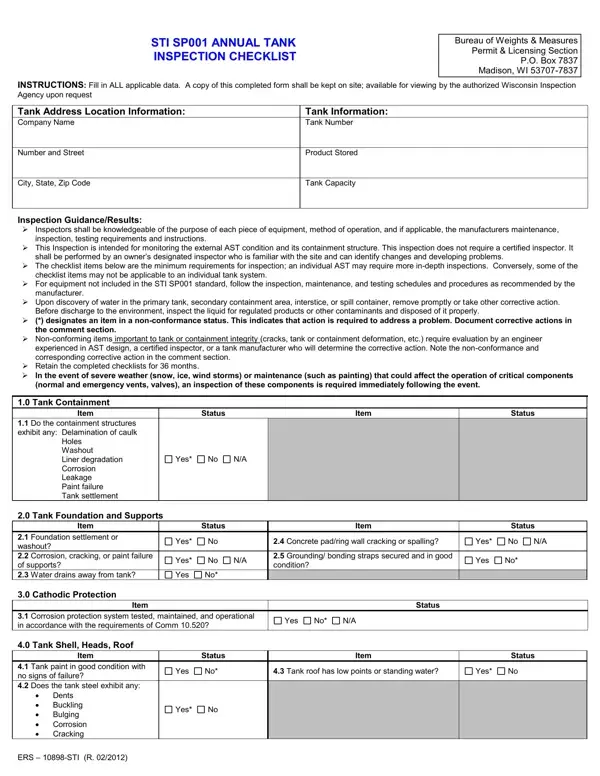

Form TR-WM-135 at a glance
What it is: This inspection is intended for monitoring the external AST condition and its containment structure; it does not require a certified inspector.
Who signs: Sign on the SIGNATURE(S) line and enter the date under INSPECTOR SIGNATURE DATE.
A filled-in Form TR-WM-135 example: an inspector completes the annual checklist
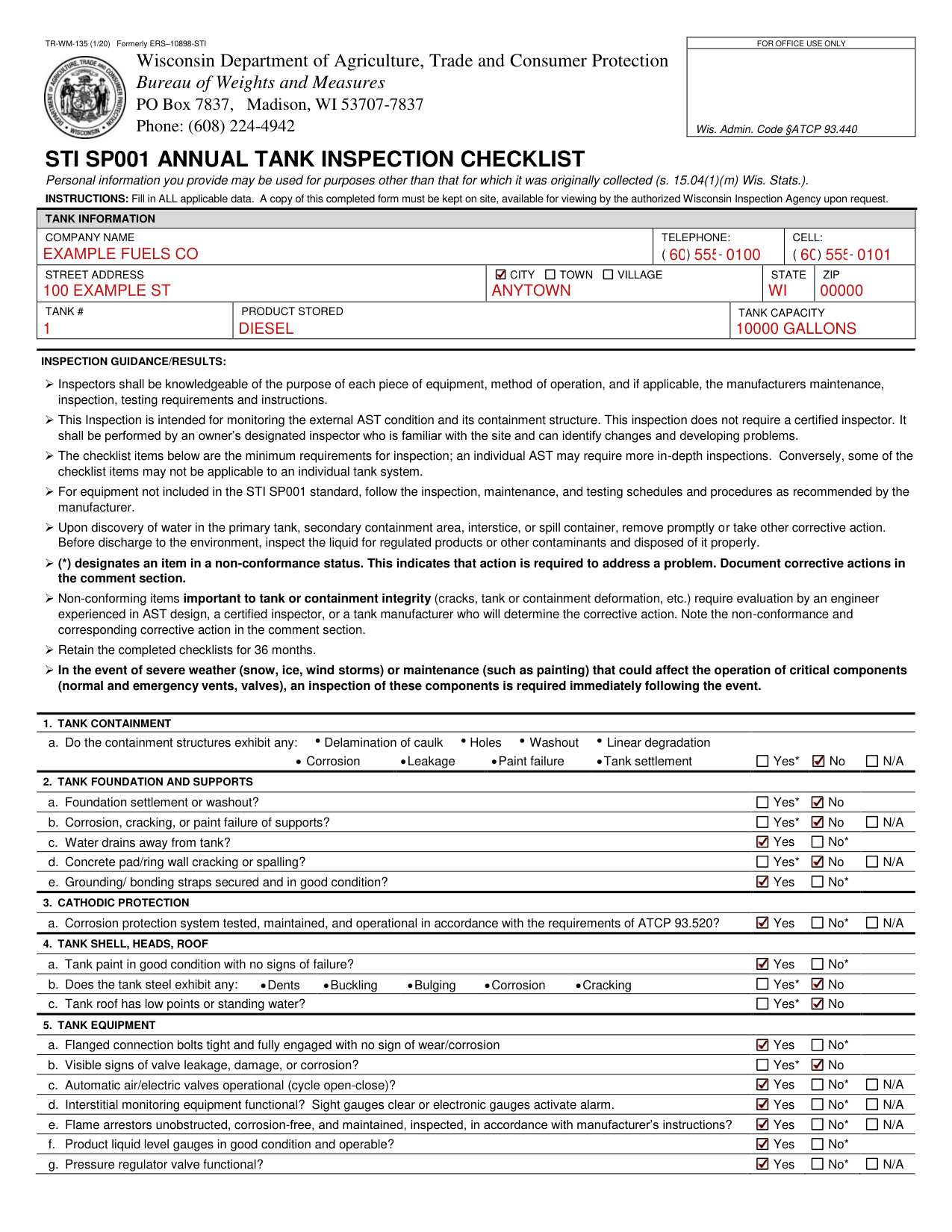
How to fill out Form TR-WM-135, box by box
Tank information
Under Tank information, enter the Company name, Street address, City, Town or Village (only the one that applies), State and Zip.
Enter the Telephone and the Cell number.
Enter the Tank #, the Product stored and the Tank capacity.
1. Tank containment
a. Do the containment structures exhibit any: Delamination of caulk, Holes, Washout, Linear degradation, Corrosion, Leakage, Paint failure, Tank settlement? Yes*, No or N/A.
2. Tank foundation and supports
a. Foundation settlement or washout? Yes* or No.
b. Corrosion, cracking, or paint failure of supports? Yes*, No or N/A.
c. Water drains away from tank? Yes or No*.
d. Concrete pad/ring wall cracking or spalling? Yes*, No or N/A.
e. Grounding/ bonding straps secured and in good condition? Yes or No*.
3. Cathodic protection
a. Corrosion protection system tested, maintained, and operational in accordance with the requirements of ATCP 93.520? Yes, No* or N/A.
4. Tank shell, heads, roof
a. Tank paint in good condition with no signs of failure? Yes or No*.
b. Does the tank steel exhibit any: Dents, Buckling, Bulging, Corrosion, Cracking? Yes* or No.
c. Tank roof has low points or standing water? Yes* or No.
5. Tank equipment
a. Flanged connection bolts tight and fully engaged with no sign of wear/corrosion? Yes or No*.
b. Visible signs of valve leakage, damage, or corrosion? Yes* or No.
c. Automatic air/electric valves operational (cycle open-close)? Yes, No* or N/A.
d. Interstitial monitoring equipment functional? Sight gauges clear or electronic gauges activate alarm. Yes, No* or N/A.
e. Flame arrestors unobstructed, corrosion-free, and maintained, inspected, in accordance with manufacturer's instructions? Yes, No* or N/A.
f. Product liquid level gauges in good condition and operable? Yes or No*.
g. Pressure regulator valve functional? Yes, No* or N/A.
h. Emergency vent covers, pressure/vacuum poppets, and moving vent components move freely, are unobstructed, and have no evidence of seat and sealing surface degradation due to: Corrosion, Damage, Wear? Yes, No* or N/A.
i. Anti-siphon, check, and gate valves cycle open-close and/or operate correctly? Yes or No*.
j. Fire and shear valves cycle open-close easily, fusible link installed, and test ports are sealed with a pipe plug? Yes, No* or N/A.
k. Spill container in good condition with all connections tight and drain valves operable and closed? Yes, No* or N/A.
l. Leak detectors for underground piping pass functionality test? (TR-WM-123) Yes, No* or N/A.
m. Overfill equipment functional? Yes, No* or N/A.
n. Expansion relief valve in correct orientation? Yes, No* or N/A.
6. Insulated tanks
a. Does the inspection of the tank insulation exhibit: Missing sections, Areas of moisture, Mold, Damage? Yes*, No or N/A.
b. Does the insulation cover or jacket exhibit damage that will allow water intrusion? Yes*, No or N/A.
7. Miscellaneous
a. Are electrical boxes, conduit and wiring intact, sealed and secure? Yes or No*.
b. Emergency disconnect is easily identifiable and shuts-off all power when actuated? Yes, No* or N/A.
c. Buried piping exposed? Yes* or No.
d. Out-of-service pipes capped or blank flanged? Yes, No* or N/A.
Comments/corrective action and signature(s)
Write the COMMENTS/CORRECTIVE ACTION.
Sign on the SIGNATURE(S) line and enter the date under INSPECTOR SIGNATURE DATE.
More rules for Form TR-WM-135
The inspection shall be performed by an owner's designated inspector who is familiar with the site and can identify changes and developing problems.
Fill in ALL applicable data. A copy of this completed form must be kept on site, available for viewing by the authorized Wisconsin Inspection Agency upon request.
Inspectors shall be knowledgeable of the purpose of each piece of equipment, method of operation, and if applicable, the manufacturers maintenance, inspection, testing requirements and instructions.
The checklist items are the minimum requirements for inspection; an individual AST may require more in-depth inspections. Some of the checklist items may not be applicable to an individual tank system.
For equipment not included in the STI SP001 standard, follow the inspection, maintenance, and testing schedules and procedures as recommended by the manufacturer.
Retain the completed checklists for 36 months.
If your situation is different
(*) non-conformance
(*) designates an item in a non-conformance status. This indicates that action is required to address a problem. Document corrective actions in the comment section.
Non-conforming items important to tank or containment integrity (cracks, tank or containment deformation, etc.) require evaluation by an engineer experienced in AST design, a certified inspector, or a tank manufacturer who will determine the corrective action. Note the non-conformance and corresponding corrective action in the comment section.
Water in the primary tank
Upon discovery of water in the primary tank, secondary containment area, interstice, or spill container, remove promptly or take other corrective action. Before discharge to the environment, inspect the liquid for regulated products or other contaminants and disposed of it properly.
Severe weather or maintenance
In the event of severe weather (snow, ice, wind storms) or maintenance (such as painting) that could affect the operation of critical components (normal and emergency vents, valves), an inspection of these components is required immediately following the event.
Sources
[1] Form TR-WM-135 (1/20), STI SP001 Annual Tank Inspection Checklist, Wisconsin Department of Agriculture, Trade and Consumer Protection (the Official source link on this page).