

FS Form 1851 at a glance
What it is: FS Form 1851 is the Request to Reissue United States Savings Bonds to a Personal Trust.
Who signs: The completed form must be signed by the owner or both coowners and acting trustee.
On page 4 of FS Form 1851, INSTRUCTIONS, USE OF FORM: complete this form to reissue paper United States Savings Bonds to a personal trust created by the owner, both coowners, or either coowner, or by some other person, provided the owner or a coowner is a beneficiary of the trust.
For Series EE bonds, some other person, provided a beneficiary of the trust is related by blood (including legal adoption) or marriage to the owner or a coowner. "Personal trust" as used in this form is a trust established by natural persons in their own right for the benefit of themselves or other natural persons in whole or in part, and common trust funds comprised in whole or in part of such estates.
A filled-in FS Form 1851 example: a grantor reissues one paper bond to his trust
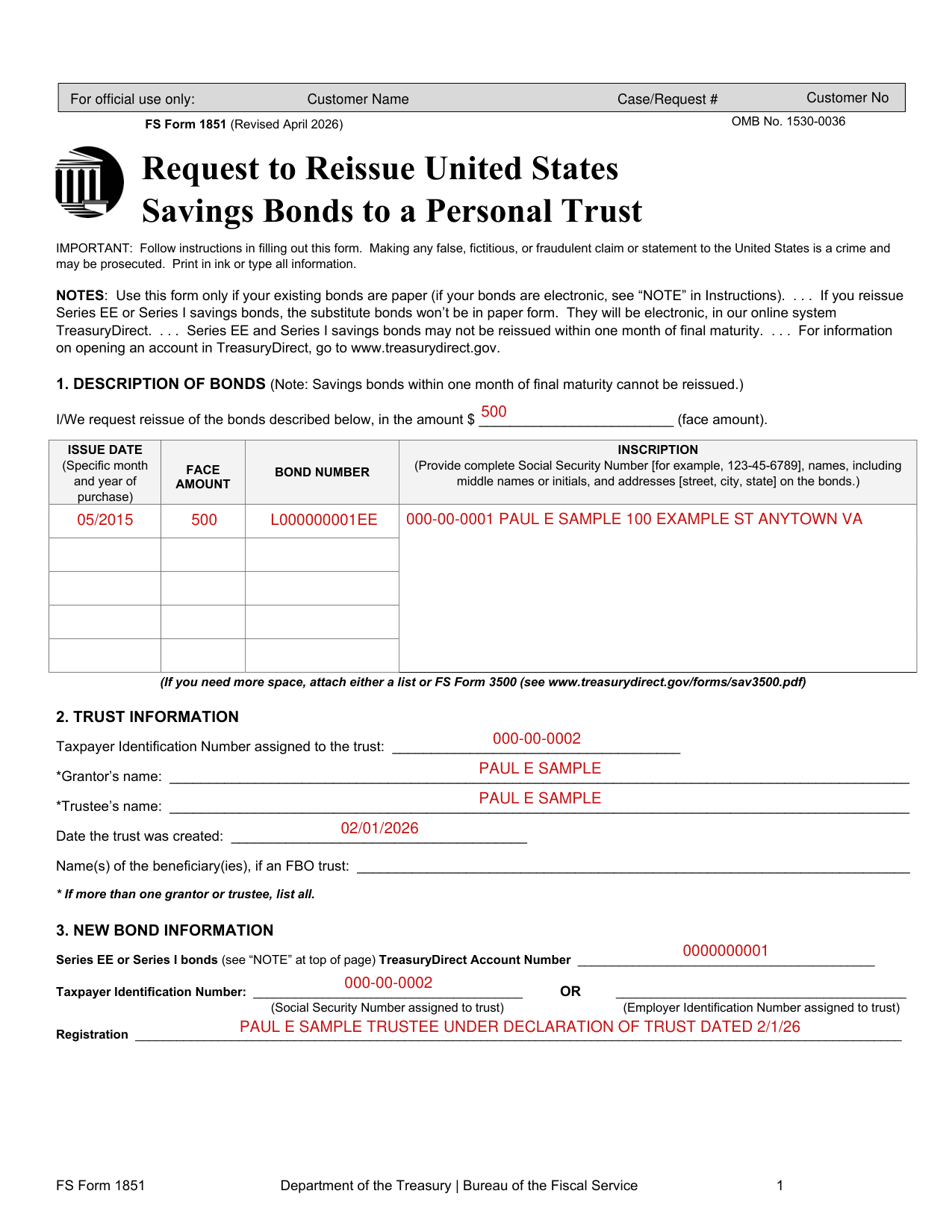
How to fill out FS Form 1851, box by box
Description of the bonds
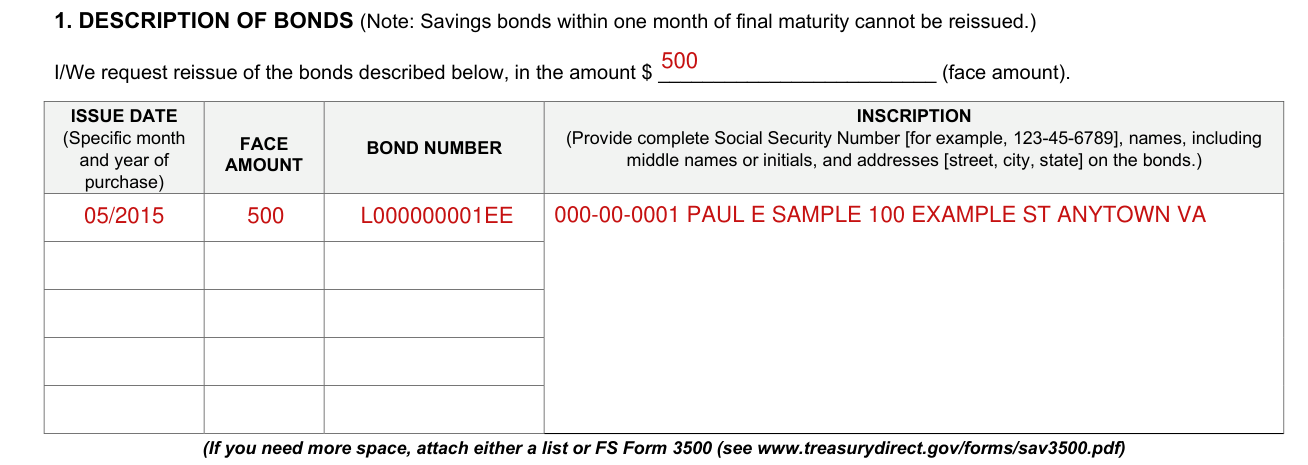
Fill in the total face amount of the bonds for which reissue is being requested. Fully describe the bonds and their present form of registration.
Under INSCRIPTION, provide complete Social Security Number, names, including middle names or initials, and addresses on the bonds.
If you need more space, attach either a list or FS Form 3500.
Trust information
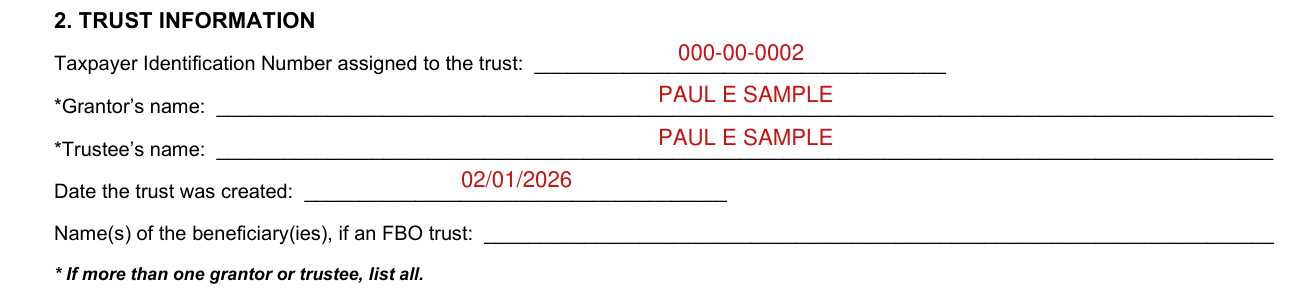
Provide the Taxpayer Identification Number assigned to the trust, the name of the grantor, the name of the trustee, the date the trust was created, and the name of any beneficiary of the trust (if the trust is an FBO trust).
If more than one grantor or trustee, list all.
New bond information

Under 3. NEW BOND INFORMATION: for Series EE or Series I bonds, provide the Treasurydirect account number for the trust. If you don't have an account, you may open one at Treasurydirect.gov.
Provide the Social Security Number or Employer Identification Number assigned to the trust.
For "Registration," show the name of the trustee, the name of the grantor, and the date the trust was created. If more than one trustee or grantor, list all.
Show the name of any beneficiary(ies) of the trust (if the trust is an FBO trust).
Tax liability statement
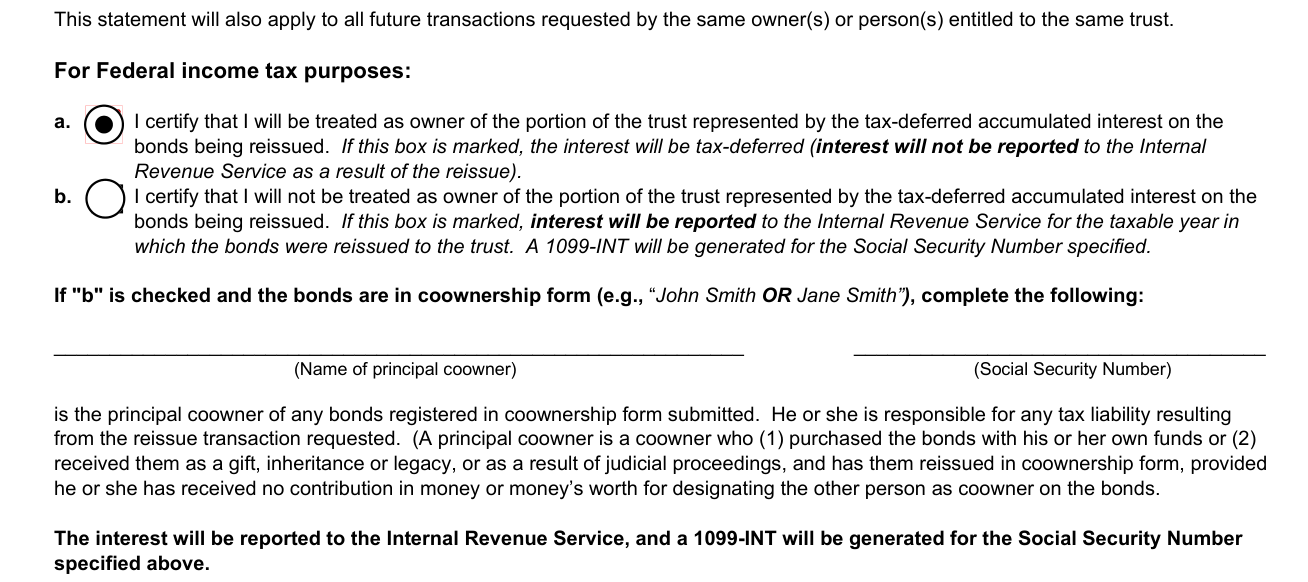
After reading Item 4, "TAX LIABILITY NOTICE," you must mark box "a" or "b" in Item 5.
Mark box "a" if you will be treated as the owner of the portion of the trust represented by the tax-deferred accumulated interest on the bonds being reissued. If this box is marked, the interest will be tax-deferred (interest will not be reported to the Internal Revenue Service as a result of the reissue).
Mark box "b" if you will NOT be treated as owner of the portion of the trust represented by the tax-deferred accumulated interest on the bonds being reissued. If this box is marked, interest will be reported to the Internal Revenue Service for the taxable year in which the bonds were reissued to the trust. A 1099-INT will be generated for the Social Security Number specified.
If "b" is checked and the bonds are in coownership form, complete the Name of principal coowner and the Social Security Number.
Signatures
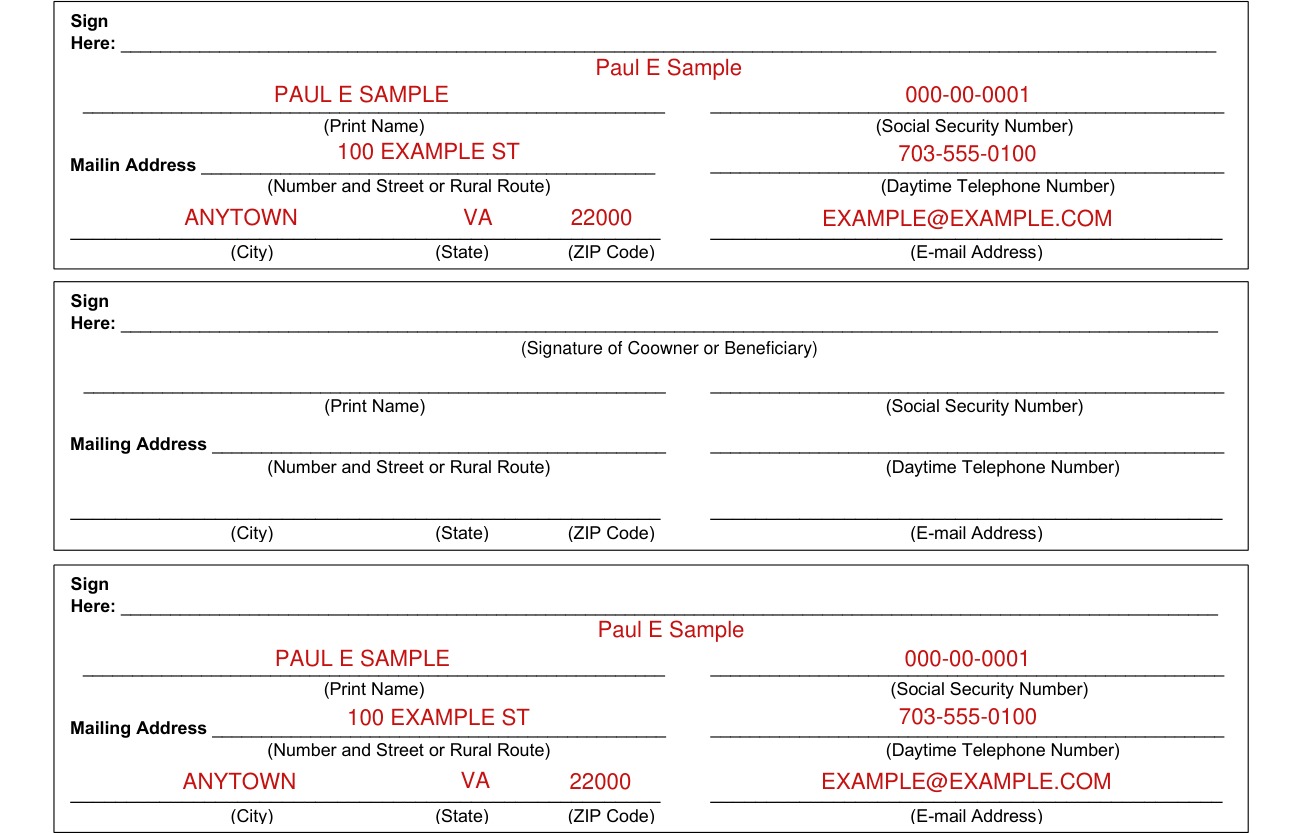
Each person whose signature is required must appear before and establish identification to the satisfaction of a notary or authorized certifying officer. The signatures to the form must be signed in the presence of the notary or officer.
Only the trustee listed as the account manager of the Treasurydirect trust account must sign the form agreeing to electronic reissue into the Treasurydirect account.
Under penalty of perjury, the undersigned grantor (creator) of the trust certifies that the Taxpayer Identification Number assigned to the trust is correct.
Sign in ink in the presence of a notary or certifying officer and provide the requested information.
Some forms require a certified signature. If your form says you need that, wait to sign it until you are with the person who will certify your signature.
If the trust was created by some person other than the owner or coowners, the trustee must furnish an IRS Form W-9.[2]
More rules for FS Form 1851
If you have ELECTRONIC bonds registered in your name and want to put them into a trust, you must open an entity trust account in Treasurydirect and submit FS Form 5511 to transfer the bonds to the account.
A bank, trust company, or other financial institution, appointed as trustee of a personal trust, should submit form FS Form 1455 with this form if the bonds are to be reissued in its name as trustee of its common trust fund.
This form should not be completed by a person under any legal disability, except for a minor of sufficient competency to sign the request and to understand the nature of the transaction.
If any person whose signature is required is deceased, submit proof of his or her death, in the form of a certified copy of the death certificate. Legal evidence or documentation you submit cannot be returned.
"Interest" includes tax-deferred interest represented by interest earned on Series EE or Series I bonds from the issue date until the date of reissue.
If co-trustees, one must be able to act individually on behalf of the trust.
The notary or certifying officer must affix the seal or stamp which is used when certifying requests for payment. Authorized certifying officers are available at financial institutions, including credit unions, in the United States.
Print in ink or type all information.
Upon the reissuance of savings bonds to a trust, you must include in your gross income any accumulated interest on the bonds, if you have not already reported it, unless, under the grantor trust provisions of the Internal Revenue Code, you are treated as the owner of the portion of the trust represented by any tax-deferred accumulated interest on the reissued bonds.
These rules apply if two conditions exist: 1) you are the owner of the portion of the trust represented by the tax-deferred accumulated interest, and 2) the bonds being reissued are either a) Series I bonds, orb) Series EE bonds.
This statement will also apply to all future transactions requested by the same owner(s) or person(s) entitled to the same trust.
Common questions about FS Form 1851
Where do I file it?
Unless otherwise instructed in accompanying correspondence, send this form, the securities, if any, and any additional information to Treasury Retail Securities Services, P.O. Box 9150, Minneapolis, MN 55480-9150.
Is there a penalty?
Making any false, fictitious, or fraudulent claim or statement to the United States is a crime and may be prosecuted.
When is this form not the right one?
Use this form only if your existing bonds are paper. If you reissue Series EE or Series I savings bonds, the substitute bonds won't be in paper form. They will be electronic, in the online system Treasurydirect. Series EE and Series I savings bonds may not be reissued within one month of final maturity.
Sources
[1] FS Form 1851 (Revised April 2026), Request to Reissue United States Savings Bonds to a Personal Trust, Bureau of the Fiscal Service (the Official source link on this page).
[2] treasurydirect.gov, certified_signature (treasurydirect.gov). Accessed October 31, 2026.
