

Observation Form at a glance
What it is: The Observation Form is a grid to record hand hygiene practices.
Who signs: The observer writes their initials; the observer is responsible for the data collection and for checking their accuracy before submitting the form for analysis.
The blank Observation Form: print it and complete it by hand
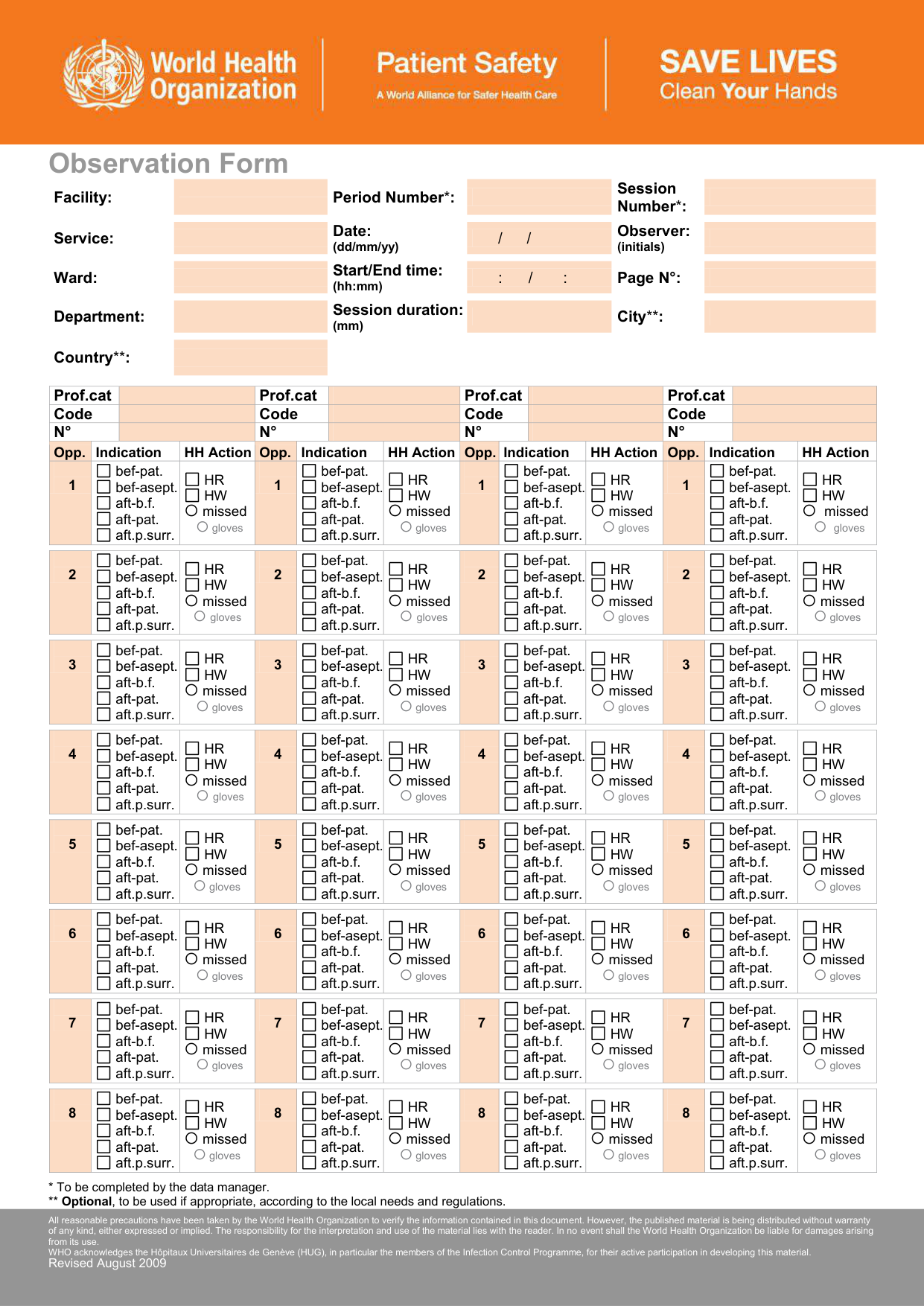
How to fill out Observation Form, box by box
Observer and health-care worker
In the context of open and direct observations, the observer introduces him/herself to the health-care worker and to the patient when appropriate, explains his/her task and proposes immediate informal feed back.
The health-care worker, belonging to one of the main four following professional categories, is observed during the delivery of health-care activities to patients.
Detected and observed data should be recorded with a pencil in order to be immediately corrected if needed.
Therefore numerous health-care workers may be sequentially included during one session in the column dedicated to their category. Alternatively each column may be dedicated to a single health-care worker only of whom the professional category should be indicated.
Facility, Service, Ward, Department, Period Number, Session Number and Page N°
The top of the form (header) is completed before starting data collection (excepted end time and session duration).
Period Number* and Session Number*: To be completed by the data manager. City** and Country**: Optional, to be used if appropriate, according to the local needs and regulations.
Facility: to complete according to the local nomenclature. Service: to complete according to the local nomenclature. Ward: to complete according to the local nomenclature. Department: to complete according to the following standardized nomenclature: medical, including dermatology, neurology, haematology, oncology, etc.; surgery, including neurosurgery, urology, EENT, ophthalmology, etc.; mixed (medical & surgical), including gynaecology; obstetrics, including related surgery; paediatrics, including related surgery; intensive care & resuscitation; emergency unit; long term care & rehabilitation; ambulatory care, including related surgery; other (to specify). Period N°: 1) pre- / 2) post-intervention; and then according to the institutional counter.
Session N°: attributed at the moment of data entry for analysis.
Page N°: to write only when more than one form is used for one session.
Date, Start/End time, Session duration and Observer
Date: day (dd) / month (mm) / year (yy) Start/end time: hour (hh) / minute (mm).
The session should last no more than 20 minutes (± 10 minutes according to the observed activity); the end time and the session duration are to be completed at the end of the observation session.
Session duration: difference between start and end time, resulting in minutes of observation.
Observer: observer's initials.
Prof.cat and Number
Prof.cat: according to the following classification: 1. nurse / midwife 1.1 nurse, 1.2 midwife, 1.3 student. 2. auxiliary 3. medical doctor 3.1 in internal medicine, 3.2 surgeon, 3.3 anaesthetist / resuscitator / emergency physician, 3.4 paediatrician, 3.5 gynaecologist, 3.6 consultant, 3.7 medical student. 4. other health-care worker 4.1 therapist (physiotherapist, occupational therapist, audiologist, speech therapist), 4.2 technician (radiologist, cardiology technician, operating room technician, laboratory technician, etc), 4.3 other (dietician, dentist, social worker and any other health-related professional involved in patient care), 4.4 student.
Number: number of observed health-care workers belonging to the same professional category (same code) as they enter the field of observation and you detect opportunities.
The observer may observe up to three health-care workers simultaneously, if the density of hand hygiene opportunities permits.
Opp, Indication and HH Action
As soon as you detect an indication for hand hygiene, count an opportunity in the appropriate column and cross the square corresponding to the indication(s) you detected.
Then complete all the indications that apply and the related hand hygiene actions observed or missed.
Each opportunity refers to one line in each column; each line is independent from one column to another.
Cross items in squares (several may apply for one opportunity) or circles (only a single item may apply at one moment).
When several indications fall in one opportunity, each one must be recorded by crossing the squares.
Performed or missed actions must always be registered within the context of an opportunity.
Glove use may be recorded only when the hand hygiene action is missed while the health-care worker is wearing gloves.
Opp(ortunity): defined by one indication at least. Indication: reason(s) that motivate(s) hand hygiene action; all indications that apply at one moment must be recorded.
bef.pat: before touching a patient. aft.b.f: after body fluid exposure risk. bef.asept: before clean/aseptic procedure. aft.pat: after touching a patient. aft.p.surr: after touching patient surroundings.
HH action: response to the hand hygiene indication(s); it can be either a positive action by performing handrub or handwash, or a negative action by missing handrub or handwash.
HR: hand hygiene action by handrubbing with an alcohol-based formula. HW: hand hygiene action by handwashing with soap and water. Missed: no hand hygiene action performed.
Compliance Calculation
Define the setting outlining the scope for analysis and report related data according to the chosen setting.
Check data in the observation form. Hand hygiene actions not related to an indication should not be taken into account and vice versa.
Report the session number and the related observation data in the same line. This attribution of session number validates the fact that data has been taken into count for compliance calculation.
4.1 Sum up recorded opportunities (opp) in the case report form per professional category: report the sum in the corresponding cell in the calculation form.
4.2 Sum up the positive hand hygiene actions related to the total of opportunities, making difference between handwash (HW) and handrub (HR): report the sum in the corresponding cell in the calculation form.
4.3 Proceed in the same way for each session (data record form). 4.4 Add up all sums per each professional category and put the calculation to calculate the compliance rate (given in percent) 5. The addition of results of each line permits to get the global compliance at the end of the last right column.
Calculation per indication
If several indications occur within the same opportunity, each one should be considered separately as well as the related action.
4.1 Sum up indications per indication in the observation form: report the sum in the corresponding cell in the calculation form.
4.2 Sum up positive hand hygiene actions related to the total of indications in the Calculation per indication section, making the difference between handwash (HW) and handrub (HR): report the sum in the corresponding cell in the calculation form. 4.3 Proceed in the same way for each session (observation form).
4.4 Add up all sums per each indication and put the calculation to calculate the ratio (given in percent) Note: This calculation is not exactly a compliance result, as the denominator of the calculation is an indication instead of an opportunity.
Action is artificially overestimated according to each indication. However, the result gives an overall idea of health-care worker's behaviour towards each type of indication.
Sources
[1] World Health Organization, Observation Form (Revised August 2009).
