

Form HUD-92458 at a glance
What it is: Form HUD-92458 is the Rent Schedule Low Rent Housing of the U.S. Department of Housing and Urban Development Office of Housing Federal Housing Commissioner.
Who signs: Part H has Name and Title, Authorized Official's Signature and Date (mm/dd/yyyy).
All project owners must submit the form HUD-92458 when requesting an adjustment to project rents.
The information is necessary for the Department to ensure that project owners are not overcharging their tenants and to ensure that the rent levels approved by the Department are not exceeded.
A filled-in Form HUD-92458 example: an owner lists two unit types in Part A
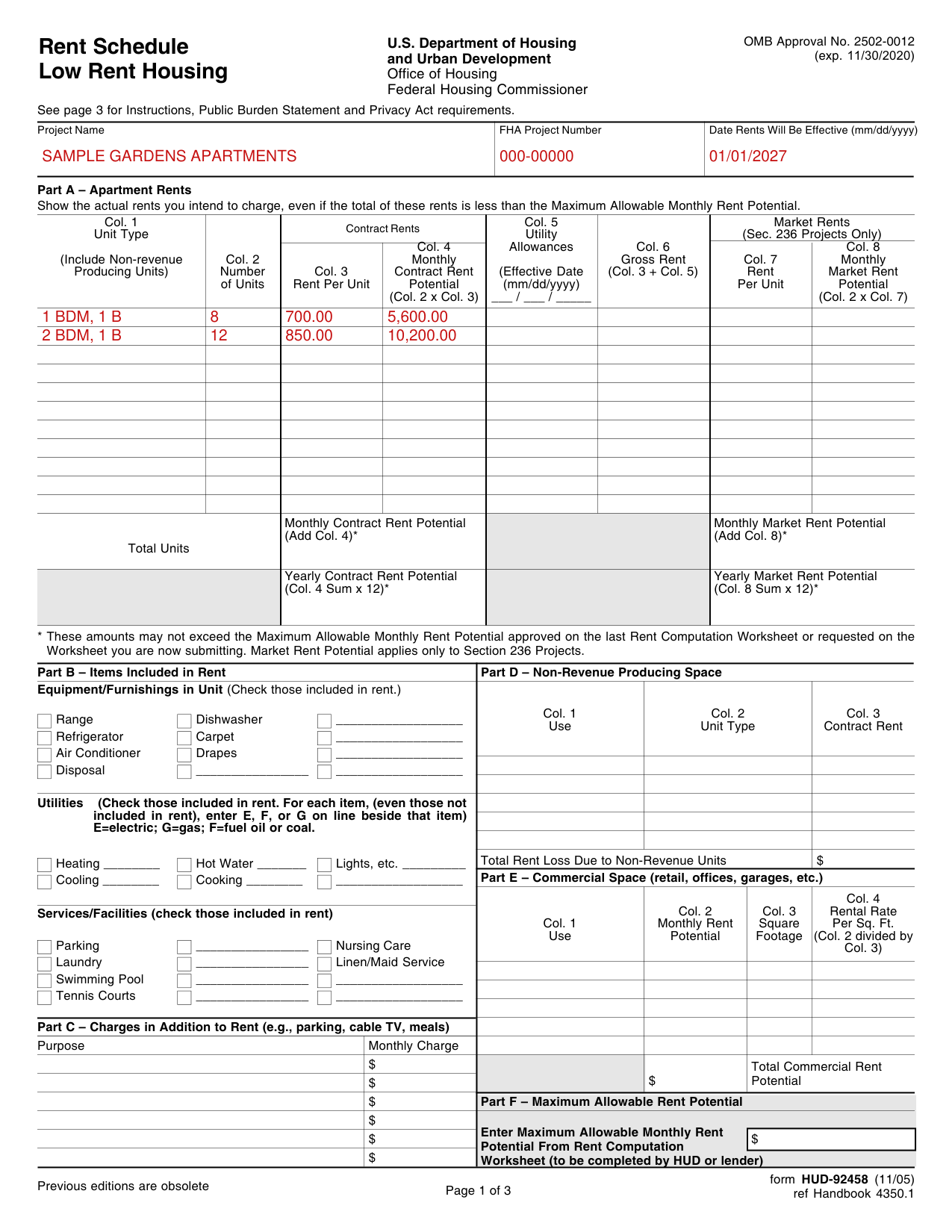
How to fill out Form HUD-92458, box by box
Part A - Apartment Rents, Columns 1 to 4
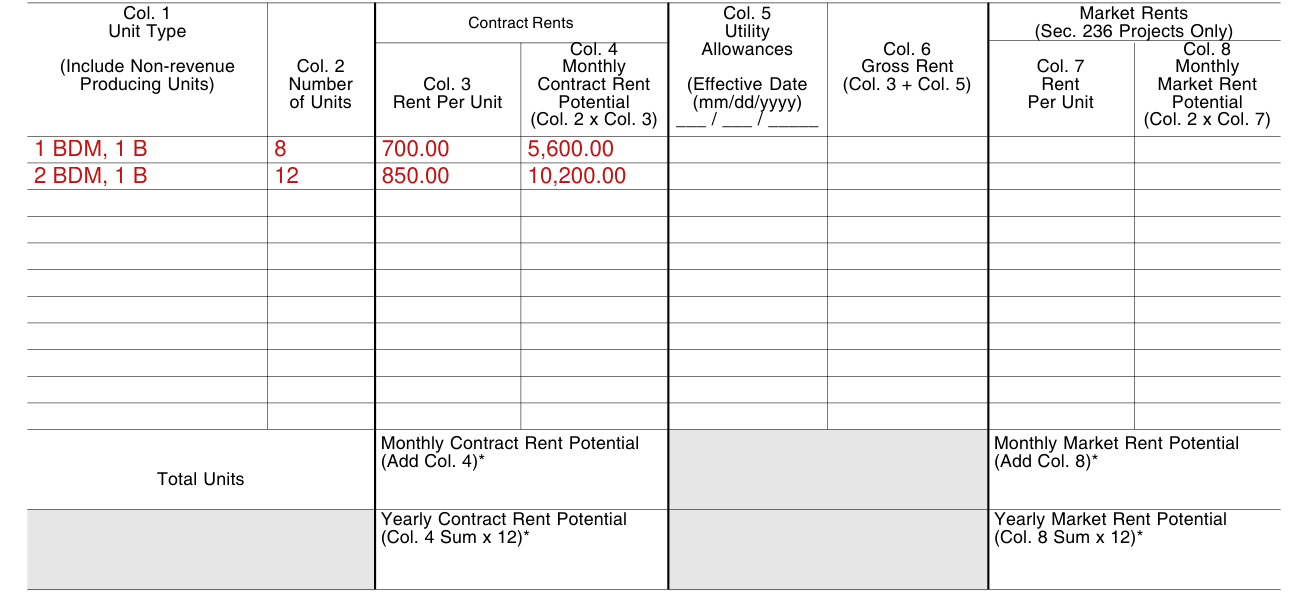
In Part A, show the actual rents you intend to charge, even if the total of these rents is less than the Maximum Allowable Monthly Rent Potential.
If the monthly rent potential you are proposing is less than or equal to the Maximum Allowable Monthly Rent Potential approved by HUD/lender on your original Rent Formula or on your most recent Rent Computation Worksheet, complete all of Part A according to the Part A instructions.
In Part A, the Monthly Contract Rent Potential (Add Col. 4)*, Monthly Market Rent Potential (Add Col. 8)*, Yearly Contract Rent Potential (Col. 4 Sum x 12)* and Yearly Market Rent Potential (Col. 8 Sum x 12)* amounts may not exceed the Maximum Allowable Monthly Rent Potential approved on the last Rent Computation Worksheet or requested on the Worksheet you are now submitting. Market Rent Potential applies only to Section 236 Projects.
In Column 1, show each type of unit for which rents will vary, with the number of bedrooms and bathrooms and other features that cause rents to vary (e.g., 2 BDM, 1 B, DA, KETTE, vs 2 BDM, 2B, DR, K). Use the following symbols: BDM - Bedroom LR - Living Room B - Bath DR - Dining Room K - Kitchen DA - Dining Alcove KETTE - Kitchenette
In Column 2, show the number of units for each unit type, and include non- revenue producing units.
In Column 3, for unsubsidized projects, show the rent you intend to charge for each unit type.
In Column 3, for subsidized projects, show the contract rent (as defined in HUD Handbook 4350.3) for each unit type.
In Column 4, for each line, multiply the contract rent in Column 3 by the number of units in Column 4.
Add monthly contract rent potentials for each unit size to compute the total monthly contract rent potential, and multiply the monthly total by 12 to compute the annual contract rent potential.
Part A - Columns 5 and 6, Utility Allowances and Gross Rent
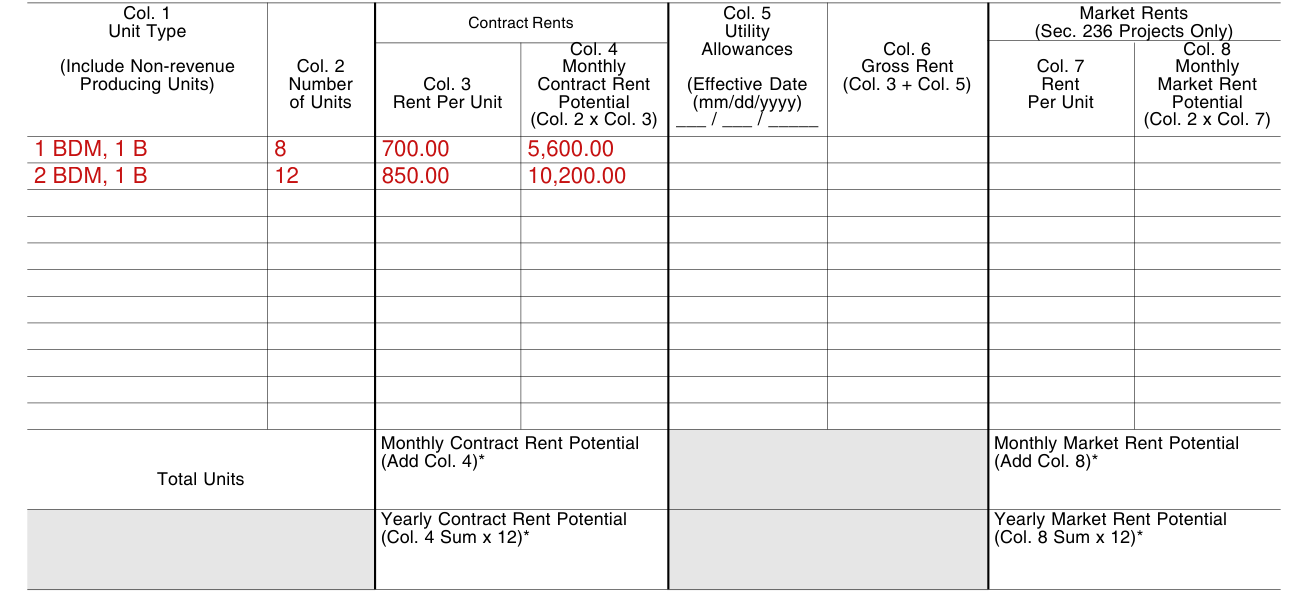
Complete Columns 5 and 6 only if the project has a subsidy contract with HUD and some utilities are not included in the rent.
In Column 5, show the utility allowance for each unit type; compute the gross rent for each unit type by adding the contract rent in Column 3 and the utility allowance in Column 5, and show this amount in Column 6.
Part A - Columns 7 and 8, Market Rents (Sec. 236 Projects Only)
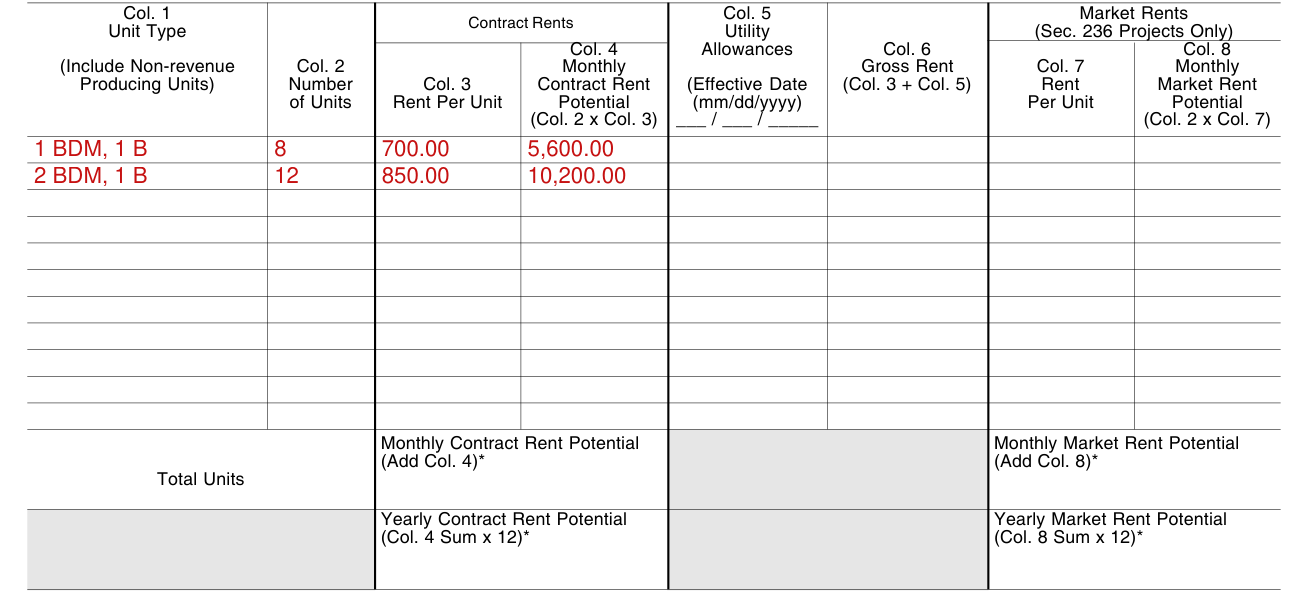
Complete Columns 7 and 8 only if the project is receiving Section 236 Interest Reduction Payments.
In Column 7, show the market rent for each unit type; in Column 8, for each line multiply the market rent in Column 7 by the number of units in Column 2.
Add the monthly market rent potentials for each unit size to compute the total monthly market rent potential, and multiply the monthly total by 12 to compute the annual market rent potential.
Part G - Information on Mortgagor Entity
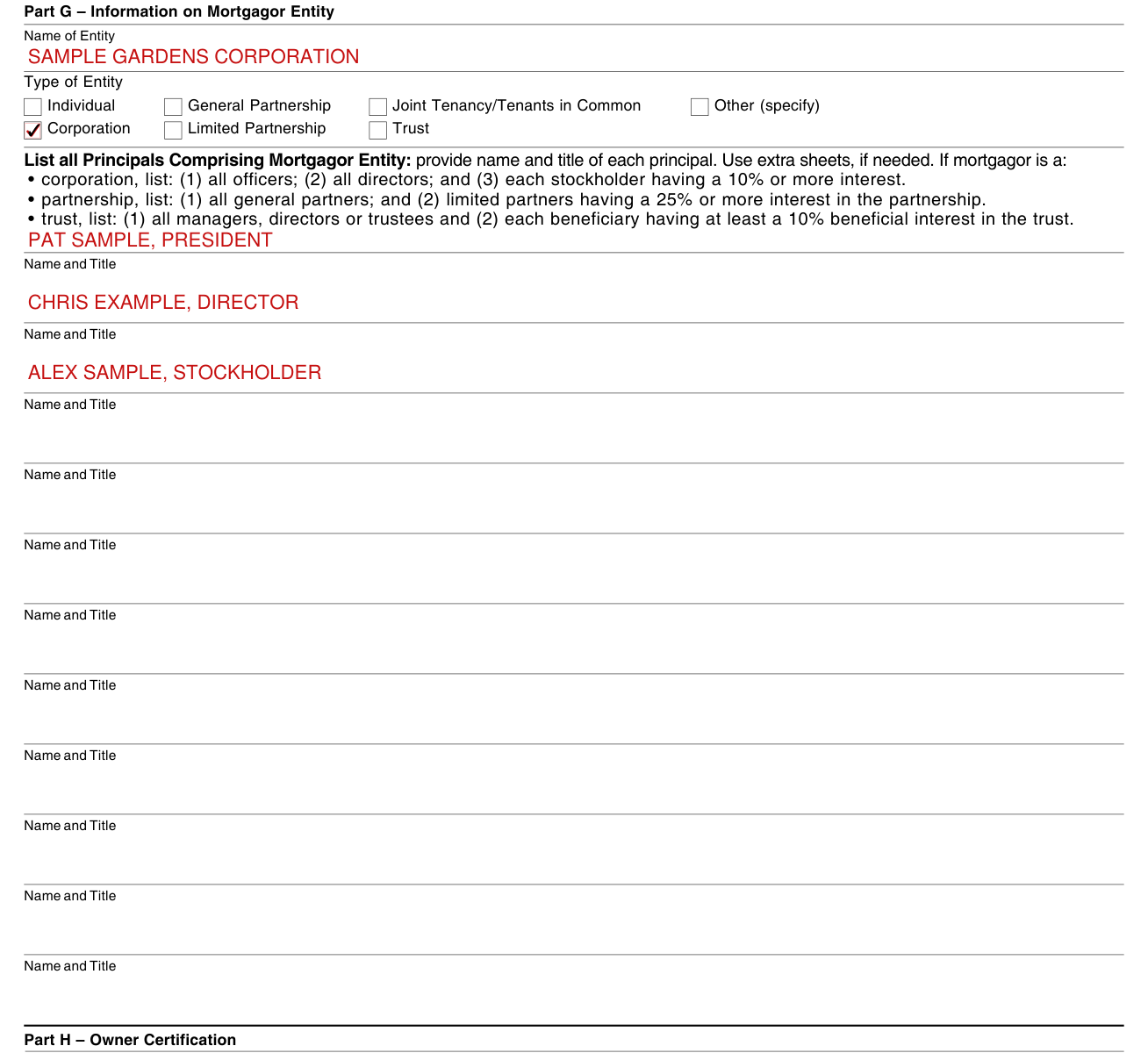
Part G is Information on Mortgagor Entity, with Name of Entity and Type of Entity.
In Part G, list all Principals Comprising Mortgagor Entity: provide name and title of each principal, and use extra sheets, if needed.
If mortgagor is a corporation, list: (1) all officers; (2) all directors; and (3) each stockholder having a 10% or more interest.
If mortgagor is a partnership, list: (1) all general partners; and (2) limited partners having a 25% or more interest in the partnership.
If mortgagor is a trust, list: (1) all managers, directors or trustees and (2) each beneficiary having at least a 10% beneficial interest in the trust.
Part H - Owner Certification

Parts G and H. Complete these Parts according to the instructions on the Rent Schedule.
In Part H, the owner certifies that to the best of my knowledge, all the information stated herein, as well as any information provided in the accompaniment herewith, is true and accurate.
Warning: HUD will prosecute false claims and statements. Conviction may result in criminal and/or civil penalties.
More rules for Form HUD-92458
The owner is responsible for notifying tenants of the approved rents.
Complete Parts B, C, D and E according to the instructions on the Rent Schedule.
In the Utilities list of Part B, check those included in rent; for each item, even those not included in rent, enter E, F, or G on the line beside that item, where E=electric; G=gas; F=fuel oil or coal.
In Part B, under Services/Facilities, check those included in rent.
Part C is for Charges in Addition to Rent (e.g., parking, cable TV, meals), with a Purpose and a Monthly Charge for each.
Part E is for Commercial Space (retail, offices, garages, etc.).
Part F. Do not complete this Part. Part I. Do not complete this Part. The HUD Field Office/lender will complete this Part.
If your situation is different
Your requested monthly rent potential exceeds the Maximum Allowable Monthly Rent Potential
If the monthly rent potential you are requesting exceeds the Maximum Allowable Monthly Rent Potential approved by HUD/lender on your original Rent Formula or on your most recent Rent Computation Worksheet, complete only Columns 1 and 2 according to the Part A instructions. Show your proposed rents and monthly rent potential in the cover letter transmitting your rent increase request.
Common questions about Form HUD-92458
Where do I file it?
For projects with fully-insured or HUD-held mortgages, the owner/agent submits this Form to the HUD Field Office; for projects with coinsured mortgages, the owner/agent submits this Form to the lender.
Sources
[1] Form HUD-92458 (11/05), Rent Schedule Low Rent Housing, U.S. Department of Housing and Urban Development (the Official source link on this page).
