

Individualized Family Service Plan at a glance
What it is: The Individualized Family Service Plan is a form with pages for identifying information, present levels of development, outcome/action steps, services and transition.
Who signs: Parent(s) signature indicates that procedural safeguards have been followed.
A filled-in Individualized Family Service Plan example: a service coordinator fills in the cover page
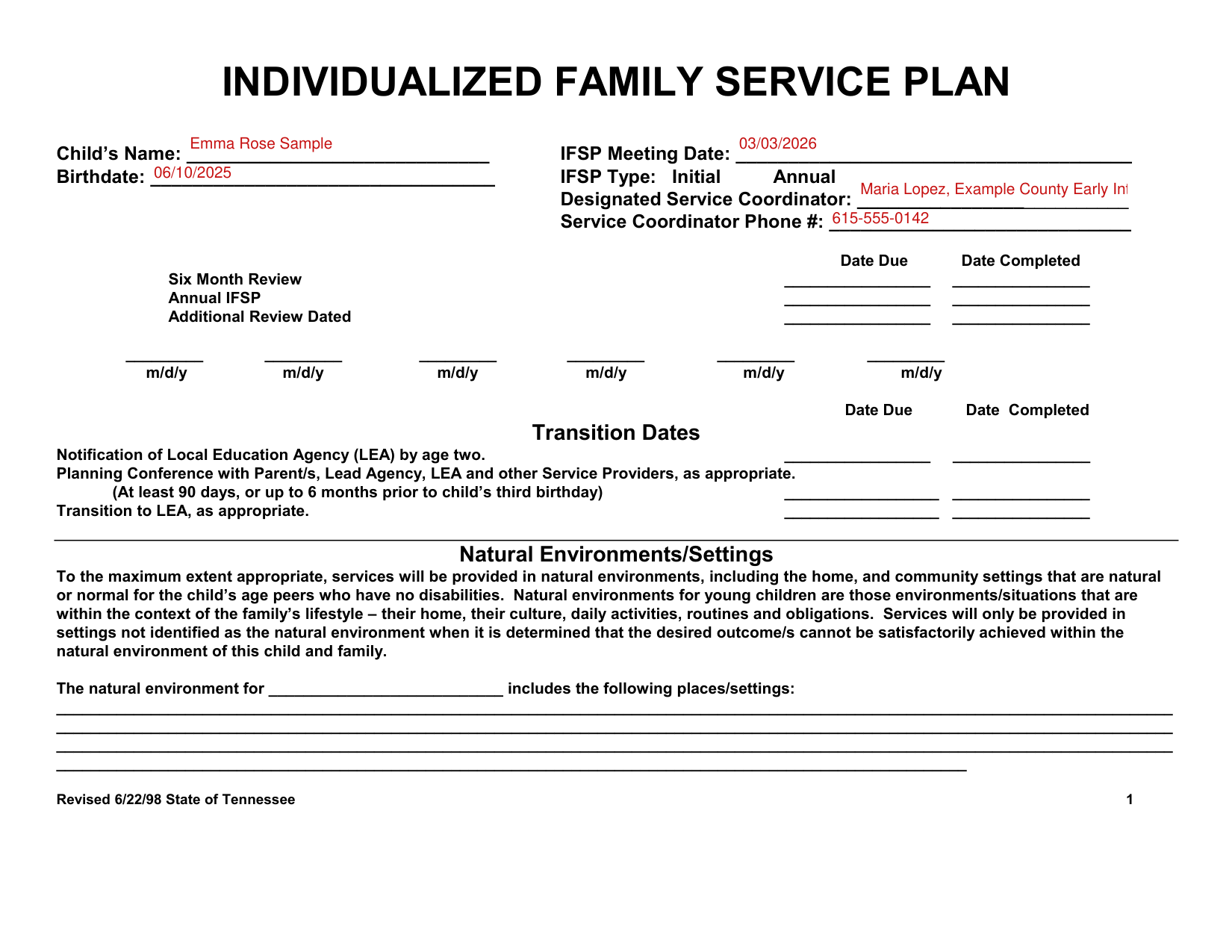
How to fill out Individualized Family Service Plan, box by box
Page One: Cover Page

Enter the Child's Name (first, middle, last), the IFSP Meeting Date, which is the date of this meeting, and the Child's Birthdate; for IFSP Type, check if Initial or Annual; enter the Designated Service Coordinator's name and agency and the Service Coordinator's Phone #. For the Planned Six Month Review date and Annual IFSP date, enter the approximate Date Due and, later, enter the Date Completed (actual date the meeting was completed).
Page Two: Identifying Information
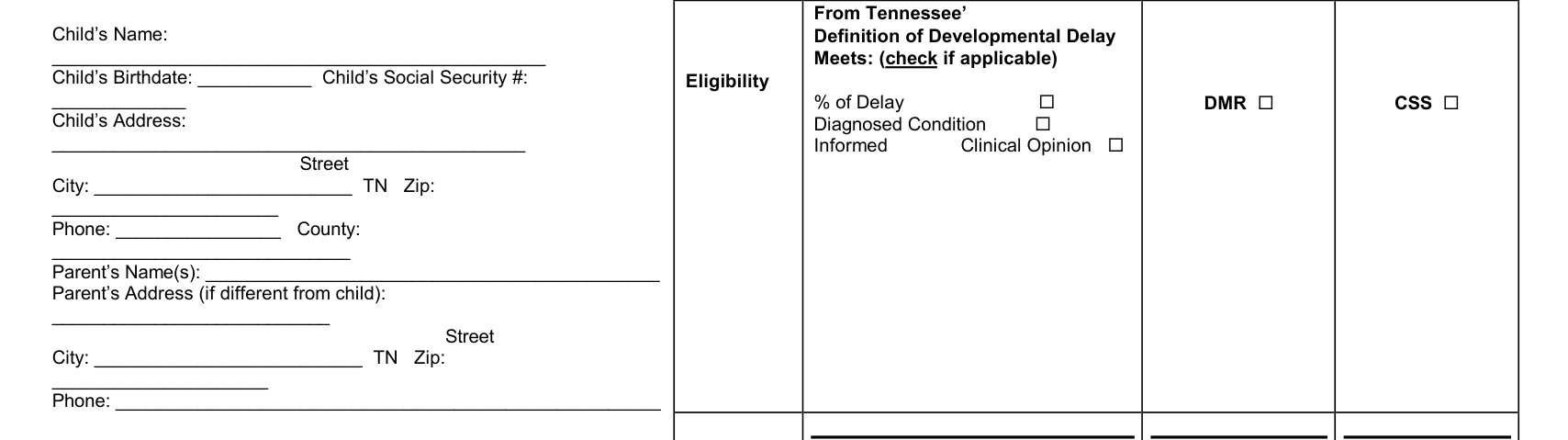
Enter the Child's Name, Birthdate, Social Security Number, Address, Phone Number.
Enter the Parent's Name(s), the natural or adoptive parent, and the Parent's Address, if different from the child's.
If your situation is different
Additional Review Dates, Transition Dates and Natural Environment/Settings
For Additional Review Dates, enter the actual date(s) of occurrence(s). For Transition Dates (Notification of Local Education Agency, Planning Conference, and Transition to LEA), enter the approximate due dates and, later, the actual dates completed. Under Natural Environment/Settings, enter the name of the child, and list or describe places and settings the team, including the family, has identified as natural environments for the child.
Eligibility and Referral
Enter a check next to the Part C eligibility which indicates the Part C eligibility criteria the child meets (check only one).
If eligible for DMR and/or CSS, check the appropriate box.
Enter the date of referral and state the specific agency, professional, or person making the referral.
Documentation
Sign (if team member contributed but was not present, see #4).
Enter the agency/title of the team member.
Enter date - the date of the meeting.
If team member contributed/not present at the IFSP meeting, print the name in the signature column and describe the method of contribution (conference call, written input, telephone call, etc.).
If team member fully agrees with the IFSP, check under "Fully Agree." If team member disagrees with part of the IFSP, use the space indicated to document area(s) of concern. Attach additional pages if necessary.
Designated Service Coordinator/Agency and Rationale, and Informed Parental Consent
Designated Service Coordinator/Agency and Rationale: enter the name of the person/agency the team selected and the rationale the team used in selecting this person.
Informed Parental Consent: parent check the appropriate boxes (each must be checked yes).
Present Levels of Development
Record, next to the word "By," the name of the professional(s) who conducted the formal or informal screening, evaluation, or assessment which provided the information for the present levels of development.
Enter the Date of the procedure and the child's Chronological Age at the time of the procedure.
If the child was at least four weeks premature and under the age of two, enter the Adjusted Age.
A narrative statement must be provided which records the strengths and needs of the child in each area of development.
Test results should be reported in quantitative form (age level, percentiles, etc.). If the adjusted age is less than zero, the quantitative form of test results is not required.
Record the strengths and needs of the child in the developmental areas, based on professionally acceptable, objective criteria.
The "Other" space may be used for any additional information, including the family's assessment of the child's present levels of functioning (especially if the family has chosen not to have a Summary of the Family Resources, Priorities, and Concerns discussed at the IFSP meeting).
The family's resources, priorities, and concerns
The assessment is voluntary on the part of the family.
Indicate, by checking either "yes" or "no" in the statements at the top of the page, the family's decision concerning participation in a voluntary family-directed assessment and the inclusion of the voluntary family-directed assessment information in the IFSP.
Enter the type(s)/method(s) of family assessment used, the date(s) that the family assessment(s) took place and the names of all in the assessment process, including family members and professionals.
Family Resources are those available to the family, including formal and informal supports systems, educational resources, personal resources of family members.
Priorities of the family: those things which are most important for the child and family.
Concerns of the family, including concerns the family has regarding their ability to cope with the child's situation.
You are writing Outcome/Action Steps
A separate page is to be used for each major outcome.
Major outcomes should be written in commonly understood language. An outcome should be written so that it could be used to determine whether the goal/objective was met.
Timeline (Target Date) is the date by which the team hopes this outcome will be reached. This is usually one year but may be less than one year but no more.
Under Action Steps, list the steps, activities, strategies needed to achieve outcomes, for example: have feeding assessment; refer to and participate in feeding therapy if recommended by feeding assessment; Susan will obtain a list of possible child care centers from friends and DHS; home base interventionist will provide information to family on feeding strategies. Enter the name of the person(s) and agency responsible for each step, activity, or strategy.
You are listing Services
Enter Services needed to achieve the outcome. These include services required by Part C and also additional services not required by Part C.
Also list services (not required by Part C) that are needed but unavailable at this time.
Required or Non-required: enter an "R" if the service is required by Part C or an "N" if the service is not required by Part C; see listing of required services on Page Eight (Outcome/Service Summary Page).
Frequency: the number of sessions scheduled each week or month, whichever is most appropriate. Do not use "TBD" or "to be determined."
Part C funds should be used only as a "last resort" after all other resources have been accessed.
If an environment is not listed on Page One as natural for this child/family, complete the Justification for Provision of Service in Environment/Setting Not Identified as the Natural Environment section.
You are completing the Review/Change Form
The Review/Change Form is a multipurpose page.
Complete the box regarding Inactive Status if form is being completed to reflect inactive status (otherwise, do not complete).
Signatures of parent(s) and designated service coordinator are required.
You are completing the Transition From Part C Services Plan
Anticipated Date of Transition is the child's third birthday.
Planned Transitioning Procedures are those steps needed to insure smooth transition from Part C services to Part B or other services as appropriate. The Timeframe is the projected date the step is to be completed. The Date Completed is the actual date the step was accomplished.
Planning Conference Transition From Part C Services
Planning Conference Transition From Part C Services form purpose: To document discussion and plans made at the transition meeting held 6 months to 90 days prior to the Part C eligible child's third birthday.
On the Planning Conference Transition From Part C Services form, the designated service coordinator completes this form during the transition meeting or shortly afterwards.
At a minimum the participants consists of the parents, designated service coordinator, TEIS representative, who may also be the designated service coordinator and LEA representative.
On the Planning Conference Transition From Part C Services form, document that parents have received a copy of parental rights under Part B.
Common questions about Individualized Family Service Plan
Is there a deadline?
On the Planning Conference Transition From Part C Services form, complete the date the transition conference was held (90 days to 6 months prior to the third birthday).
Where do I file it?
The Planning Conference Transition From Part C Services form is faxed to the Department of Education, Division of Special Education, Office of Early Childhood, where it is filed for monitoring purposes.
Sources
[1] Individualized Family Service Plan, State of Tennessee (the Official source link on this page).
