

Form 56 at a glance
What it is: Form 56, Notice Concerning Fiduciary Relationship, is used to notify the IRS of the creation or termination of a fiduciary relationship under section 6903 and give notice of qualification under section 6036.[2]
Where and when to file: Generally, you must file Form 56 when you create (or terminate) a fiduciary relationship.[2]
A fiduciary who seeks to act on behalf of a taxpayer before the IRS or to inform the IRS that the fiduciary capacity has terminated must file Form 56 to notify the IRS of the creation or termination of a fiduciary relationship under section 6903.[2]
Receivers and assignees for the benefit of creditors also file Form 56 to give notice of qualification under section 6036.[2]
However, a bankruptcy trustee, debtor-in-possession, or other like fiduciary in a bankruptcy proceeding is not required to give notice of qualification under section 6036.[2]
If there is more than one fiduciary, each fiduciary must file a separate Form 56 or otherwise provide notice of their status to the IRS.[2]
What to bring and attach to Form 56
Attach to your Form 56 current letters testamentary or a court certificate as proof of your court appointment.[2]
You must be prepared to furnish evidence that substantiates your authority to act as a fiduciary.[2]
A filled-in Form 56 example: an executor reports a will's estate
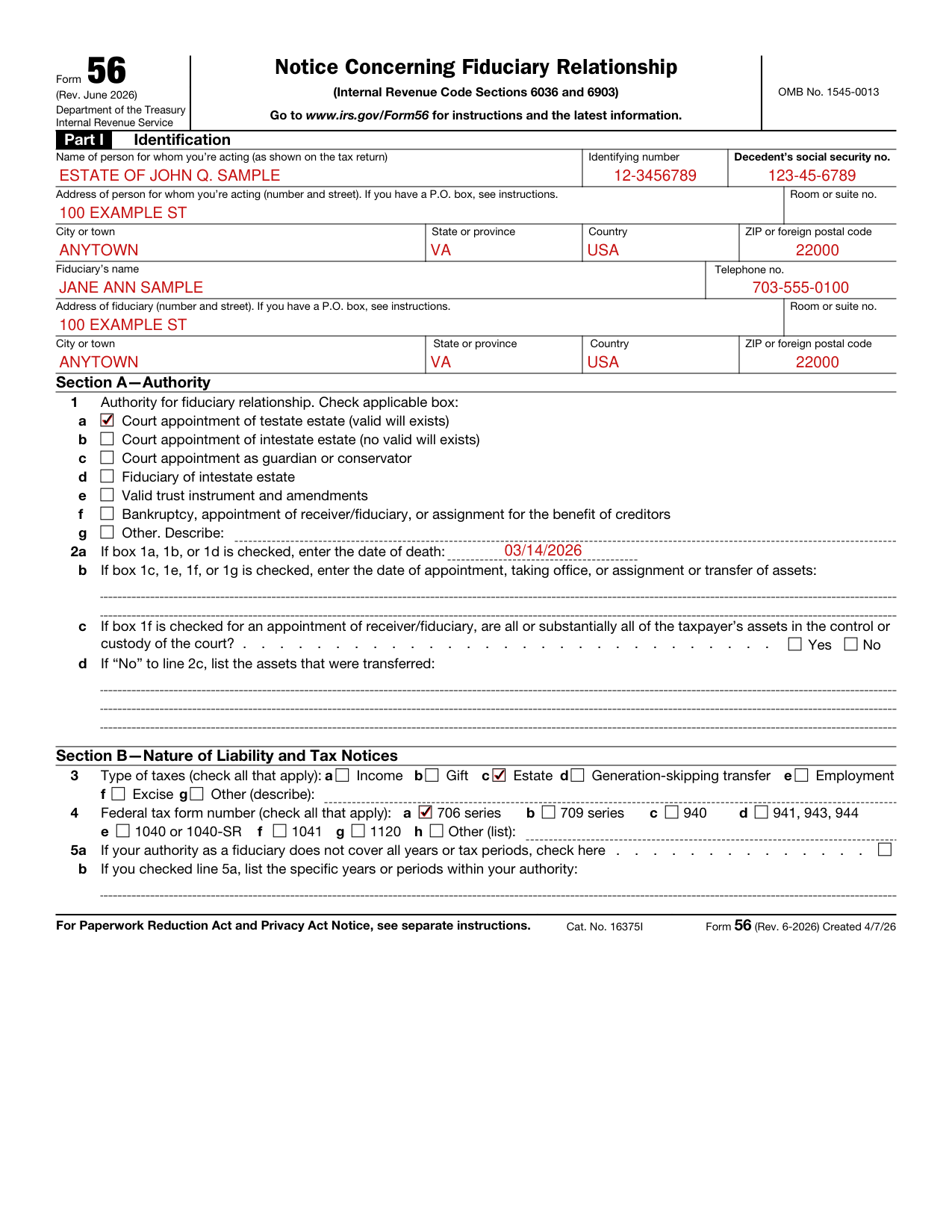
How to fill out Form 56, box by box
Part I Identification
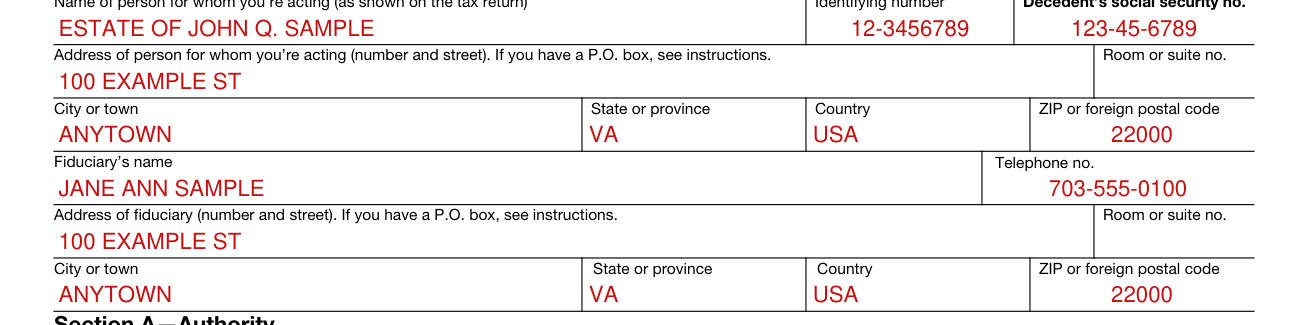
Provide all the information called for in this part.
File a separate Form 56 for each person for whom you're acting in a fiduciary capacity.
For example, if you will be filing the decedent's final Form 1040 and are the executor/administrator of the decedent's estate, file one Form 56 entering the name of the decedent as the person for whom you're acting and file one Form 56 entering the name of the estate as the name of the person for whom you're acting.
If you're acting for an individual, an individual debtor, or other person whose assets are controlled, the identifying number is the social security number (SSN) or individual taxpayer identification number (ITIN).
If you're acting for a person other than an individual, the identifying number is the employer identification number (EIN).
If you're acting on behalf of a decedent, enter the decedent's SSN or ITIN shown on the decedent's final Form 1040 in the space provided.
If you're acting on behalf of a decedent's estate that must file a Form 706, United States Estate (and Generation-Skipping Transfer) Tax Return, enter the decedent's SSN or ITIN and the EIN (if applicable) as discussed under Identifying number, earlier.
Include the room, suite, or other unit number, in the applicable box.
If the postal service does not deliver mail to the street address and the fiduciary has a P.O. box, show the box number instead of the street address.[2]
Section A Authority
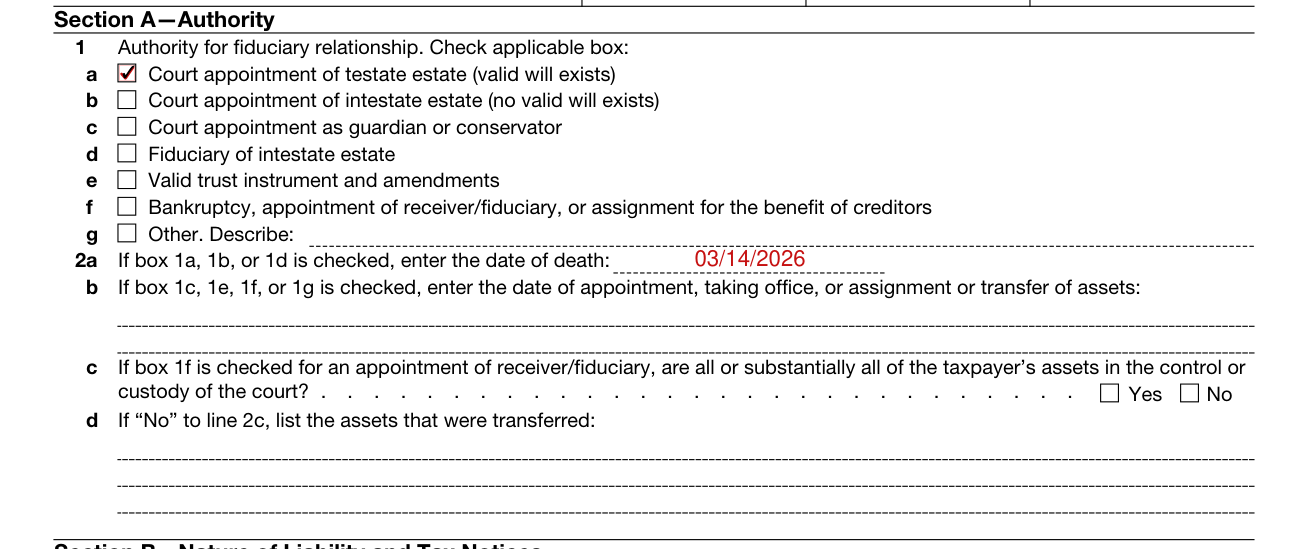
Check the box on line 1a if you're the executor of an estate of a decedent who died testate (that is, having left a valid will) and have been authorized to serve by a court of appropriate jurisdiction.
Check the box on line 1b if you have been appointed the administrator or representative of an estate of a decedent who died intestate (that is, without leaving a valid will).
Check the box on line 1c if a court of appropriate jurisdiction has appointed you to serve as guardian, custodian, or conservator over the interests of another person or entity.
Check the box on line 1d if you're the fiduciary of a decedent who died intestate (that is, without leaving a valid will).
Only check this box if there is no court appointed administrator or representative for the estate of the decedent and you're the sole person charged with the property of the decedent.
Check the box on line 1e if you were named a trustee under a valid instrument.
If you're a bankruptcy trustee or an assignee for the benefit of creditors, check the box on line 1f.
If you're a court-appointed receiver or fiduciary, check the box on line 1f.
If you're acting in a fiduciary capacity under circumstances different from those listed on lines 1a through 1f, check the box on line 1g and describe the authority for the fiduciary relationship in the space provided.
Line 2a, date of death. Complete this line only if you checked the box on line 1a, line 1b, or line 1d.
Enter the decedent's date of death on line 2a.
Line 2b, date of appointment or transfer of assets. Complete this line only if you checked the box on line 1c, 1e, 1f, or 1g.
Enter the date you were appointed or assets were transferred or assigned to you on line 2b.
Lines 2c and 2d, assets in control or custody of the court. Complete these lines only if you checked the box on line 1f for an appointment of receiver or fiduciary.[2]
Section B Type of tax, forms and periods
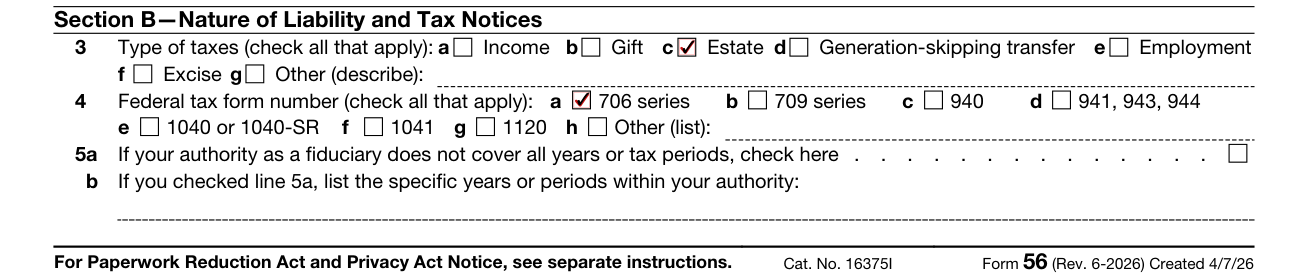
Check the appropriate box(es) indicating the type of tax and forms you will be filing in performance of your fiduciary duties.
If your authority does not cover all years or tax periods, check the box on line 5a and list the specific years or periods within your authority on line 5b.
Form 56 cannot be used to request copies of notices and correspondence.[2]
Part II Revocation or Termination of Notice
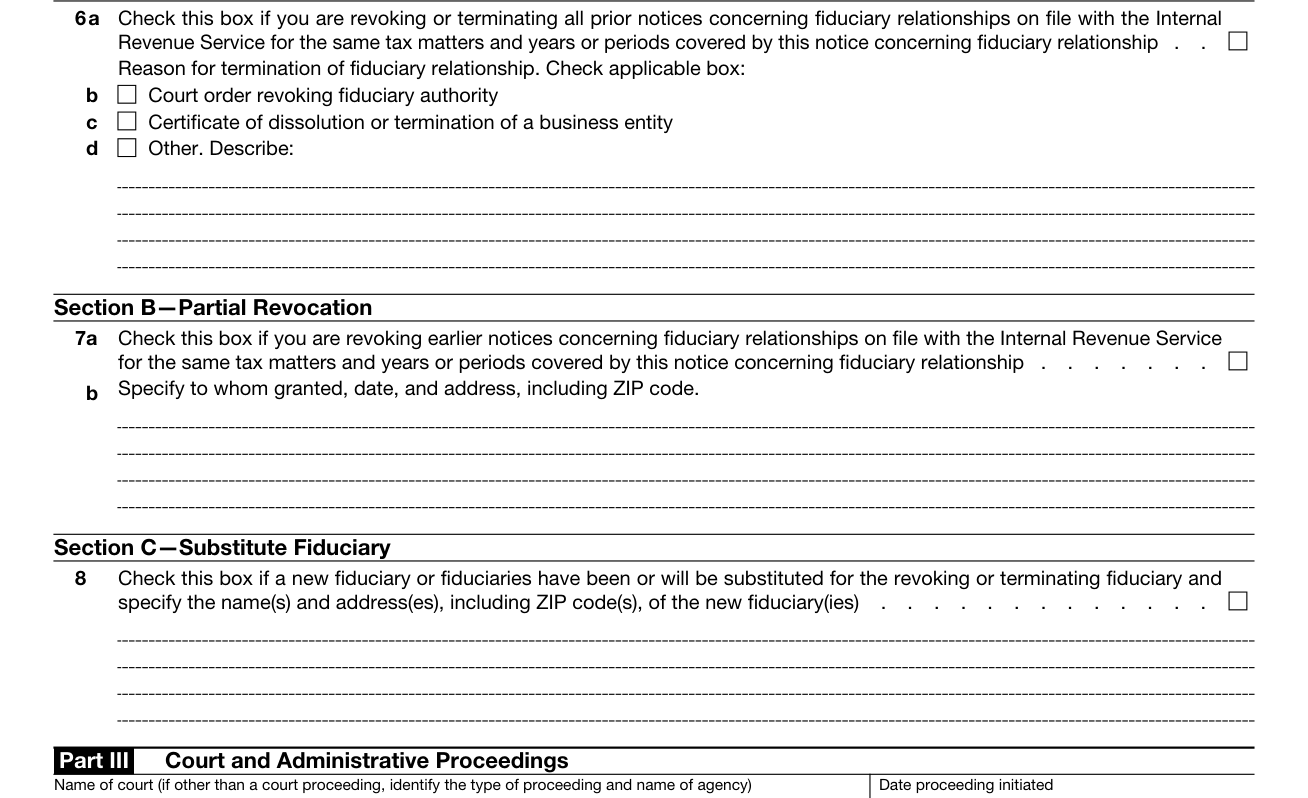
Complete Part II only if you're revoking or terminating a prior notice concerning a fiduciary relationship.
Line 6a: Check this box if you are revoking or terminating all prior notices concerning fiduciary relationships on file with the Internal Revenue Service for the same tax matters and years or periods covered by this notice concerning fiduciary relationship.
Reason for termination of fiduciary relationship. Check applicable box: Court order revoking fiduciary authority, Certificate of dissolution or termination of a business entity, or Other. Describe:
Line 8: Check this box if a new fiduciary or fiduciaries have been or will be substituted for the revoking or terminating fiduciary and specify the name(s) and address(es), including ZIP code(s), of the new fiduciary(ies).
Completing Section B or C does not relieve any new or substitute fiduciary of the requirement to file a Form 56 or to otherwise give notice.[2]
Part III Court and Administrative Proceedings

Complete this part only if you have been appointed a receiver, trustee, or fiduciary by a court or other governmental unit in a proceeding other than a bankruptcy proceeding.
Address of court (number and street) Room or suite no.[2]
If your situation is different
You are a receiver or an assignee for the benefit of creditors
A fiduciary who is appointed or authorized to act as a receiver in a receivership proceeding or similar fiduciary (including a fiduciary in aid of foreclosure) or an assignee for the benefit of creditors must file Form 56 on or within 10 days of the date of appointment.
Form 56 must be filed with the insolvency function at Internal Revenue Service Insolvency MS 5027 DAL Dallas, TX 75242 The receiver or assignee may also file a separate Form 56 with the service center where the person for whom the fiduciary is acting is required to file tax returns to provide the notice required by section 6903.[2]
Update the last known address
Form 56 cannot be used to update the last known address of the person, business, or entity for whom you're acting. Use Form 8822, Change of Address, or Form 8822-B, Change of Address or Responsible Party-Business, to update the last known address.[2]
Common questions about Form 56
Who signs it?
Sign Form 56 under penalty of perjury and enter a title describing your role as a fiduciary (for example, assignee, executor, guardian, trustee, personal representative, receiver, conservator, surviving spouse, or sole heir in possession of the property of the decedent).[2]
Where do I file it?
File Form 56 with the Internal Revenue Service Center where the person for whom you're acting is required to file tax returns. For example, if the person for whom you're acting is required to file a Form 1040, go to the Instructions for Form 1040 to locate the mailing address.[2]
Is there a penalty?
Providing false information may subject you to penalties.[2]
What am I certifying when I sign?
Under penalties of perjury, I declare that I have examined this document, including any accompanying statements, and to the best of my knowledge and belief, it is true, correct, and complete.
Sources
[1] Form 56 (Rev. June 2026), Notice Concerning Fiduciary Relationship, Internal Revenue Service (the Official source link on this page).
[2] Instructions for Form 56 (Rev. June 2026), Internal Revenue Service.
